





How to Rank on Perplexity: A Guide for AI Search Visibility


Sep 10, 2026

Contents
 17 min
- What Does Ranking on Perplexity Mean?
- How Does Perplexity Rank Content?
- What Is Perplexity’s RAG System?
- Why Video Content Earns More Citations on Perplexity?
- 8 Strategies to Rank on Perplexity
- Which Content Performs Best on Perplexity?
- How to Track Your Visibility in Perplexity?
- Examples of Content That Performs Well
- Conclusion


I was doing a quick check on how competitors looked on Perplexity for buyer-style searches, not for exact-match keywords.
For one prospect, I was searching for HRMS tools in New Jersey, CRM software in LA, and CRO services in Boston. I found some competitors began to emerge; they cited web pages, and their position was unmistakable. Our customer’s brand was missing where it should have been.
The problem was not just Google rankings anymore; it was whether AI search engines could understand the brand and connect it to the right service category.
Perplexity helps users research topics, compare vendors, and discover brands through AI-generated answers with cited sources. In May 2025, it handled approximately 780 million queries, according to CEO Aravind Srinivas. For B2B businesses, this creates another opportunity to reach buyers researching solutions and comparing providers.
So ranking on Perplexity is not about gaming another algorithm. It’s about making it easier for AI systems to find, understand, validate, and trust your brand.
What Does Ranking on Perplexity Mean?
Perplexity ranking means that your content, brand, or source appears in AI-generated answers when users ask relevant questions.
This process is different from traditional SEO.
On Google, you usually compete for page positions. On Perplexity, you compete to become part of the answer. That can happen when your page is cited as a source, your brand is mentioned in a response, or your content helps support the answer.
For example, a B2B buyer may ask:
-
“Best AI SEO agency for B2B lead gen”
-
“How does website migration affect SEO?”
-
“What should a technical SEO audit include?”
If Perplexity uses your content to answer those questions, you gain visibility earlier in the buyer journey.
That visibility matters because AI search compresses research. The buyer may not open ten tabs. They may read one AI answer, check the cited sources, and move forward with a short list of vendors.
How Does Perplexity Rank Content?
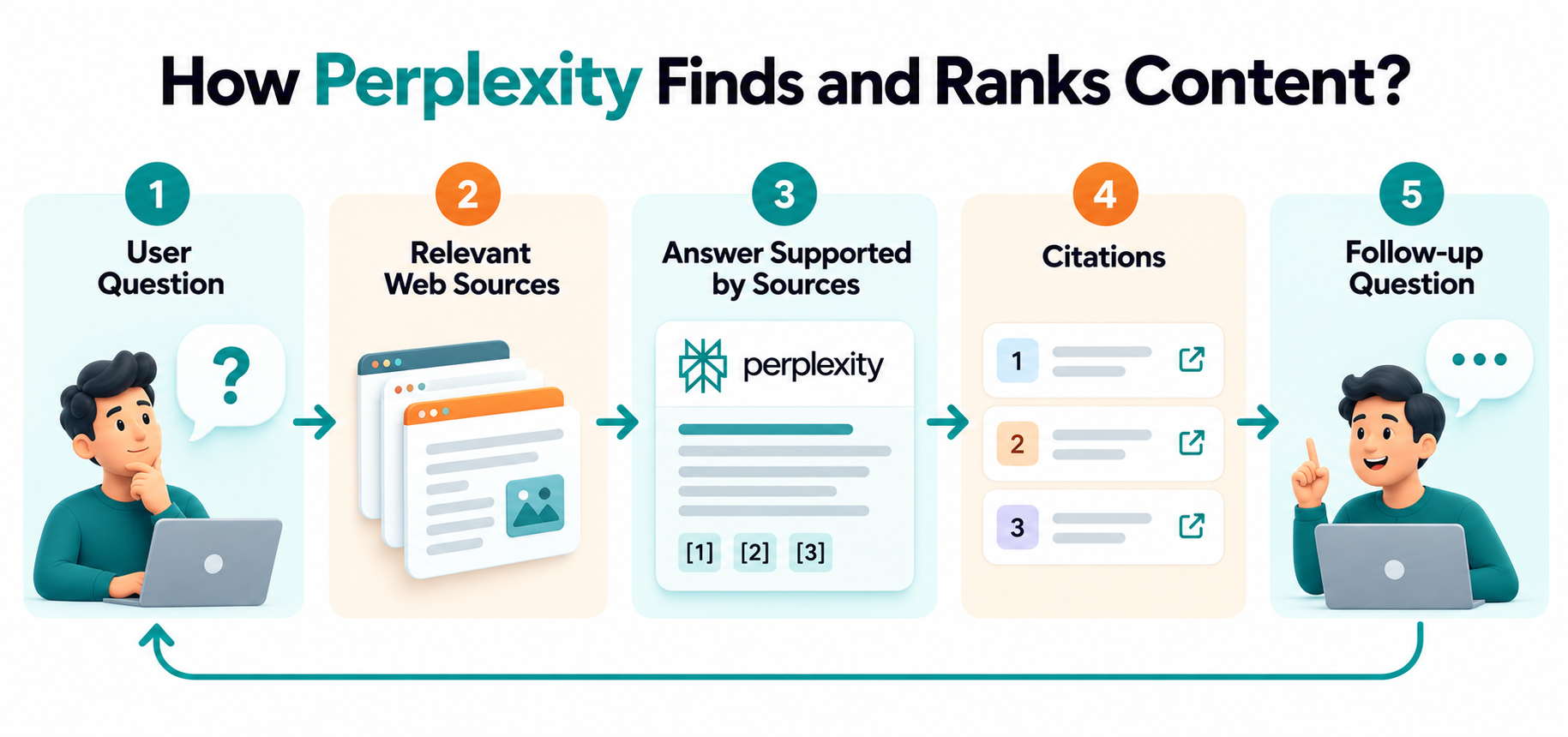
Perplexity does not publish a simple public ranking formula. Any agency claiming guaranteed "perplexity rankings” is overselling.
Perplexity searches the web in real time for authoritative sources, including blogs, websites, and academic or industry journals. It distills the most important findings into a conversational response with source references. You can get more information and research benefits if you have the paid version
Perplexity combines web search with large language models from Perplexity and other providers. Available models vary by subscription plan and search mode and change over time.
1. Query Relevance
Perplexity needs to understand that your content answers the user’s exact question.
A broad page about “SEO services” may not be strong enough for a query like
-
“How can a B2B SaaS company use AI SEO for lead generation?”
A stronger page would directly explain how AI search visibility can support B2B SaaS lead generation, with relevant examples, supporting evidence, and a clear process for measuring results.
2. Source Quality
Perplexity cites sources to support factual answers. Pages with clear explanations, credible claims, updated information, and useful structure are more likely to be useful sources.
This is why generic content rarely performs well in AI search. It gives the model little reason to select your page over a more specific, better-supported source.
3. Freshness and Substantive Updates
Perplexity searches the web for current information, making freshness particularly relevant for topics such as AI products, software features, pricing, regulations, and industry statistics. However, freshness does not mean changing the publication date without improving the page.
Perplexity is designed for current answers. Time-sensitive topics like AI SEO, AI services, Perplexity optimization, website migration, and marketing technology need recent content.
Old content can still rank if the topic is stable, but fast-changing AI topics require regular updates. During a refresh, verify every factual claim, replace outdated sources, update examples, and improve sections that no longer answer the query completely.
4. Extractability
AI engines favor content that is straightforward to pull into an answer.
That means:
-
Clear headings
-
Direct answers
-
Short paragraphs
-
Definitions
-
Steps
-
Tables
-
FAQs
-
Evidence-backed claims
If your content hides the answer inside long paragraphs, it becomes harder to extract.
5. Brand Authority
Perplexity does not only need your page to say you are credible. It also benefits from third-party signals.
These include:
-
Mentions on trusted websites
-
Reviews
-
Case studies
-
Industry directories
-
Partner pages
-
Podcast mentions
-
Digital PR
-
Consistent company information
For AI SEO, authority is not limited to backlinks. It includes how consistently your brand is described across the web.
What Is Perplexity’s RAG System?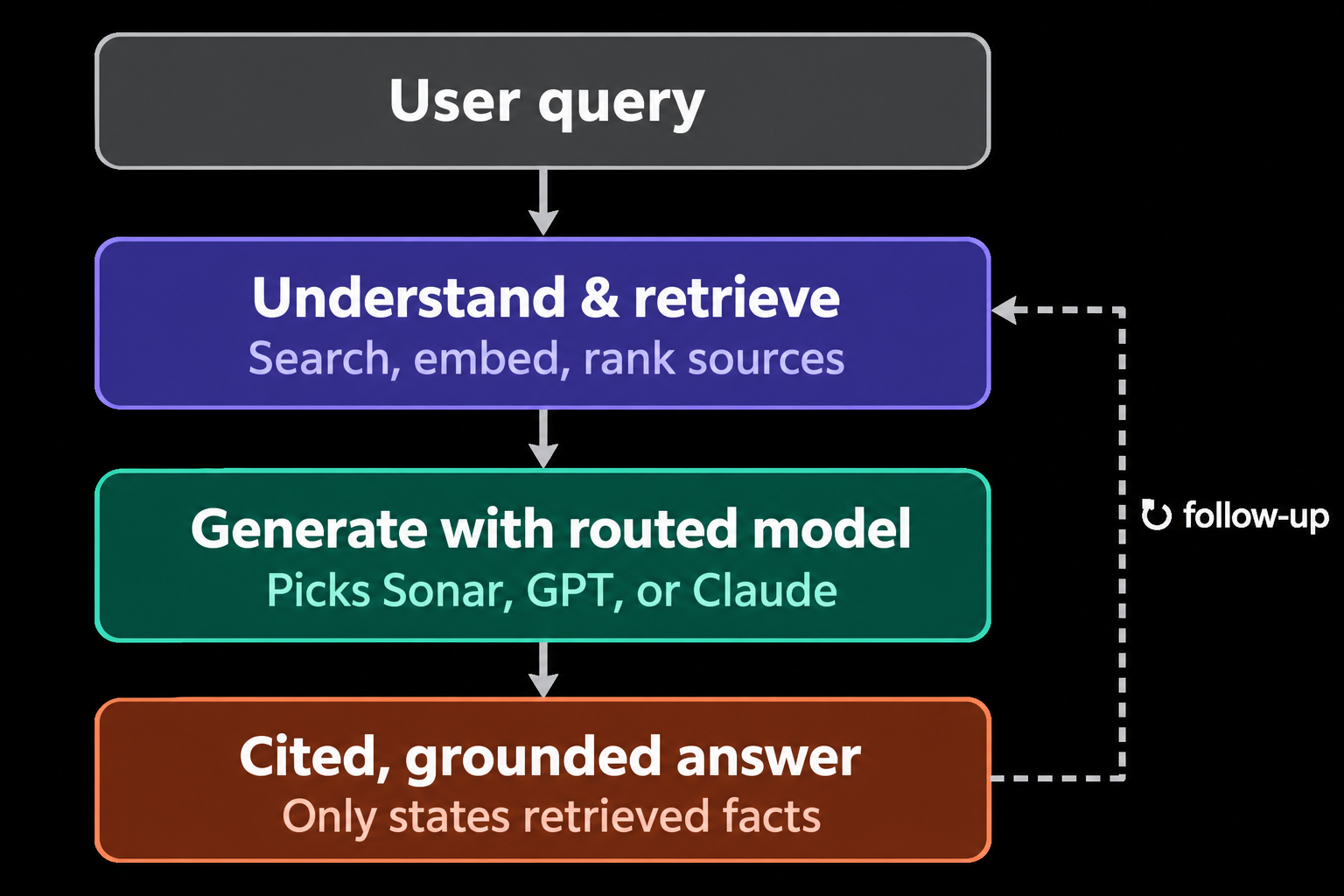
Perplexity's RAG (Retrieval-Augmented Generation) system is the core architecture behind how it answers queries—retrieving live information from the web and using it to ground an LLM's response, rather than relying purely on the model's training data.
How the pipeline works
Query understanding & routing: An incoming query first goes through intent/complexity classification. Perplexity interprets the user’s question and searches the web for relevant sources. In its “Best” setting, the platform can also select an appropriate model for the query. Perplexity has not publicly disclosed its complete query classification or routing architecture.
Retrieval: The system retrieves relevant documents and passages before assembling an answer. Perplexity describes this process as searching the internet in real time and compiling useful information from authoritative sources. However, details such as its precise retrieval algorithms and ranking signals are proprietary.
Perplexity retrieves sources relevant to the user’s question. Its complete retrieval methods and the weighting of individual ranking signals are not publicly disclosed.
Grounded generation: Perplexity uses retrieved sources to support its answers. This helps improve factual grounding, but generated responses can still contain unsupported statements or citation errors.
Perplexity CEO Aravind Srinivas has described the company’s guiding principle as avoiding claims that were not retrieved. This approach is intended to improve factual grounding, although it does not guarantee that every generated statement will be error-free.
Model coordination: Perplexity combines its own Sonar models with models from providers such as OpenAI, Anthropic, and Google. Users on eligible paid plans can select models manually, while certain modes select models automatically. Available models change regularly.
Conversational refinement: Perplexity uses the existing conversation to interpret follow-up questions and may retrieve additional sources when needed.
Why Video Content Earns More Citations on Perplexity?
Perplexity cites video more than any other AI engine. Citation tracking across YouTube videos shows Perplexity drives 38.7% of all YouTube AI citations, ahead of Google AI Overview, AI Mode, and ChatGPT. Video SEO is no longer optional if you want Perplexity visibility.
-
Perplexity leans on external, link-based multimedia more than any competing AI engine, per Otterly AI's citation study.
-
A video on a topic gives Perplexity a second, independent source to verify your written page. Two sources beat one.
-
Good YouTube SEO habits, such as transcripts, exact titles, and chapters, feed Perplexity's retrieval directly, since it reads text, not footage.
-
Pairing a service page with a matching video widens the number of ways buyers can find your brand for the same query.
8 Strategies to Rank on Perplexity
To rank on conversational AI engines such as Perplexity, your content should be optimized for conversational search visibility, structured data, and high-quality factual citations.
|
Step |
Focus Area |
What It Covers |
|
1 |
Audit Perplexity Visibility |
Track brand mentions, competitors, cited sources, and brand descriptions. |
|
2 |
Build Answer-First Content |
Answer questions directly, then support with proof and details. |
|
3 |
Strengthen Technical SEO |
Improve crawlability, indexability, schema, redirects, and internal links. |
|
4 |
Create Specific Service Pages |
Build focused pages for AI SEO, CRO, ABM, migration, and lead gen. |
|
5 |
Use Data and Proof |
Add case studies, benchmarks, outcomes, screenshots, and citations. |
|
6 |
Build Third-Party Mentions |
Grow authority through reviews, directories, PR, partners, and communities. |
|
7 |
Refresh Content for AI Search |
Update pages with direct answers, FAQs, sources, schema, and examples. |
|
8 |
Align Perplexity SEO With Lead Gen |
Link the cited pages to CTAs, forms, demos, and service paths. |
To improve visibility on Perplexity, make your content accessible, relevant to buyer questions, and supported by credible evidence. Track mentions and citations to understand which improvements help across your target prompts.
|
Step |
Focus Area |
What It Covers |
|
1 |
Audit Perplexity Visibility |
Track brand mentions, competitors, cited sources, and how Perplexity's LLMs describe your brand. |
|
2 |
Double Down on Authority and Trust |
Build citation authority through "best of" mentions, backlinks, awards, and demonstrated expertise. |
|
3 |
Use Clear Structure and Formatting |
Use descriptive headings, Q&A sections, FAQ schema, and structured data to improve LLM extractability. |
|
4 |
Include Multimodal Sources |
Optimize YouTube videos, images, and infographics to appear across Perplexity's answer tabs. |
|
5 |
Engage on Reddit |
Build a direct citation pipeline into Perplexity through genuine participation on Reddit. |
|
6 |
Adopt LLMs.txt |
Give AI crawlers a machine-readable map of your site architecture and priority pages. |
|
7 |
Join Perplexity's Merchant and Publisher Programs |
Get your products and content indexed directly inside Perplexity's platform. |
|
8 |
Use Perplexity Pages |
Publish first-party content natively inside Perplexity's ecosystem to bypass the citation lottery. |
|
9 |
Improve readers engagement |
You should improve engagement by adding interactive elements like calculators, checklists, examples |
1. Build Authority and Trust
In April 2024, BrightEdge reported that 60% of Perplexity citations overlapped with Google’s top 10 organic results. This historical finding suggests overlap between the platforms, but it does not establish that Google rankings or backlinks directly determine Perplexity citations.
Relevant industry roundups, independent reviews, and credible third-party mentions can help buyers evaluate your brand. Review the sources cited for your target prompts to identify publications and directories relevant to your market.
-
Publish Original Research and Benchmarks
Original research gives other publishers and answer engines information that cannot be found on every competing page. Useful formats include industry surveys, experiments, case studies, performance benchmarks and analyses of anonymized customer data.
Present important findings in a concise summary, followed by tables, charts, and the complete methodology. Where possible, provide downloadable or inspectable supporting data.
For example, Saffron Edge could monitor 50 commercial Perplexity prompts for eight weeks and publish changes in brand mentions, citation share, cited domains, and referral conversions.
Pitch relevant industry publications and review platforms with verifiable results, original research, or useful expert commentary that could merit editorial coverage.
Include relevant awards and verified credentials on your website, with links to the issuing organizations where possible. These give readers and search systems clearer evidence of your expertise.
2. Use Clear Structure and Formatting
Clear structure makes a page easier to navigate and its answers easier to identify. Use descriptive headings, concise explanations, and relevant examples to help readers find the information they need.
Split text into descriptive headings, bullet points, and straight summaries. Include Q&A-style sections or titles that match how consumers actually ask questions.
This enables a human to scan and an LLM to derive a clean, traceable result.
Use appropriate structured data that accurately reflects the visible page content. Treat it as supporting context, not as a confirmed way to increase Perplexity citations.
Use GA4 or another analytics platform to measure scroll depth, engaged sessions, return visits, downloads, qualified leads and conversions. Use these findings to identify confusing or incomplete sections.
3. Focus on Reddit Engagement
In Profound’s August 2024–June 2025 dataset, Reddit accounted for 6.6% of Perplexity citations and 1.8% of ChatGPT citations. These findings describe the tracked dataset and period; they do not guarantee the same source distribution for your industry or prompts.
Check whether relevant Reddit discussions appear in answers to your target prompts before prioritizing the platform.
Share practical expertise, answer relevant questions, and disclose your connection to any business you mention.
Giuseppe Colucci discusses an OtterlyAI experiment exploring the relationship between Reddit participation and AI citations.
Follow each subreddit’s rules and avoid promotional posting. Focus on useful contributions that address the discussion, without assuming they will earn engagement or citations.
If threads with many upvotes mention your content or brand organically, Perplexity is more likely to bring them up as cited references. Here is a subreddit that can help you understand the root source of all AEO answers.
But how often does Perplexity use Reddit as a source, here is a conversation that can help you understand.
Subreddits to explore include SEO, digital marketing, SaaS growth, B2B marketing, and specialist verticals that your clients operate in. And being a consistently helpful presence in these forums creates exactly the kind of third-party validation Perplexity’s models are looking for.
4. Support Your Content With Useful Visuals and Videos
Use relevant videos, diagrams, screenshots, and charts to explain complex processes and support your claims. Choose formats that help your audience understand the topic, rather than adding media solely to seek citations.
Create YouTube explainer videos that answer your audience’s core questions about your services.
Perplexity can surface YouTube videos in its video results. Publishing useful, well-titled explainers may expand your visibility beyond text citations, although video inclusion is not a guaranteed ranking factor.
Visual assets that illustrate processes, frameworks, or outcomes and are appropriately categorized can appear in Perplexity’s picture results, giving your brand visibility across response categories beyond the main citation list.
5. Treat llms.txt as an Optional Experiment
An llms.txt file provides a curated overview of a website and links to useful content. It does not control crawler access, and its presence does not establish a Perplexity ranking advantage.
If you choose to create one, keep it accurate and link to your most useful pages. Prioritize crawlable content, clear internal links, and correct robots.txt and firewall settings first.
6. Evaluate Relevant Perplexity Partnership Programs
Perplexity offers two methods that brands can use to boost their chances of being cited directly on the platform.
Merchant Program: A program that allows businesses to push product and service data directly into Perplexity’s index. Perplexity surfaces approved listings in product and service suggestion responses, similar to how Google Shopping placements appear inside an AI answer engine.
You can register for the program free of charge by completing a simple application form.
This is a direct index channel for agencies with productized service offerings or clients in eCommerce or SaaS and is separate from the usual crawl and cite pipeline.
Publisher Program: Created for content providers looking to have their sites acknowledged in Perplexity’s replies and to benefit from new revenue opportunities.
Benefits include revenue share from ads on related questions where your content is referenced, access to Perplexity’s API to build custom answer engines on your site, free Perplexity Enterprise Pro for all employees for one year, and citation analytics showing how your content performs inside the platform.
7. Use Perplexity Pages
Perplexity Pages are first-party content within the platform, unlike external pages that Perplexity may or may not choose to cite. You select the topic, tone, structure & images. Once published, the content is indexed as a native Perplexity source, giving it a structural citation advantage over outside pages competing for the same queries.
To create one:
-
Log into your Perplexity account
-
Go to the Library page
-
Click on “Create a Page.
-
Select a theme, understand your audience,
-
Develop it and publish it.
Pages work best for businesses when they establish category authority, including service explainers, vendor comparison guides, and use-case-specific material for high-intent inquiries, ensuring guaranteed platform presence regardless of how your external domain performs in Perplexity’s crawl priorities.
8. Improve Reader Engagement
Useful pages earn attention because they solve the task. Improve engagement with calculators, checklists, examples, annotated screenshots, and a clear next step.
Measure scroll depth, return visits, qualified conversions, and content-assisted revenue to improve the reader experience.
However, do not state that your site’s dwell time, comments, or social shares directly raise Perplexity citation rankings.
Perplexity has not publicly documented access to those first-party analytics or confirmed them as citation inputs.
Does Perplexity Prefer Specific Video Types?
Format matters as much as topic. BrightEdge's video citation research found how-to, visual demonstrational, and instructional videos lead every other category, and the gap is widening fast.
-
How-to content wins the most citations. It answers a process question the same direct way Perplexity's answers do.
-
Audit walkthroughs, migration checklists, and tool comparisons beat brand or culture videos every time.
-
Transcripts, exact-match titles, and chapter timestamps boost extractability, since Perplexity parses metadata and text, not visuals.
-
Results shift by query and model. Test before you rebuild your video marketing plan around one format.
Which Content Performs Best on Perplexity?
The best content for Perplexity is clear, specific, evidence-backed, and structured around real user questions.
You can also create comparison and alternatives pages to address queries from users who are actively evaluating solutions. Instead of mentioning several products briefly inside a general article, create a focused page that answers one clear comparison question.
Most relevant and relatable formats include
-
How-to guides
-
Comparison pages
-
Definitions
-
Service explainers
-
Industry guides
-
Data-backed blog posts
-
FAQs
If you are someone who likes to know more about GEO and would search about it on Google, “What is GEO," and would get baseline satisfactory answers.
If you search for GEO on an AI chatbot, you can ask it, “I just came across the term GEO and would like to know more about its usage and the changes it brings with itself."
Examples include “Agency vs. In-House SEO Team,” “Best AI SEO Agencies for SaaS” and “[Product] Alternatives for Mid-Market Companies.”
Avoid automatically placing your company first. A credible comparison should help readers decide even when your offering is not the best fit
Then you might want to answer these questions to get cited by Perplexity and get more clicks.
For B2B brands, the strongest pages answer decision-stage questions. These are questions buyers ask when they are already comparing solutions. Examples:
-
“What should a technical SEO audit include?”
-
“How does AI SEO improve lead generation?”
-
“Which agency helps with CRO and ABM?”
-
“How do I protect rankings during website migration?”
-
“What should I look for in an AI agency?”
The closer your content aligns with real buyer questions, the greater its potential for perplexity and visibility.
How to Track Your Visibility in Perplexity?
Monitor mentions across brand, competitor, service, industry, challenge, and buying-intent prompts to boost citations and traffic. Here are some ways you can do this:
1. Manual tracking
Test Perplexity directly with customized prompts for assessing real-time visibility.
-
Create query groups with your brand, competitors, services, industry subjects, pain points, and high-intent terms (for example, "Best AI SEO agency" or "Top technical SEO agencies for SaaS").
-
Check for brand mentions, sources cited, competition presence, and the caliber of citations.
-
Check cited pages in Ahrefs for rankings, backlinks, and content strength
-
Identify content depth, technical SEO, and authority deficiencies to boost GEO/AEO performance.
2. Buy an AI Visibility Tool
Use specialized tools to track Perplexity and other AI platforms automatically and at scale.
-
Monitor brand mentions, citations, share of voice, and competitive benchmarking.
-
Analyze content and authority gaps for services, comparisons, and buying-intent queries.
-
Gain meaningful insights to improve AIO efforts and track visibility trends over time.
3. GA4 Reports
Measure actual traffic and conversions from Perplexity in GA4.
-
Use regex filters or custom channels to track referral sessions from Perplexity and other AI sources.
-
Compare engagement, conversions, and lead quality vs. typical organic traffic.
-
Make use of data to optimize your landing pages and concentrate on your best content to improve your AIO results.
Combine these approaches for a comprehensive GEO, AEO, and AIO visibility strategy. Regularly review as AI platforms develop.
4. Identify Prompt-Level Sentiment and Brand Perception
Measure how Perplexity describes your brand, not merely whether it mentions it.
-
Classify mentions as positive, neutral, negative, or mixed.
-
Record recurring descriptions, strengths, weaknesses, and use cases associated with the brand.
-
Check whether Perplexity presents the company as a recommended provider, an alternative, or simply an informational source.
-
Manually review automated sentiment labels because context, comparisons, and sarcasm can cause classification errors.
5. Monitor Perplexity Share of Voice
Calculate how often your brand appears compared with selected competitors across the same monitored prompt set.
Define the metric before reporting it. For example:
Prompt visibility rate = responses mentioning your brand ÷ total monitored responses × 100
Keep the prompts, country, language, model, or search mode, and testing frequency consistent.
Otherwise, changes in share of voice may reflect a change in methodology rather than improved visibility.
6. Review Cited Pages and Sources
Analyze the sources Perplexity uses to support answers in your target topics.
-
Record the cited URL, domain, query, citation context, and date.
-
Separate citations to your website from third-party mentions of your brand.
-
Identify competitors and publishers that receive citations repeatedly.
-
Check whether each cited source genuinely supports the corresponding statement.
-
Look for citation gaps that could be addressed with research, comparison pages, definitions, statistics, or stronger supporting evidence.
Perplexity itself recommends checking original sources because a source label does not guarantee that every individual claim is accurate.
7. Check the AI Site Audit Report
Use an AI-focused site audit to identify technical issues that may prevent Perplexity from accessing or interpreting important pages.
Review:
-
robots.txt access for PerplexityBot
-
WAF or CDN rules that could block verified crawler requests
-
Broken pages, redirect chains, and incorrect status codes
-
Canonical tags, indexability, and duplicate content
-
Page titles, headings, author information, and structured data
-
Whether important information is available in crawlable HTML
Perplexity recommends allowing PerplexityBot and its published IP ranges when you want pages to appear in its search results.
An AI Site Audit score is a tool-specific diagnostic—not an official Perplexity ranking score.
Examples of Content That Performs Well
Content that earns visibility in Perplexity usually provides direct answers, clear formatting, and verifiable information.
Top-Performing Content Formats
-
Listicles and comparisons: “Top 10” lists, product alternatives, and head-to-head comparisons make options easy to evaluate.
-
FAQs and how-to guides: Direct questions and step-by-step answers align with conversational searches.
-
Data-rich reports: Original statistics, benchmarks, and research give Perplexity evidence it can reference.
-
First-party evidence: Include original examples, expert commentary, case studies, or proprietary data that other pages cannot easily replicate.
Key Optimization Factors
-
Scannable structure: Use descriptive headings, short paragraphs, lists, and tables.
-
Freshness: Review time-sensitive information and display an accurate update date.
-
Credible sourcing: Support important claims with relevant government, academic, industry or primary sources.
-
Clear entity context: Consistently identify the people, companies, products, and locations being discussed to reduce ambiguity.
Conclusion
Perplexity changes how B2B buyers discover brands.
They are not only searching for keywords. They are asking full questions, comparing vendors, and trusting cited answers. If those answers don’t include your brand, you may lose potential customers before they visit your site.
To rank on Perplexity, focus on the fundamentals:
-
Audit your AI visibility
-
Fix technical SEO issues
-
Build answer-first content
-
Create specific service pages
-
Add data and proof
-
Build third-party mentions
-
Refresh existing content
-
Connect visibility to lead gen and CRO
The goal is to make your brand easy for AI systems to retrieve, understand, cite, and recommend. For B2B brands, that is the new search advantage.



Your SEO, on autopilot
Saffron OS runs 15+ AI agents that audit your visibility across Google, ChatGPT, Gemini and Perplexity every day — then fix what's broken, automatically. Built over 18 months. Results in 2–15 minutes.
Explore Saffron OSFrequently Asked Questions
How important are Reddit and Quora for Perplexity visibility?

They are significant because Perplexity frequently identifies community-driven and conversational sources when answering practical questions. Real-world discussions, problem-solving threads, and firsthand experiences can all help to raise your topic's authority profile.
Can Perplexity be optimized with FAQ pages alone?
FAQ pages are useful, but they alone are insufficient. The best results arise from combining service pages, comparison pages, case studies, and topical guides that reinforce the same entity and expertise from various perspectives.
What kind of proof makes content more citation-worthy?
Case studies, original data, benchmarks, screenshots, expert quotes, and clear process breakdowns are all useful. Perplexity favors content that is both useful and verifiable, as well as specific enough to support an answer.
How often should I update pages for AI search visibility?
Regularly update high-value pages, especially if the topic changes frequently or the page is revenue-related. A practical approach is to refresh core pages whenever statistics, platform behavior, or competitor positioning change in a significant way.
What is the fastest way to improve Perplexity visibility for a B2B brand?
Start with your most important pages and make them easier to cite: answer first, add proof, tighten headings and schema, and include internal links from related pages. Then expand authority with third-party mentions, community participation, and updated content around buyer questions.
Can you rank directly on Perplexity?
Yes, but not like Google, where you are chasing a fixed position. You can improve citation and mention eligibility, but no placement is guaranteed. We build Perplexity as a cited source, a mentioned brand, and a trusted recommendation in AI-generated answers. For B2B businesses, this can fuel lead gen when buyers find your brand via problem-based or vendor-comparison prompts.

Shreya Debnath

Shreya Debnath is a Marketing Manager at Saffron Edge with over 5 years of experience in SEO, AI-driven marketing, growth marketing, and technical SEO. She has hands-on expertise in optimizing existing content, improving performance, and driving scalable growth through data-backed strategies. She has worked with international markets, especially the US and UK, and diverse teams to build effective marketing campaigns, strengthen brand positioning, and enhance audience engagement across multiple channels. Her approach focuses on aligning sales and marketing to ensure consistent and measurable results. Outside of work, Shreya enjoys exploring new cities, pursuing creative hobbies, and discovering unique stories through travel and local experiences.
Related Blogs
We explore and publish the latest & most underrated content before it becomes a trend.

4 min read
Things You Must Remember Before Adopting Marketing Automation
By Sabah Noor


Subscribe to Saffron Edge Newsletter!


Your SEO, on autopilot
Saffron OS runs 15+ AI agents that audit your visibility across Google, ChatGPT, Gemini and Perplexity every day — then fix what's broken, automatically. Built over 18 months. Results in 2–15 minutes.
Explore Saffron OS