


How To Do A SEO Content Audit?


Dec 08, 2025

 10 min
If your traffic has plateaued, rankings fluctuate for no reason, conversions from organic are painfully low and your website feels like a graveyard of old blogs, then you’re experiencing a problem almost every business hits after 12–24 months of content publishing:
And no amount of new content can fix that until you handle the root issue other than a full SEO Content Audit.
A content audit is not merely focused on enhancing SEO; it includes several other elements and contributes largely to user experience improvements, building your brand authority, and aligning every piece of content with your business and marketing goals.
Whether your business is a startup, an e-commerce or a large-scale enterprise, it’ll need a content audit to enhance your website’s search engine ranking potential.
What Is an SEO Content Audit?
A content audit is a comprehensive overview of all content on your website, from blog posts to landing pages to product pages to multimedia content to PDFs and old marketing collateral.
An SEO content audit is a systematic process where you evaluate all content on your website to determine:
- What to keep
- What to update
- What to merge
- What to rewrite
- What to delete
- What to build next
The main goal is to analyse the quality, performance, and relevance of the content. Key aspects of a content audit include:
- Quality: Is the content written accurately and free of errors?
Relevance: Is the content in alignment with business goals and audience needs?- SEO Performance: Have the keywords, metadata optimized and how are the pages ranking?
- Engagement Metrics: How are visitors interacting with the content? Metrics cover bounce rate, time on page and social shares.
- Conversion Contribution: Is the content generating leads, sign-ups or sales?
By evaluating these elements, a content audit enables informed decision-making about which content to keep, update, consolidate or eliminate.
But let’s be brutally clear:
A content audit is NOT just looking at pageviews.
It’s diagnosing whether your content aligns with user intent, matches modern SEO requirements, satisfies E-E-A-T, and is eligible for AI-generated summaries.
In other words, a content audit is the strategy to reset your marketing engine needs.
Learn more about our SEO Audit services.
What Are The Benefits Of A SEO Content Audit?
Numerous essential benefits come from performing a content audit, contributing to both SEO and marketing effectiveness:
1. Improve SEO Rankings
A SEO content audit identifies errors in links and underperforming pages caused by metadata and keyword issues. Evaluate and optimize the necessary elements to improve the website’s search results ranking and organic traffic.
2. Enhance User Experience
Suppose the content does not align with the audience’s intent or fails to resonate with their thoughts. In that case, it ends up exhausting visitors and a content audit will allow you to evaluate and eliminate such content to ensure it engages accurately and covers crucial data.
3. Strengthen Brand Authority
Performing a marketing content audit allows your brand to establish its presence as a reputable, credible and authoritative brand with continuous checks on content quality.
4. Increase Conversions
A content audit primarily helps identify content that drives conversions and supports strategy development for page optimization to push target user actions such as sign-ups, downloads, or purchases.
5. Optimize Resource Allocation
You can remove redundant or low-value content through auditing existing content by investing your resources in content that generates a measurable impact.
Why Is SEO Content Audit Important?
A SEO content audit is not just a routine job; it’s an activity that needs an effective strategy for digital marketing growth. Its vitality extends across SEO, user experience and business success:
- Google’s algorithm no longer rewards content volume, it rewards content value.
- AI Overviews only cite content that is structured, complete, answer-ready.
- 70% of existing website content brings no measurable traffic (HubSpot, 2025).
- 84% of marketers say their older blogs “no longer reflect current industry insights.”
- 68% of SaaS companies have content cannibalization without knowing it.
If your website has:
- 100+ untargeted blogs
- Content older than 18 months
- Duplicate topic clusters
- Outdated statistics
- Thin or weak pages
- Slow traffic growth
Your content is not underperforming, it’s silently hurting your authority.
And that’s exactly what a content marketing audit reveals.
Outdated Content Sabotaging Your SEO Efforts?
Frustrated by low engagement and zero conversions from your blog? Learn easy audit techniques to identify winners, fix duds, and craft SEO gold that drives real results.
7-Step SEO Content Audit Framework
A systematic content audit checklist ensures no element is overlooked.
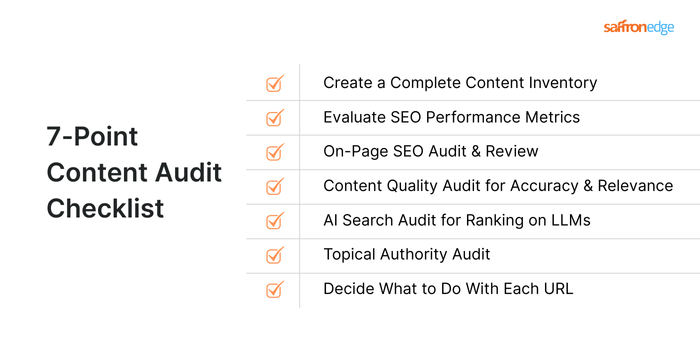
Here’s a detailed guide for your website content audit:
1. Create a Complete Content Inventory
Organize a list of all pages, posts, media files and downloadable resources. Cover URLs, titles, content type and publication date.
Before analyzing, create a content inventory spreadsheet.
Include:
- URL
- Content type (blog, landing page, product page, resource, FAQ)
- Target keyword
- Traffic (organic & total)
- Impressions
- Click-through rate
- Conversions
- Word count
- Publish date
- Last updated date
- Backlinks
- Internal links
- Primary intent
- Content score (quality + freshness)
This becomes your single source of truth.
Example: A content audit for our SaaS client cut the total count to 180 high-performing, deeply updated pages, leading to +148% more organic signups.
2. Evaluate SEO Performance
This is where cheap listicle audits fail. Most guides only look at pageviews.
But performance must be measured across four dimensions:
a) Traffic Performance
- Organic sessions
- Impressions
- Trending over 6–12 months
- Sudden drops (algorithm or technical issues)
b) Ranking Performance
- Target keyword rank
- Secondary keyword rank
- Featured snippet eligibility
- Lost rankings
c) Engagement Metrics
- Bounce rate
- Scroll depth
- Time on page
- Pages per session
Poor engagement = weak intent alignment.
d) Conversion Metrics
- Conversions (lead forms, demos, carts)
- Assisted conversions
- CTA interactions
Leverage analytics tools to measure traffic, bounce rate, conversion rate, social shares and other engagement parameters for every content piece.
3. On-Page SEO Audit
Scrutinize metadata, headings, keyword usage, backlinks, internal links, alt text for images and URL structure.
a) H1 quality
Must match the query directly: “How to enrich my data on Clay?”
b) H2/H3 hierarchy
Use query-based subheadings.
c) Keyword optimization
- Primary keyword in H1 + intro paragraph
- Semantic terms throughout
- Content completeness
d) Meta Data
- Titles under 60 characters
- Description under 150–160 characters
- Include intent-driven messaging
e) Internal Links
- Links from high-authority pages
- Cluster-level linking
- Contextual anchors
4. Content Quality Audit
Analyze grammar, readability, and factual accuracy to identify any changes or optimizations required and alignment with existing business goals, enabling you to uncover outdated content needing update or elimination.
You need to evaluate:
a) E-E-A-T Signals
Google’s modern evaluator:
- Experience (first-hand examples, real insights)
- Expertise (qualified author)
- Authoritativeness (citations, credentials)
- Trustworthiness (accuracy, sources, dates)
Pages missing E-E-A-T rarely rank in competitive industries.
b) Depth & Completeness
Ask: Does this fully answer the query? Is this the best content online for this topic?
c) Freshness
Anything older than 12–18 months should be refreshed.
d) Data & Credibility
High-performing content always includes:
- Stats
- Primary research
- Examples
- Case studies
- Benchmarks
5. AI Search Audit
This is the gap missing from 99% of top-ranking guides.
AI Overviews, ChatGPT Search, and Perplexity prefer:
- Short definitions
- Structured steps
- TL;DR summaries
- Clean subheadings
- Schema
- Consistent terminology
Audit:
- Does your page have a direct answer under each header?
- Are sections skimmable by an AI?
- Are examples clearly attributed?
- Are stats and insights structured?
- Does each section stay on one idea?
Your content must be easy for AI to quote.
6. Topical Authority Audit
This is where big ranking gains hide.
a) Identify Keyword Cannibalization
If 2–5 blogs target the same topic → consolidate them.
b) Check Topic Clusters
Clusters improve rankings more than individual posts.
c) Discover Content Gaps
Use Semrush/Ahrefs to find:
- Competitor topics you’re missing
- Untapped keywords
- Questions users ask
- AI summary topics
Example: Notion grew by dominating every angle of “productivity workflows.” Cluster dominance → Google consistently rewards the brand.
7. Decide What to Do With Each URL
Every piece of content shall be categorized as Keep, Update, Consolidate or Eliminate. Preference should be kept based on ROI, traffic and strategic importance.
a) Keep (1–5% of pages)
High-performing evergreen content.
Criteria:
- Ranking well
- Consistent traffic
- Strong conversions
- Accurate & fresh
b) Refresh (50–60% of pages)
Most pages fall here.
Actions:
- Rewrite outdated sections
- Add stats
- Improve structure
- Add examples
- Update keywords
c) Repurpose / Merge (15–25% of pages)
Fix cannibalization.
Actions:
- Combine related blogs
- Turn several short pieces into one pillar
- Move content into clusters
d) Remove (10–20% of pages)
Pages that harm your SEO.
Criteria:
- Thin content
- No traffic
- No conversions
- No value
- Dangerous YMYL inaccuracies
What Are The Best Tools For SEO Content Audit?
Performing a content audit manually can be tedious. These tools can simplify and accelerate the process:
| Tool | Purpose | Best For |
| Google Analytics | Track traffic, bounce rate, conversions | Performance analysis |
| Google Search Console | Monitor search performance and index issues | SEO monitoring |
| Screaming Frog SEO Spider | Crawl website pages and collect metadata | Technical SEO audit |
| SEMrush | Analyze keywords, backlinks, and site health | SEO content audit |
| Ahrefs | Competitor analysis and backlink tracking | Link profile and keyword audit |
| Hotjar / ContentSquare | Heatmaps and engagement tracking | User behavior analysis |
Using a combination of these tools ensures a thorough SEO content audit and provides actionable insights.
Ranking is not recovering?
Overwhelmed by keyword cannibalization and duplicate issues killing your site? We follow a proven audit process to recover opportunities and boost authority with targeted goals.
How To Successfully Conduct A SEO Content Audit?
Conducting a website content audit can feel overwhelming, but a clear, structured approach makes it manageable.
Here’s a comprehensive 6-step guide for performing a successful content audit, with suggested visuals for each step.
Step 1: Define Goals and Scope
A content audit begins with a clear understanding of the purpose and objectives. Without defining goals, it’s impossible to evaluate what success looks like.
Goals can vary depending on business needs: improving SEO rankings, increasing organic traffic, enhancing user experience, identifying content gaps, or optimizing for lead generation and conversions.
The scope of the audit defines which areas of the website will be reviewed. For instance, you may focus on:
- Blog content to optimize for search intent and engagement.
- Landing pages to ensure alignment with marketing campaigns and lead capture objectives.
- Product or service pages to improve conversions and reduce bounce rates.
- Downloadable resources or gated content to ensure relevance and up-to-date information.
Defining scope also prevents wasting time on pages that are too new, irrelevant, or outside the business focus.
A well-defined goal and scope provide the framework for all subsequent audit activities and ensure that the audit delivers actionable insights.
Step 2: Build a Content Inventory
A comprehensive content inventory is the backbone of a website content audit. It involves listing every content asset on the site to have a complete overview of what exists.
The inventory typically includes:
- URL
- Page Title and Meta Description
- Content Type (blog, landing page, product page, PDF, video)
- Publication Date and Last Updated Date
- Author or Content Owner
- Word Count and Content Format (text, infographic, video)
A complete inventory enables you to see gaps, redundancies, or outdated material across your website.
Tools like Screaming Frog, SEMrush, Ahrefs, or CMS export functions can help automate this process for larger websites, while smaller sites can maintain the inventory manually. The inventory becomes the foundation for the audit. With this centralized record, every page can be assessed consistently for performance, relevance, and SEO optimization.
Step 3: Measure Performance and Engagement
Performance measurement is critical for understanding which content is achieving its objectives.
Metrics provide insight into how visitors interact with your content and identify areas for improvement. Important metrics include:
- Traffic Metrics: Page views, unique visitors, organic search traffic, and referral traffic. High-performing content drives consistent traffic, whereas low-performing content may need updates or removal.
- Engagement Metrics: Average time on page, bounce rate, scroll depth, and social interactions. These indicate how users perceive and engage with content.
- Conversion Metrics: Leads, sign-ups, downloads, or purchases generated by each page. Even high-traffic pages are less valuable if they don’t contribute to conversions.
Analyzing these metrics helps identify:
- High-performing pages that may be repurposed or promoted further.
- Low-performing pages that may need updates or consolidation.
- Pages that are performing well for SEO but underperforming in engagement or conversion signal a need for UX improvements.
Step 4: Review Content Quality and SEO
Content quality and SEO health are evaluated together to ensure content is both relevant and discoverable. Key factors to review include:
Content Quality:
- Readability and tone consistency with brand voice.
- Accuracy and relevance of information; outdated facts or statistics should be updated.
- Duplicate or thin content that adds little value.
- Clarity of messaging and alignment with the target audience's needs.
SEO and Technical Aspects:
- Meta titles and descriptions: Ensure they are descriptive, keyword-optimized, and the correct length.
- Heading hierarchy (H1, H2, H3) and keyword placement.
- Internal and external linking structure to improve crawlability and authority.
- Image optimization: Alt text, file names, and compression for faster loading.
- Mobile-friendliness and page speed to support SEO and user experience.
- Broken links or 404 errors may harm rankings and usability.
Analyzing both content quality and SEO simultaneously ensures that content not only engages users but also ranks effectively in search engines.
Step 5: Categorize and Prioritize Content
Once performance, quality, and SEO are assessed, content is categorized based on its value and relevance. Common categories include:
- Keep: High-performing, relevant content that requires no changes.
- Update or Optimize: Content that is moderately performing but could benefit from refreshed information, improved SEO, or added multimedia.
- Consolidate or Merge: Multiple low-performing pages covering similar topics can be combined into one authoritative piece.
- Remove or Archive: Outdated, irrelevant, or redundant content that no longer supports business goals.
Prioritization helps focus efforts on content that delivers the greatest impact. High-value pages with potential for growth should be updated first, while low-value content can be archived or removed to improve overall site quality.
Step 6: Implement Updates and Monitor Results
The final step is updating content based on the audit findings and tracking the impact over time. This includes:
- Refreshing outdated content and optimizing metadata for SEO.
- Consolidating or merging pages to improve authority and reduce redundancy.
- Removing irrelevant pages that negatively affect user experience or site quality.
- Monitoring updated content for improvements in traffic, engagement, and conversions.
- Continuous review to ensure that content remains optimized and aligned with business goals.
Monitoring results after implementation ensures that the audit delivers measurable improvements.
Scheduling regular audits (every 6–12 months) maintains content relevance and performance in the long term.
Conclusion
A website content audit is an essential practice for maximizing the value of your digital content. It helps improve SEO performance, enhances user experience, strengthens brand authority, and aligns content with marketing goals.
Whether you conduct a marketing content audit to refine campaigns or an SEO content audit to boost search visibility, the insights gained will guide your content strategy for months to come.
Regular content audits ensure that your website remains relevant, authoritative, and competitive in an ever-changing digital landscape.
By following a structured approach, leveraging the right tools, and acting on insights, businesses can optimize content performance and achieve higher engagement and conversions.
Content Gaps Crushing Your Organic Traffic?
Stuck with outdated pages and thin content that's invisible to search engines? Our step-by-step guide reveals how to audit, refresh, and optimize for massive ranking gains.
Share


Get The SaaS Marketing Toolkit
FAQs
What is a website content audit and why is it important?

A website content audit is the process of reviewing all pages and assets on your site to evaluate performance, relevance, and SEO value. Conducting a website content audit regularly ensures outdated content is updated, gaps are filled, and your site maintains strong search engine rankings.
How does a marketing content audit improve SEO and engagement?
A marketing content audit analyzes all marketing assets, including blogs, landing pages, and downloadable resources, to identify which content drives traffic and engagement. By optimizing underperforming content during a marketing content audit, you can boost conversions and improve your overall digital marketing ROI.
What tools should I use for an SEO content audit?
An SEO content audit can be done efficiently using tools like Google Analytics, Google Search Console, Screaming Frog, SEMrush, or Ahrefs. These tools help track page performance, keyword rankings, backlinks, and other SEO factors, making your audit data-driven and actionable.
How often should I perform a content audit for my website?
A content audit should ideally be conducted every 6–12 months or whenever major updates are made to your website or content strategy. Regular content audits ensure your site stays current, relevant, and aligned with your marketing goals.
What is the difference between a content audit and an SEO content audit?
A content audit reviews all aspects of content quality, relevance, and alignment with marketing objectives, while an SEO content audit specifically focuses on search engine optimization factors such as keyword usage, metadata, backlinks, and page performance. Both are critical for a successful digital strategy.
Nishant Ahlawat

Nishant Ahlawat is a marketing professional specializing in SaaS, SEO, and content strategy. He has experience working with B2B companies to improve online visibility, develop content frameworks, and implement data-driven SEO practices. His work focuses on helping businesses grow their organic presence through search optimization, strategic planning, and performance tracking. Outside of work, Nishant enjoys traveling to offbeat destinations, trekking in the mountains, and exploring local cultures and landscapes.
Related Blogs
We explore and publish the latest & most underrated content before it becomes a trend.

6 min read
Why Location-Based SEO Works Better for a Healthcare DTC Brand
By Vibhu Satpaul

4 min read
84% of shares happen via dark social - Did you check your metrics in 2020?
By Vibhu Satpaul

Subscribe to Saffron Edge Newsletter!


Get The SaaS Marketing Toolkit