





Enterprise SaaS SEO: Your Simple Guide to Faster Organic Growth in 2026


Dec 10, 2025

Contents
 9 min
9 min
- TL;DR: Key Takeaways on Enterprise SaaS SEO
- What Is Enterprise SaaS SEO?
- What are the benefits of Enterprise SaaS SEO?
- Step-by-Step: Build Your Enterprise SEO Strategy
- SEO Strategy 1: Smart Keyword Research for Enterprise SaaS SEO
- SEO Strategy 2: Fix Your SaaS Website Architecture
- SEO Strategy 3: Create Content That Gets Cited on AI
- SEO Strategy 4: Build Links and Authority as an Enterprise SaaS Company
- SEO Strategy 5: AI Tools to Boost Your Enterprise SaaS SEO Rankings
- SEO Strategy 5: Track and Tweak Your SaaS SEO Metrics
- How Saffron Edge Drives Success in Enterprise SaaS SEO?
- Conclusion
Enterprise SaaS SEO is the foundation for the success of Software-as-a-Service (SaaS) firms.
With organic search driving over 53% of traffic for B2B SaaS companies and AI-powered search engines reshaping user behaviors, enterprise SaaS leaders must evolve beyond basic optimization.
This guide breaks it down simply: what it is, how to create an enterprise SEO strategy for SaaS, and the tools to make it happen. Let's make your SaaS visible, trusted, and profitable.
TL;DR: Key Takeaways on Enterprise SaaS SEO
- Why it matters: Organic search drives 44.6% of B2B revenue—more than any other channel. In 2026, AI tools like Google AI Overviews will handle more than 50% of searches.
- Core strategy: Focus on user intent, technical fixes, and Answer Engine Optimization (AEO) to rank in AI responses.
- Quick wins: Audit keywords with SEMrush, build flat site architecture, and create concise, citable content.
- Expected ROI: Brands like Adobe doubled traffic in a year by aligning SEO with sales.
- Pro tip: Use structured lists and FAQs for easy AI extraction.
Enterprise SaaS SEO services turn complex websites into revenue machines. It's not just about ranking—it's about being the go-to answer in a world where AI answers queries instantly.
What Is Enterprise SaaS SEO?
Enterprise SaaS SEO optimizes large-scale software sites—like those with 1,000+ pages—for search engines and AI tools. Think Salesforce or HubSpot: They handle global traffic, multiple products, and fierce competition.
Simple definition: It's the plan to get your SaaS found organically, without ads. Why "enterprise"? It scales for big teams, budgets, and tech stacks.
In 2025:
- Organic search powered 68% of website traffic.
- AI shifted the game: 50% of Google searches now show AI summaries, up 115% since early 2026. Users get answers without clicking—unless your content is cited.
Benefits at a glance:
- More leads: 2x revenue vs. other channels.
- Brand trust: Top rankings build authority.
- Cost savings: Organic beats paid over time.
Enterprise SEO is primarily concerned with improving the organic visibility of large businesses. Unlike small company SEO, corporate SaaS SEO delves into the intricacies of short-tail, highly competitive SaaS keyword research.
Specialized teams expertly handle specific pages for each product, demonstrating the complexities and meticulousness of their SEO efforts.
What are the benefits of Enterprise SaaS SEO?
Enterprise SaaS SEO optimizes large-scale software platforms—like CRM or HR tools—for organic search, driving visibility and revenue without ad spend. In a market projected to hit $390.5 billion by year-end, it's essential for B2B leaders. Here's why it pays off:
- Massive ROI Boost: SEO yields a 702% ROI for SaaS firms, with payback in under 7 months. Every $1 invested returns $2.75 on average, far outpacing PPC. These compounds as rankings stabilize.
- Superior Lead Quality: 81% of B2B marketers say SEO delivers better leads than paid channels. Top-3 results capture 54.4% of clicks, funneling high-intent traffic to product pages.
- Sustainable Traffic Growth: Organic search starts 68% of website visits. Investing builds backlinks and authority, turning one-time visitors into loyal users.
- Market Leadership: Enterprise strategies position your brand as the category king, dominating SERPs and AI overviews for long-term dominance.
- Cost Efficiency: Minimal ongoing costs yield compounding gains, attracting leads weekly as algorithms favor fresh, authoritative content.
- Enhanced Reputation Management: Enterprise SaaS SEO emphasizes producing favorable online reviews, media mentions, and publishing authoritative material to construct a positive online narrative and protect brand equity.
- Industry Domination and Trust Building: Enterprise SEO strategically invests in top-of-the-funnel content, dominating Search Engine Results Pages (SERPs) and building trust. By providing valuable information, brands encourage prospects to progress through the sales funnel, ultimately choosing their product or service when ready to purchase.
Step-by-Step: Build Your Enterprise SEO Strategy
Don't overwhelm your team. Use this 3-phase roadmap. It's flexible for bootstrapped startups or enterprises.
Phase 1: Plan and Audit (1-4 Weeks)
Know where you stand.
1. Assess your site: Use Google Search Console to check errors, speed, and mobile friendliness. Fix Core Web Vitals—pages should load in under 2.5 seconds.
2. Define goals: Target 20% more organic traffic in 6 months. Link SEO to revenue (e.g., track leads from "CRM software" searches).
3. Team up: Involve marketing, dev, and sales. Tools like Asana keep everyone aligned.
Quick audit checklist:
| Issue | Check | Fix Tip |
| Crawl errors | Google Console | Redirect broken links |
| Page speed | PageSpeed Insights | Compress images |
| Indexation | Sitemap submission | Add robots.txt rules |
Phase 2: Execute Core Tactics (Months 1-3)
Focus on quick, high-impact changes.
- Keywords first: See next section.
- Site structure: Flatten navigation—no page over 3 clicks deep.
- Content refresh: Update old posts with fresh stats.
Budget split: 40% tools/tech, 40% content, 20% testing.
Phase 3: Scale and Measure (Ongoing)
Review quarterly. Adapt to updates like Google's Helpful Content rules.
- Track with Google Analytics 4.
- Pivot: If AI traffic dips, boost AEO (more below).
This enterprise SEO strategy evolves—like Shopify's theme updates that cut load times and boosted rankings.
SEO Strategy 1: Smart Keyword Research for Enterprise SaaS SEO
Keywords guide users to your door. It forms the bedrock of any effective SEO strategy. Utilizing industry-standard tools like Semrush or Ahrefs is paramount for SaaS brands venturing into enterprise-level SEO.
1. Build Customer Personas:
Developing comprehensive consumer personas is essential. Consider the demographics, major objectives, and pain issues. Use corporate SEO analytics, surveys, consumer interviews, and internal conversations. Understand how your target audience uses your website and identify areas for improvement.
2. Brainstorm and research keywords:
Collaborate with your team to identify the many ways people look for your goods. Using seed keywords as a basis, evaluate related themes, product features, and consumer pain concerns. Demographics Pro and Audience provide insights on social media audiences.
3. Identify Competitors' Top Keywords:
Use tools like SEMrush or BrightEdge Data Cube to analyze competition data. Analyze rivals' title tags to identify keyword possibilities and perform a keyword gap analysis. Consider using rival names as keywords to get relevant search traffic.
4. Monitor branded keywords:
To shape the story surrounding your brand. Track branded searches using Google Alerts, social media search functionality, and services such as SEMrush. Dominating search results for branded terms improves brand reputation.
5. Optimize for international keywords:
if your business operates abroad. Translation alone may not be sufficient; instead, work with a native translator who is knowledgeable about keyword research. Identify regional difficulties and optimize keywords accordingly.
6. Consider new keyword search trends:
such as voice search optimization. Focus on voice-friendly keywords, particularly question-form or long-tail keywords. Understanding user intent can help target highlighted snippets and improve exposure.
7. Long-Tail Keywords:
Identify long-tail keyword variants using Google's Autosuggest, Ahrefs, or KeywordTool.io. These specific, targeted terms align with user intent and are valuable for capturing niche audiences.
8. Map Keywords to Important Pages:
Assign target keywords to relevant pages based on a solid understanding of your website structure. Use a spreadsheet to create a keyword research template, mapping keywords to specific pages. Applying keywords with site structure enhances the overall content strategy.
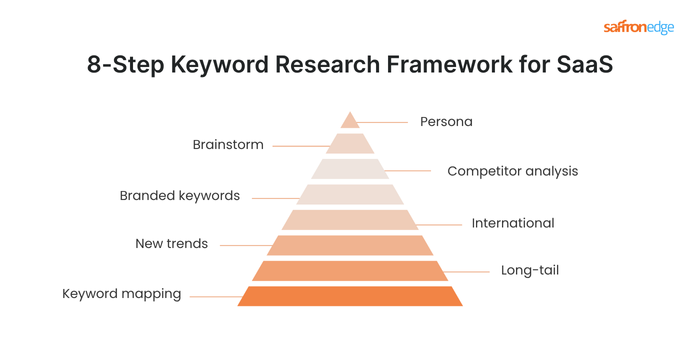
8 Step Keyword research
Top SaaS SEO tools for 2026:
| Tool | Key Feature | Why for SaaS? |
| SEMrush Keyword Magic Tool | 26B+ keywords, intent filters | Spots "integrations" modifiers for product pages. |
| Ahrefs Content Gap | Competitor keyword finder | Reveals untapped terms like "enterprise project management." |
Aim for a mix: 40% high-volume (e.g., "SaaS tools"), 60% long-tail (e.g., "SaaS tools for remote sales teams").
AEO tip: Target questions. "What is Enterprise SaaS SEO?" Use Google's "People Also Ask" for ideas. This gets you cited in AI answers.
Map keywords to pages in a spreadsheet: Intent | Keyword | URL | Priority.
SEO Strategy 2: Fix Your SaaS Website Architecture
A messy site confuses users and bots.
Good architecture = easy navigation + strong rankings.
Website structure, often known as website architecture, is a critical component that influences both user experience and search engine optimization (SEO).
It refers to the structure and interconnection of pages on a website, which is important for influencing search engine rankings and enabling user navigation.
A well-planned website architecture, guided by a skilled SaaS SEO consultant, helps search engines find and index relevant pages more efficiently, thereby optimizing the enterprise SaaS marketing strategy.
It creates an internal linking structure that effectively distributes authority throughout the site, providing critical information to search engines such as Google about the purpose of each page.
A chaotic structure might confuse search engines and potentially reduce a website's visibility in search results.
Core rules:
- Flat and logical: Homepage > Category > Product. E.g., /saas-seo/ > /saas-seo/keywords/.
- Internal links: Connect related pages to share "authority."
- User helpers: Add breadcrumbs (Home > SEO > Keywords) and clear menus.
2026 must-follows:
- Mobile-first: 60% of searches are mobile.
- Schema markup: Helps AI pull your data for rich snippets.
- Audit with Screaming Frog: Fix if >10% pages are "orphans" (unlinked).
Example: Shopify's clean structure improved UX and SEO signals like dwell time.
SEO Strategy 3: Create Content That Gets Cited on AI
Content is your magnet. Make it scannable, valuable, and AI-ready.
To start a successful content production journey, make a list of industry-related subjects that are relevant to your business goals.
- Once you've compiled your list, conduct keyword research to find relevant and robust keywords related to each topic.
- Striking a balance between short-tail and long-tail keywords increases the diversity of your content strategy.
- Understanding the search intent behind your core keyword—the primary phrase you want to rank higher for—is critical in creating appealing content. Analyzing Google search results for your primary keyword might give helpful information about the content relevant to user inquiries.
- For example, if your keyword is "fall fashion trends," match your content type with the current trend of making posts highlighting the season's main trends.
Simple workflow:
1. Match intent: For "Enterprise SaaS SEO tips," write a how-to guide.
2. Structure for skimmers: Short paragraphs, H2/H3 heads, bullets.
3. Add visuals: Tables, infographics.
4. Optimize length: 1,500-2,500 words for depth.
AEO best practices (Answer Engine Optimization):
- Direct answers: Start sections with 1-2 sentence summaries.
- Citable facts: Back claims with sources (like this guide!).
- Schema & lists: Use FAQ schema for "zero-click" wins.
- Question focus: Optimize for voice/AI: "How to do X?"
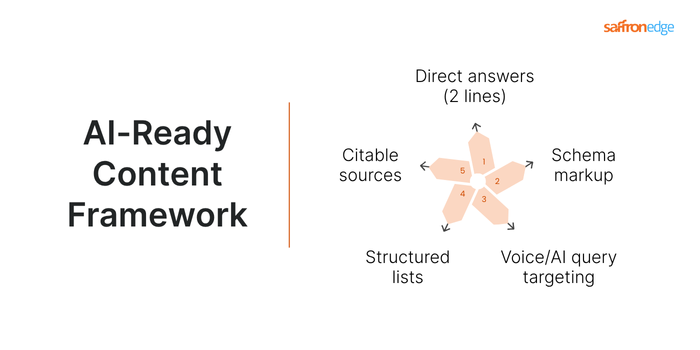
Tools: SurferSEO for on-page scores; Jasper for drafts (human-edit always).
Refresh content every 6 months—Google loves fresh info.
SEO Strategy 4: Build Links and Authority as an Enterprise SaaS Company
Imagine you're looking for a job suggestion. Would you rather have 10 recommendations from acquaintances and strangers or one powerful reference from the leading expert in your field?
The latter, of course! Similarly, having fewer connections from authoritative, trustworthy websites is preferable to having many links from doubtful sources. Low-quality or spammy websites might damage your reputation and SEO rankings.
Benefits of Link Building for Enterprise SaaS SEO
Link building is more than just a strategy for gaining higher search rankings. For SaaS companies, it can play a pivotal role in enhancing online visibility, building brand authority, and driving targeted traffic.
- Enhanced search engine rankings
- Driving Referral Traffic
- Establishing Industry Authority
- Building Brand Awareness
- Relationship Building
Easy tactics:
1. Guest posts: Write for industry blogs.
2. HARO: Answer journalist queries.
3. Partnerships: Link swaps with complementary SaaS (e.g., Zapier + your tool).
Things to remember:
1. Links = trust votes.
2. Quality over quantity: One from Forbes > 100 spammy sites.
3. Track with Ahrefs: Aim for Domain Rating >50.
4. Backlinks drive 25% of referrals in SaaS.
SEO Strategy 5: AI Tools to Boost Your Enterprise SaaS SEO Rankings
AI isn't replacing SEO—it's supercharging it. Rank in tools like Perplexity by being extractable.
Must-try tools:
| Tool | Use Case | AI Perk |
| Clearscope | Content grading | Semantic relevance scores. |
| Frase | Intent research | Predicts AI snippet chances. |
| Perplexity.ai | Test rankings | Query your content—see if it cites you. |
Ranking in AI: Use bullets/tables, cite sources. 80% of AI sources differ from Google—original research wins.
Ethical note: Label AI-generated parts for trust.
SEO Strategy 5: Track and Tweak Your SaaS SEO Metrics
Measure what matters. Set up GA4 for organic-to-revenue paths.
Key metrics:
- Traffic: +20% YoY.
- Conversions: Snippet clicks (15% target).
- Share of voice: Beat competitors by 10%.
Tools: SEMrush for forecasts; Hotjar for user heatmaps.
Review monthly: Adjust based on data.
How Saffron Edge Drives Success in Enterprise SaaS SEO?
With over a decade of experience serving global brands like Travelocity and Citigroup, they tailor strategies for complex, large-scale SaaS sites; focusing on technical depth, AI-ready content, and full-funnel alignment.
Our approach goes beyond traffic: It ties SEO directly to business outcomes like MRR growth and demo bookings, making it a top choice for B2B SaaS leaders.
In 2025, as AI search tools like Perplexity and Google's AI Overviews dominated, Saffron Edge emphasizes Answer Engine Optimization (AEO) and Generative Engine Optimization (GEO) to future-proof clients against zero-click searches.
Saffron Edge shines in delivering measurable wins. Here are standout examples from their portfolio:
- JOP (SaaS Platform): Faced stagnant organic growth amid fierce competition. Saffron Edge revamped semantic SEO and content clusters, resulting in a 522% organic traffic surge, 99x more Page 1 rankings, and 15x SEO-driven revenue growth. This positioned JOP as a category leader in project management tools.
- Member Health Insurance (Enterprise SaaS): Struggled with lead velocity in a regulated market. Through technical audits, AEO-optimized content, and targeted outreach, they achieved 12.5x faster lead gen, a 22% acceptance rate increase, and a $10M pipeline expansion—directly boosting MRR.
- HR Tech SaaS Client (Semantic SEO Focus): Implemented entity-based strategies for global expansion, yielding 4x MQL growth and 200+ Keywords on Page 1, with content ranking in AI overviews for key queries.
These cases highlight their ROI focus: Average clients see 15x traffic lifts and 3.5x conversion improvements within 6-12 months.
Whether you're a bootstrapped SaaS startup or an enterprise like Salesforce-scale, Saffron Edge embeds SEO into your GTM (Go-To-Market) stack.
Conclusion
Enterprise SaaS SEO is straightforward when broken down: Plan, optimize, measure, adapt.
With AI rising, focus on AEO to get cited everywhere. Implement one phase this week, your future self (and revenue) will thank you.
This enterprise SEO strategy for saas works because it's actionable and proven. Share your wins below!


Get The SaaS Marketing Toolkit
FAQs
What makes Enterprise SaaS SEO more effective than traditional SEO for large platforms?

Unlike basic SEO, Enterprise SaaS SEO scales for complex sites with thousands of pages, focusing on technical depth, cross-team alignment, and AI-ready content. This leads to sustained dominance in SERPs, with brands like Adobe seeing 40% traffic lifts through unified silos. Saffron Edge helps enterprises navigate these intricacies for faster, measurable wins.
How does Enterprise SaaS SEO boost ROI compared to paid channels?
It delivers a 702% average ROI, with payback in under seven months—$2.75 returned per $1 spent—outpacing PPC's short-term gains. Organic leads convert at 14.6% vs. 1.7% for outbound, compounding over time for cost-efficient growth.
Why is lead quality higher with Enterprise SaaS SEO?
It targets high-intent queries, capturing 54.4% of clicks from top-3 results and driving 2x revenue over other channels. Saffron Edge's keyword clustering ensures traffic aligns with buyer journeys, reducing CAC by up to 30%.
How does it enhance brand authority in a competitive market?
By dominating SERPs and earning AI citations, it builds E-E-A-T signals, positioning your SaaS as the industry leader. In the $390B SaaS space, this edge attracts partnerships and talent; Saffron Edge's clients report 25% authority gains in six months.
Nishant Ahlawat

Nishant Ahlawat is a marketing professional with 6+ years of experience specializing in SaaS SEO, content strategy, and go-to-market (GTM) strategies. He has worked extensively with B2B SaaS companies to improve online visibility, build scalable content frameworks, and execute data-driven SEO initiatives. His expertise lies in driving proven results through search optimization, performance tracking, and strategic marketing planning tailored for SaaS growth. Nishant focuses on building and executing marketing strategies that strengthen organic presence, support product-led growth, and deliver measurable business outcomes. Outside of work, Nishant enjoys traveling to offbeat destinations, trekking in the mountains, and exploring local cultures and landscapes.
Related Blogs
We explore and publish the latest & most underrated content before it becomes a trend.





Subscribe to Saffron Edge Newsletter!


Get The SaaS Marketing Toolkit