


How To Do An SEO Audit for Your Website (2026 Edition)?


Dec 16, 2025

 8 min
8 min
Despite constant efforts to optimise content for website ranking, many pages still barely garner traffic, even though they are kept live for months.
If your website traffic has dropped…
If your rankings are flat…
If conversions aren’t improving…
If your site feels “invisible” in AI overviews…
You’re probably facing the same painful realization thousands of companies face each year:
Your website is the backbone of your business, but you don’t actually know what’s working, what’s broken, and what’s silently costing you revenue.
This is why SEO audits exist.
Not as a checklist.
Not as a quick scan.
But as a full diagnostic, like an MRI for your website.
Yet, almost every top-ranking page online still gives incomplete advice:
- HubSpot focuses heavily on basics (titles, links) but overlooks modern AEO (Answer Engine Optimization)
- Semrush gives technical depth but lacks storytelling, industry examples, and AI-search preparation
- Ahrefs has great workflows, but assumes users already know how to interpret data This guide fixes those gaps.
You’re about to learn exactly how to conduct a modern SEO audit—the same way enterprise SaaS, fintech, healthcare, and HRTech brands do it before scaling traffic from 5,000 → 50,000+ monthly visits. This guide is not a list. It’s a system.
What is an SEO Audit (Really)?
An SEO audit is the comprehensive analysis of your website’s ability to rank, convert, and appear in AI-driven search results.
It examines various aspects, like technical infrastructure, on-page content and off-page signals of a site to detect issues that hinder its ranking metric.
But here’s the truth, no one says out loud:
Most companies don’t have a ranking problem. They have a visibility, crawlability, credibility, or experience problem.
An SEO audit enables you to identify the areas where the site is underperforming, what’s working, and where the biggest opportunities lie.
Use Cases
1. When HRTechplatform Workday saw its organic conversions flatten, its audit revealed:
- 9,000+ duplicate URLs
- Missing schema on 80% of product pages
- Crawl budget wasted on outdated job posts
- 200+ pages not passing Core Web Vitals
After fixing them, their organic pipeline grew 33% in one quarter.
2. Fintech companies like Stripe discovered:
- AI models were summarizing competitor content more accurately
- Their API docs outranked competitors for the keywords that competitors targeted
- But their main product pages lacked internal linking, costing them trust and authority
The fix led to +58% more enterprise sign-ups from organic.
3. The most well-known SaaS company, Notion, found that:
- Their help docs were getting 5× more organic traffic than the homepage
- But no CTAs existed inside the docs
Fixing it led to +268% demo lifts from SEO.
Your audit can uncover opportunities equally dramatic. Learn more about SEO Audit Services.
SEO traffic plummeting without warning?
Frustrated by stagnant rankings despite your efforts? Scan your site in seconds for critical flaws and get expert recommendations to reclaim top spots effortlessly.
The Modern SEO Audit Framework (2026): 8 Core Pillars
Start the audit by clearly stating your business objectives, selecting the KPIs to track (such as organic sessions, conversion rate, or ranking keywords), and the website sections, languages, or regions to audit.
You need to follow this: “Objectives → KPIs → Audit Scope”.
Once you know the scope, here’s what a complete audit includes:
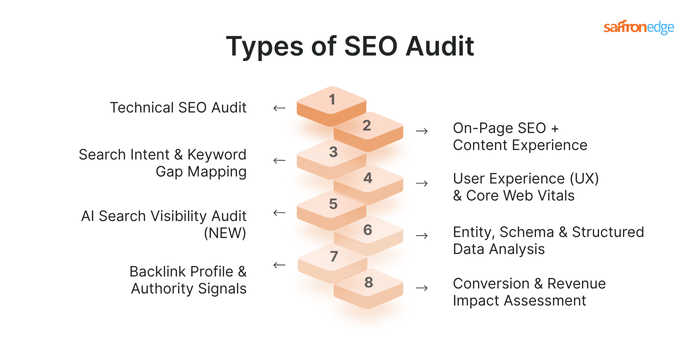
1. Technical SEO
2. On-Page SEO + Content Experience
3. Search Intent & Keyword Gap Mapping
4. User Experience (UX) & Core Web Vitals
5. AI Search Visibility Audit (NEW)
6. Entity, Schema & Structured Data Analysis
7. Backlink Profile & Authority Signals
8. Conversion & Revenue Impact Assessment
Every high-ranking guide explains what to check.
But this one explains why each matters, how to check it, what benchmarks to use, and what top brands do differently.
1. Technical SEO Audit: Can Search Engines Crawl, Index, and Understand Your Website?
This pillar answers: Can Google, Bing, and AI crawlers access and interpret your content?
Technical SEO is foundational. Without it, content quality doesn’t matter.
Next is analysing site performance across mobile and desktop by performing PageSpeed Insights or Lighthouse to evaluate Core Web Vitals such as Largest Contentful Paint (LCP), Cumulative Layout Shift (CLS), and First Input Delay/Interaction to Next Paint.
Also, before proceeding, ensure that you check the HTTPS implementation, valid structured data, mobile-first readiness, and site architecture that supports fast crawl speed.
1.1 Check Indexation & Crawl Health
Tools:
- Google Search Console (Coverage, Pages Indexing)
- Screaming Frog / Sitebulb
- Bing Webmaster Tools
Audit questions:
- Are key pages being indexed?
- Are junk pages being indexed? (tag pages, duplicate filters, dev URLs)
- Is your crawl budget being wasted?
Enterprise example: A SaaS HRTech brand was indexing
1.2 Fix Broken Links & Redirect Chains
Broken links create poor experiences and wasted equity.
Benchmark:
- Less than 0.5% of all URLs should return 404
- Redirect chains should be 1-to-1, not multi-hop
1.3 Audit URL Structure
URLs affect both ranking & crawling.
Best practices:
- Use clean, keyword-relevant slugs
- Avoid dynamic parameters (unless handled through canonicalization)
- Ensure HTTPS sitewide
1.4 XML Sitemap & Robots.txt Validation
Common mistakes:
- Sitemap includes 404 pages
- Robots blocks CSS/JS
- No reference to sitemap in robots.txt
- Orphaned pages not in sitemap
Healthcare example: A multi-location healthcare group increased organic patient appointments by 27% by fixing a poorly formed sitemap that excluded 120 service pages.
These four criteria can significantly impact rankings and user experience, namely slow performance, large layout shift, or irrelevant schema markup.
2. On-Page SEO Audit:
Is your page structured for AI + human readability? Top-ranking SEO guides often oversimplify this step.
Modern on-page SEO is not “add keywords in H1.”
It’s much deeper. It’s about topical clarity, information hierarchy, answerability, and user experience.
2.1 Title Tags, H1s & Metadata
Audit questions:
- Does each page have a unique title?
- Is the primary query represented naturally?
- Does the H1 answer the search intent?
LLM-friendly tip: Use natural, complete-sentence H1s, e.g., “How to Do an SEO Audit for Your Website (Complete 2026 Guide)”
2.2 Keyword Placement & Semantic Relevance
Tools:
- Clearscope
- SurferSEO
- Semrush Keyword Gap
You’re optimizing for: topics → subtopics → entities, not just keywords.
2.3 Internal Linking Structure Audit
Most companies interlink strategic pages.
Checklist:
- Do all core pages have ≥10 internal links?
- Does anchor text reflect search intent?
- Are orphan pages fixed?
Fintech example: A payments company added 200+ contextual internal links to API docs → their API ranking jumped from #8 to #2 globally.
2.4 Thin Content, Duplicate Content & Cannibalization
Look for:
- Pages with <300 words
- Pages competing for the same queries
- Multiple blog posts on identical subjects
We’ve seen that fixing cannibalization often increases rankings within weeks, as it directs relevant traffic to the most important page.
One thing not to forget is to review content depth and relevance: Does the page give a thorough answer to the user’s query? Detect thin, duplicate, or outdated pages and mark them for consolidation or refresh.
3. Search Intent Audit: Does Your Content Match What Users Actually Want?
Search intent is the new SEO battleground.
Google wants to rank pages that solve the user’s problem, not pages that repeat the keyword.
Types of Search Intent:
- Informational: “how to do an SEO audit”
- Commercial: “best SEO audit tools”
- Transactional: “hire SEO audit service”
- Navigational: “Semrush audit tool”
During your audit:
- Align each URL with the appropriate intent
- Identify missing intents (gap opportunities)
SaaS example: Notion identified missing “Notion vs Evernote” comparison pages → adding them increased trials by
Top-ranking SEO guides rarely teach this practical application.
4. UX & Core Web Vitals Audit: Is Your Site Fast, Stable & Easy to Use?
Google’s research shows that a 1-second delay reduces conversions by 20%. Audit Core Web Vitals:
- LCP (Largest Contentful Paint) < 2.5s
- INP (Interaction to Next Paint) < 200ms
- CLS (Cumulative Layout Shift) < 0.1
Use:
- PageSpeed Insights
- Lighthouse
- WebPageTest
Healthcare example: A telehealth platform reduced LCP from 4.9s → 1.8s. Outcome? +32% more bookings and +45% increase in mobile organic conversions.
5. AI Search Visibility Audit (2026 Requirement): Are You Citable by AI Overviews?
This is the biggest missing piece in all top-ranking pages.
LLMs (ChatGPT, Gemini, Claude, Perplexity) are becoming dominant discovery engines.
A modern SEO audit must evaluate:
- Does your page contain AI-friendly summaries?
- Are headings structured like question-answer pairs?
- Are you using FAQ schema?
- Is your content detailed enough to be cited?
- Are your brand mentions present in authoritative sources?
What LLMs prefer:
- Clear answers
- Structured lists
- Step-by-step explanations
- High authority sources
- Fresh content
- Complete topical coverage
This blog is actually written with those principles.
6. Schema & Entity Audit
Does Google understand who you truly are, what your website actually offers, and how your content solves the most important problems?
Most websites underutilize schema.
Core schemas to audit:
- Organization
- Product
- FAQ
- HowTo
- Breadcrumb
- Article
- MedicalEntity (for healthcare)
- FinancialService (for fintech)
- SoftwareApplication (for SaaS)
Schema increases:
- CTR
- AI search visibility
- Rich results
- Trust signals
Fintech example: A lending platform added a structured “LoanType” schema → increased featured snippets by 38%.
7. Backlink & Authority Audit: Do You Have Enough Trust to Rank?
Backlinks remain a top-ranking factor.
Audit elements:
- Domain authority vs competitors
- Referring domain velocity
- Link quality (spam score)
- Anchor text balance
- Broken or lost links
For SaaS, PR-driven backlinks outperform directory links.
For B2B services, comparison sites influence rankings heavily.
For healthcare, authoritative citations (.gov/.edu) dramatically improve trust signals.
8. Conversion Audit: Is Your SEO Driving Revenue, Not Just Traffic?
Traffic without conversion is vanity.
Audit:
- Landing page conversion rate
- CTA placement
- CTA clarity
- Lead quality
- Attribution
- Funnel dropout points
- CRO opportunities
HRTech example: A hiring software company repositioned CTAs and added product-led content → organic demo conversions rose by 71%.
SEO is not “traffic generation.”
SEO is “revenue generation.”
What Are the Benefits of an SEO Audit?
Performing an SEO audit produces tangible benefits to any website:
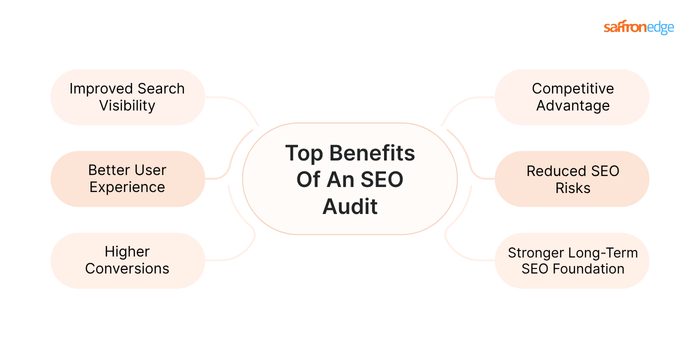
- It identifies issues and fixes them, which eventually enhances visibility in search results, impacting ranking, e.g., missing meta tags, broken links and duplicate pages.
- It contributes to the enhancement of user experience through the audits conducted, as they help identify issues such as slow pages and broken links, which impact user engagement.
- It optimises content and site structure, often leading to improved engagement, longer sessions and more conversions, increasing conversion rates.
- It offers a competitive advantage by establishing a site’s mark against your competitors, detecting keyword/backlink gaps, and implementing improvements before they do.
- It eliminates risk by detecting technical debt, harmful backlinks or content duplication and you decrease the chance of algorithmic penalties.
- It designs a long-term SEO foundation rather than one-off fixes. An audit allows you to plan strategically and measure enhancement over time.
What Tools Are Needed For an SEO Audit?
You need a set of tools encompassing technical, on-page, off-page and performance dimensions to perform a successful SEO audit:
- There are tools like Screaming Frog, SEO Spider or Sitebulb that enable you to crawl all pages, identify broken links, check redirects, detect duplicate titles and map site architecture.
- There are all-in-one SEO suites that help across multiple dimensions, such as SEMrush or Ahrefs for keyword research, backlink analysis, site audits and competitor benchmarking.
- Performance tools, such as Google PageSpeed Insights and Lighthouse, measure core web vitals, mobile load speed, layout shifts and UX.
- There are analytics and indexation tools, such as Google Search Console and Bing Webmaster Tools, to examine coverage, indexing errors, search queries, click-through rates and user behaviour metrics.
- There are tools like Ahrefs/SEMrush which include specialised features for backlink profile audits, anchor text distribution, domain authority comparisons and keyword gaps.
- Google Sheets and Data Studio are certain reporting and visualisation tools with an internal dashboard to exhibit findings in an actionable way.
Common SEO Audit Red Flags
If you see these issues, act fast:
- Traffic declining YOY
- Deep impressions, low clicks
- Ranking for wrong queries
- Slow mobile performance
- High bounce rate (>60%)
- Low dwell time (<20 seconds)
- Duplicate metadata
- Orphan pages
- Missing schema
- Pages not included in sitemap
- Content outdated by >18 months
- No internal linking strategy
- No AI search visibility structure
Conclusion
An SEO audit is not a report. It’s not a checklist.
It’s not a PDF you keep on Google Drive.
It is a business-changing opportunity to find revenue leaks, ranking gaps, AI visibility issues, technical weaknesses, UX barriers, demand opportunities, and content expansion paths.
When you know the exact strengths and weaknesses of your website, making informed decisions is easy through strategic optimisation and progress measurement over time.
If done correctly, an SEO audit can grow your traffic, improve your conversions, and transform your website into a revenue engine.
Confused where to start your SEO audit?
Drowning in tools but no clear path to better rankings? Follow our simple guide with checklists to audit like pros and turn insights into traffic wins.
Share


Get The SaaS Marketing Toolkit
FAQs
What is an SEO audit, and why is it important?

An SEO audit is a comprehensive evaluation of your website’s technical, on-page and off-page SEO performance to uncover issues that prevent ranking and identify optimisation opportunities.
How to do an SEO audit for my website?
To do an SEO audit, follow a structured process: define scope, crawl/indexation check, technical site performance, on-page/content review, keyword alignment, backlink audit, content gap/competitor analysis, UX engagement review, local/schema extras, then report findings and prioritise actions. Use the 10-step checklist above to guide you.
What tools are needed for an SEO audit?
The tools you’ll need for an SEO audit include crawling tools (Screaming Frog, Sitebulb), performance tools (PageSpeed Insights, Lighthouse), SEO suites (SEMrush, Ahrefs), search console tools (Google Search Console, Bing Webmaster Tools), backlink analysis tools, and reporting tools (Sheets, Data Studio). These will help you cover technical, on-page, off-page, and competitor dimensions.
What are the benefits of an SEO audit for a business?
The benefits of an SEO audit for a business include improved search visibility, better user experience, higher conversion rate, competitive advantage, risk mitigation, and a solid foundation for ongoing SEO. By detecting and fixing problems early, you improve your site’s health and deliver greater ROI from your SEO investment.
How often should I perform an SEO audit?
You should perform an SEO audit at least once a year for a well-maintained site, but more frequently (e.g., quarterly) if you operate in a competitive niche, have frequent website changes, or have experienced a drop in organic rankings. Regular audits help maintain the health of your SEO, adapt to algorithm updates, and capitalise on new opportunities before competitors do.
Nishant Ahlawat

Nishant Ahlawat is a marketing professional specializing in SaaS, SEO, and content strategy. He has experience working with B2B companies to improve online visibility, develop content frameworks, and implement data-driven SEO practices. His work focuses on helping businesses grow their organic presence through search optimization, strategic planning, and performance tracking. Outside of work, Nishant enjoys traveling to offbeat destinations, trekking in the mountains, and exploring local cultures and landscapes.
Related Blogs
We explore and publish the latest & most underrated content before it becomes a trend.

6 min read
What is Account-Based Sales? The Right Way to Account-Based Selling
By Shreya Debnath
5 min read
How HubSpot Workflow Automation Can Improve Customer Engagement
By Sabah Noor


Subscribe to Saffron Edge Newsletter!


Get The SaaS Marketing Toolkit