


Website Content Audit Guide: How to Audit Effectively


Feb 19, 2026

Contents
 8 min
8 min
- What Is a Content Audit, and Why Does It Directly Impact Revenue?
- Why Do Most Content Strategies Fail Without Regular Audits?
- How Do You Know If Your Website Needs a Content Audit?
- How Does a Content Audit Improve Traffic, Leads, and ROI?
- How Do You Conduct a Content Audit Step by Step?
- How Can Saffron Edge Turn a Content Audit into Measurable Growth?
- What Tools and Frameworks Do You Need for a Modern Content Audit?
- Closing Thoughts
Most companies do not struggle with publishing content. They struggle with content performance. Every quarter, it is the same vicious cycle:
- New blogs go live.
- New landing pages launch.
- New campaigns roll out.
Yet the numbers barely move. This is where a content audit changes the conversation.
Among top-performing teams, one-third audit their content at least twice a year, according to SEMrush. The difference shows up in the results. Companies that run regular audits report around 30% growth in organic traffic. In some cases, updating older posts has produced traffic gains of up to 106%.
So, it is clear that most traffic, leads, and conversions come from content that already exists. This is why many brands are now investing in content marketing services that examine what already exists, identify gaps, and turn underperforming pages into lead-generating assets.
A content audit is now the fastest way to find that growth is to look at what you have already published.
What Is a Content Audit, and Why Does It Directly Impact Revenue?
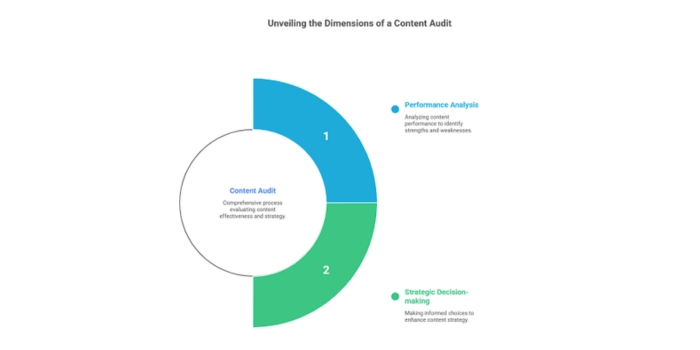
A content audit is a structured review of every major content asset on your website. It measures how each page performs, how it supports the buyer journey, and how it contributes to revenue. A proper audit answers a few direct questions:
- Which pages generate qualified pipelines?
- Which posts are losing rankings or traffic?
- Which topics are missing from the funnel?
- Where do conversions drop off?
Your best leads are already hiding in your content.
A focused content audit with Saffron Edge reveals the pages that attract the right visitors and shows how to turn them into qualified leads. Find the gaps, fix the friction, and build a stronger conversion path.
Why Do Most Content Strategies Fail Without Regular Audits?
Most content strategies fail because teams focus on publishing more, while performance issues in existing content remain untouched.
A regular content audit brings those hidden problems to the surface. Without it, companies keep investing in new posts while older and high-potential pages lose rankings, traffic, and conversions.
Industry data confirms this shift in thinking. About 90% of marketers say updating existing content delivers better results than creating new posts. The teams that win are the ones that maintain and refine what they already have.
This is why many brands pair ongoing reviews with dedicated content audit services to keep the entire library working toward pipeline growth.
#1 Content Decay is Real
Content rarely holds its peak performance forever. Over time:
- Rankings drop as competitors publish stronger pages.
- Search intent evolves.
- Statistics and references become outdated.
- Internal links break or become irrelevant.
Regular audits help detect decay early. Pages can be refreshed, consolidated, or repositioned before they lose their value.
#2 Funnel Gaps Kill Conversions
Many companies produce large volumes of awareness content while neglecting decision-stage assets. A typical distribution looks like this:
- 80% awareness-stage content
- 15% consideration-stage content
- 5% decision-stage content
This creates a clear problem. Traffic grows, but conversions stay flat because there is nothing guiding visitors toward a purchase or demo. Research shows that fixing funnel imbalances can increase qualified leads by 35%.
How Do You Know If Your Website Needs a Content Audit?
A content audit becomes necessary when performance stops matching effort. Here is a simple diagnostic checklist. You likely need a content audit if:
- Traffic has plateaued for several months.
- Older posts generate most of your visits.
- You publish regularly, but conversions stay low.
- Rankings fluctuate after algorithm updates.
- Multiple pages target the same keyword.
- Sales teams report poor lead quality.
How Does a Content Audit Improve Traffic, Leads, and ROI?
A well-executed content audit shows which pages deserve attention, which ones need updates, and which topics are missing from the funnel.
When companies use targeted content audit services, they usually see measurable gains in the following areas:
#1 Traffic Growth
Organic traffic often comes from a small portion of the content library. When that content loses freshness or rankings, the entire channel slows down. Regular audits help teams:
- Refresh outdated statistics and references.
- Strengthen internal linking.
- Improve search intent alignment.
- Consolidate competing pages.
#2 Lead Generation
The real value appears when content aligns with buyer intent. A content audit identifies:
- High-traffic pages with weak calls to action.
- Topics that attract unqualified visitors.
- Missing mid- or bottom-funnel assets.
#3 Conversion Optimization
Many high-traffic pages underperform because they lack clear conversion paths. A content audit reveals those missed opportunities. Common fixes include:
- Adding contextual CTAs.
- Improving page structure and readability.
- Aligning offers with user intent.
- Reducing friction in forms or navigation.
How Do You Conduct a Content Audit Step by Step?
A successful content audit follows a structured process. Each step connects content performance to business outcomes.
Step 1: Define a Revenue-Linked Goal
Start with a clear and measurable objective. The audit should connect directly to pipeline growth or customer acquisition.
Examples:
- Increase organic leads by 30%.
- Improve demo sign-ups from blog traffic.
- Reduce content decay across key pages.
Step 2: Build a Content Inventory
Create a list of all relevant content assets. This forms the foundation of the audit. Track the following for each page:
- URL
- Traffic
- Conversions
- Rankings
- Backlinks
- Funnel stage
Step 3: Score Each Page Using a Performance Model
A scoring model helps prioritize work.
Content Score = (Traffic x 0.4) + (Conversions x 0.3) + (Keyword value x 0.2)+ (Backlinks x 0.1)
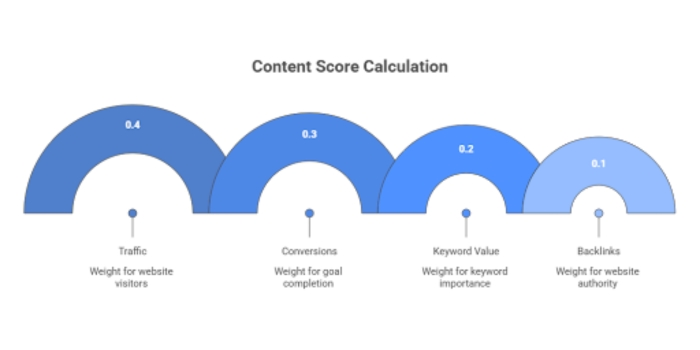
Outcome
- A high score means you will have to scale and promote.
- A medium score indicates improving and refreshing the existing content.
- A low score represents consolidating or removing the existing content.
Step 4: Map Content to Funnel Stages
Every piece of content should serve a specific stage of the buyer journey.
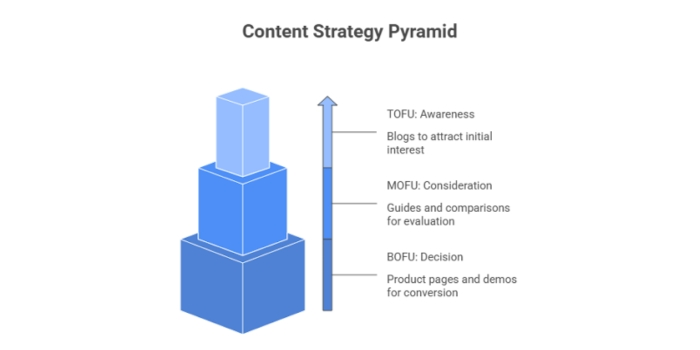
During the audit, look for:
- Overloaded awareness content
- Missing decision-stage assets
- Gaps in the consideration phase
Step 5: Prioritize Using an Impact vs Effort Matrix
After scoring and mapping, decide what to fix first.
- High impact and Low effort = Easy improvements
- High impact and High effort = Strategic rewrites
- Low impact and Low effort = Maintain
- Low impact and High effort = Remove or consolidate
How Can Saffron Edge Turn a Content Audit into Measurable Growth?
At Saffron Edge, a content audit is treated as a growth initiative tied directly to pipeline and revenue.
Our content marketing services focus on visibility, funnel progression, and measurable outcomes. The following case study shows how this approach works in practice.
Accounting Firm Growth Through a Conversion-Focused Content Audit
A Denver-based accounting firm had a strong offline reputation. Referrals kept the business steady, yet the website struggled to attract new visitors or generate consistent inbound leads.
Monthly organic traffic stayed below 600 visitors. Several technical and content issues limited the site’s performance:
- Broken links across key pages.
- Missing alt tags on images.
- Important pages not indexed.
- Weak keyword targeting and structure.
The firm needed a clear plan that combined technical fixes with content improvements. This is where Saffron Edge’s audit-led approach came in.
#1 Funnel Mapping: Identifying the Right Audience and Journey
The process started with a full-funnel review. Our team:
- Defined the ideal customer profile.
- Mapped typical buying triggers.
- Identified common questions across the decision process.
- Aligned existing content with funnel stages.
This step revealed major gaps. The site had general information about services but lacked structured paths that moved visitors toward contact or consultation. The site began to support real decision-making behavior by restructuring topics around buyer intent.
#2 Audience and Intent-Driven Content Creation
After mapping the funnel, the next step focused on search intent and topic relevance. The team:
- Conducted keyword gap and competitor analysis.
- Identified high-value, semantically related search terms.
- Reformatted existing content for clarity and readability.
- Published targeted, keyword-rich guest posts.
- Strengthened local citations.
This stage combined new material with improvements to existing pages. The goal was to attract qualified visitors who were already searching for accounting and financial consulting services.
#3 Aligning Content with Website Architecture
The audit revealed that the site’s technical and structural issues blocked visibility and engagement. The team:
- Fixed broken links across the site
- Corrected indexing problems
- Added missing alt tags
- Improved internal linking
- Cleaned up page structure
These changes made the site easier to navigate and easier for search engines to understand.
#4 Content Amplification Across Channels: Expanding Reach
With technical fixes in place and content aligned to intent, the next step focused on distribution. Saffron Edge:
- Placed content across relevant platforms
- Built high-quality backlinks
- Expanded local citations
- Increased referral traffic from niche sources
This multi-channel approach helped the content reach audiences already interested in accounting services.
The Results: Measurable Growth Across Key Metrics
Within the campaign period, the improvements produced strong gains:
- 97.17% increase in total users
- 100.78% increase in new users
- 80.98% increase in sessions
The site moved from limited visibility to consistent organic growth. Traffic increased, engagement improved, and the business gained a stronger digital presence.
What This Shows
This case highlights a simple principle. Growth rarely comes from publishing more content alone. It comes from improving what already exists, fixing structural issues, and aligning every page with buyer intent.
A structured content audit makes that possible. When paired with the right content marketing services, it turns an underperforming site into a steady source of qualified traffic and leads.
What Tools and Frameworks Do You Need for a Modern Content Audit?
A successful content audit depends on accurate data and a clear decision model. Tools provide the numbers. Strategic models help teams decide what to fix, what to expand, and what to remove.
Many companies invest in content marketing services or content audit services because they already have the tools, but lack a structured process. The real value comes from combining both.
You do not need a large tech stack to run an effective audit. A few reliable tools can provide most of the required data.
Core tools for a content audit
- Google Analytics: Tracks traffic, engagement, and conversion behavior.
- Google Search Console: Shows impressions, rankings, and click data for each page.
- SEO platforms such as Ahrefs or Semrush provide keyword rankings, backlink data, and competitive insights.
- Spreadsheet or dashboard: Centralizes all metrics in one place for analysis and prioritization.
Closing Thoughts
Many marketing teams treat content like a production line. They publish, move to the next topic, and repeat the cycle. The library grows each quarter, yet performance often stays flat.
Over time, content becomes uneven. Some pages attract traffic but never convert. Others once ranked well and now sit lower in search results. A few high-value topics may be missing altogether. Without a structured content audit, these issues remain hidden inside the site.
The real cost is a missed opportunity.
Experienced marketing teams treat content like an investment portfolio. They review performance, shift resources, and strengthen the assets with the highest potential. A regular content audit supports that discipline. It shows what to improve, what to expand, and what to retire.
When this approach is paired with focused, dedicated content audit services, the library begins to work as a coordinated system. Traffic becomes more stable, and conversion paths grow clearer.
Growth comes from relevance and alignment with buyer intent. A content audit creates that alignment and turns existing pages into a stronger base for traffic, leads, and revenue.
Unlock hidden traffic, leads, and revenue in your existing content.
Your highest-impact opportunities may already be published. A strategic content audit shows where growth is possible and how to turn underperforming pages into steady sources of leads.
Share


The ultimate marketing toolkit
FAQs
How long does a full content audit usually take?

For small websites, it may take 1 to 2 weeks. Large enterprise sites may require 4–8 weeks, depending on content volume and complexity.
Should you audit only blogs or all digital content?
A modern audit should include:
- Blogs
- Landing pages
- Email content
- PDFs
- Knowledge base articles
- Social assets
Can small businesses benefit from content audits?
Yes. In fact, smaller sites often see faster results because:
- Fewer pages to optimize.
- Quicker implementation.
- Higher impact per update.
What is content decay, and how do you detect it?
Content decay happens when pages lose rankings, traffic, or conversions over time. It’s detected by tracking:
- Declining impressions.
- Dropping rankings.
- Reduced engagement.
Nishant Ahlawat

Nishant Ahlawat is a marketing professional specializing in SaaS, SEO, and content strategy. He has experience working with B2B companies to improve online visibility, develop content frameworks, and implement data-driven SEO practices. His work focuses on helping businesses grow their organic presence through search optimization, strategic planning, and performance tracking. Outside of work, Nishant enjoys traveling to offbeat destinations, trekking in the mountains, and exploring local cultures and landscapes.
Related Blogs
We explore and publish the latest & most underrated content before it becomes a trend.





Subscribe to Saffron Edge Newsletter!


The ultimate marketing toolkit