


How to Identify Your Ideal Customer Profile (ICP)


Nov 02, 2026

Contents
 13 min
- What is an ideal customer profile (ICP)?
- Stage 1: Reverse engineer the customers you can already win
- Stage 2: Research the market and expand beyond the current pattern
- Stage 3: Separate the ICP from buyer personas and the buying group
- Stage 4: How to validate whether your ICP is correct
- Common ICP mistakes that weaken growth
- Build your ICP from evidence, then use research to expand it


How to Identify Your Ideal Customer Profile (ICP)
To identify your ideal customer profile, start with the customers you have already converted, retained and served profitably, find the traits and buying conditions they share, and then test whether that pattern holds across a larger market.
Your ICP should describe the accounts your business is demonstrably equipped to win and help, rather than a wish list of companies you would like to reach.
This evidence-first approach matters because B2B purchases rarely depend on one person. A Gartner survey of 632 B2B buyers found that 74% of buying teams experienced unhealthy conflict during the decision process. A useful ICP must therefore identify the right account, the buying situation and the group of people who can move a decision forward.
This guide shows you how to reverse engineer three to four years of customer and sales data, score segments on commercial quality, uncover the trigger behind the purchase, separate the account profile from buyer personas, and turn the result into a usable targeting system.
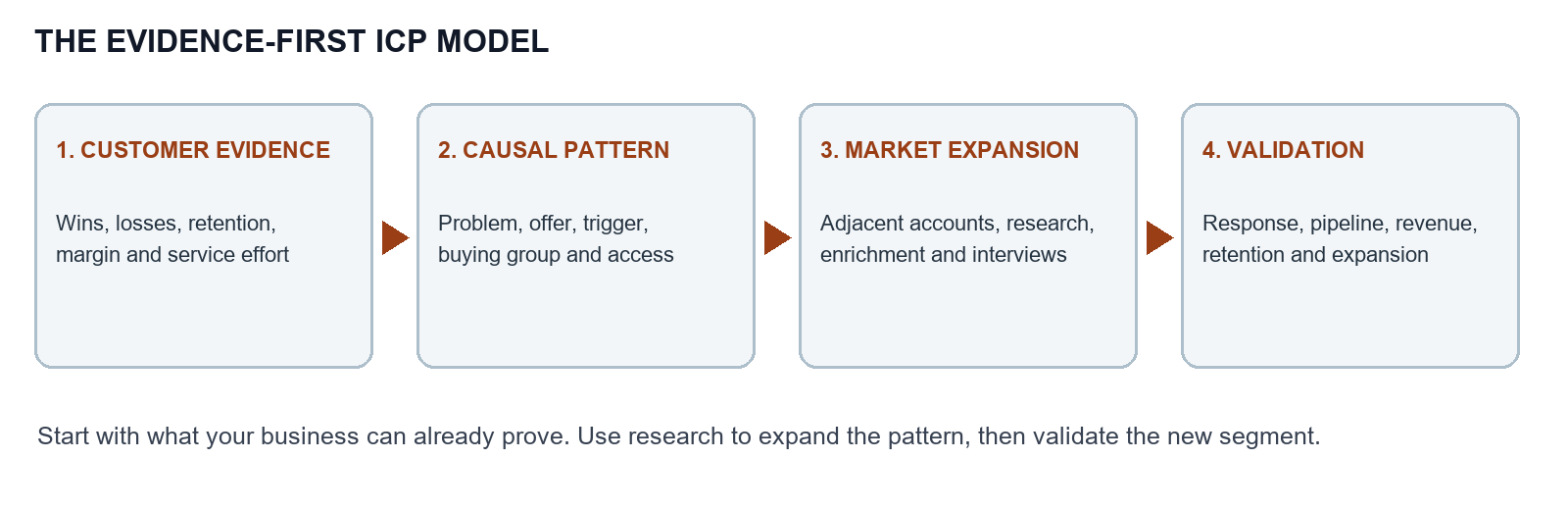
The evidence-first ICP model: learn from the customers you have won, then expand with market research.
What is an ideal customer profile (ICP)?
An ideal customer profile, or ICP, defines the type of company that is most likely to buy your offer, receive meaningful value from it, remain a healthy customer and produce an attractive return for your business.
For a B2B company, the ICP normally includes account-level attributes such as industry, revenue, employee count, geography, business model, maturity, technology, compliance requirements and buying conditions.
It should also include the problem the account is trying to solve, the event that makes the problem urgent and the conditions that disqualify an account.
Salesforce recommends beginning with current high-value customers and looking for patterns in customer lifetime value, long-term relationships, ease of closing, company size, industry, location and pain points. That is a sound starting point, but the analysis becomes more useful when you compare good customers with slow, low-value, high-effort and churned accounts.
Your ICP is discovered before it is designed
The most common mistake is to describe the market the company hopes to sell to. A team writes “US healthcare companies with 200 to 5,000 employees” because the market looks valuable. It then buys a list, creates messaging and discovers that its proof, offer, sales process or delivery model does not fit those accounts.
Your first ICP should be grounded in reachability and delivery reality. Ask where you have already earned trust, which problems you have solved repeatedly and which offers buyers understood quickly. Once you can explain why those accounts converted, you can expand toward adjacent segments without guessing.
Stage 1: Reverse engineer the customers you can already win
Begin with three to four years of data if you have it. A full business cycle reveals patterns that a single quarter may hide. If your company is younger, use every completed deal and mark conclusions that rest on a small sample.
1. Build one account-level dataset
Export closed-won, closed-lost, active, churned and expanded accounts. Join CRM opportunity data with billing, customer success and support records. One row should represent one account, even if several contacts and opportunities belong to it.
Capture these fields where available:
-
Account cha racteristics: industry, subindustry, revenue band, employee count, geography, business model, locations and technology stack.
-
Acquisition: original source, campaign, first meaningful interaction, outbound sequence, referral source and offer.
-
Sales: first response date, qualified meeting date, close date, sales-cycle length, contract value, discount and loss reason.
-
Delivery: onboarding time, support burden, gross margin, time to first value, adoption and implementation constraints.
-
Customer quality: retention, expansion, contraction, churn reason, payment behavior, referrals and customer health.
-
People: first responsive role, internal champion, budget owner, technical evaluator, blocker and final approver.
Do not analyze contacts as if they were separate companies. Ten contacts from one large account are one commercial outcome, not ten pieces of account evidence.
2. Define what “ideal” means for your business
The largest contract is not automatically the best customer. A large account can take 14 months to close, demand heavy customization, and leave after renewal. A smaller account may close in 45 days, adopt the full service, refer peers and expand twice.
|
Function |
Questions to address |
Useful measure |
|---|---|---|
|
Value |
How much attractive revenue does the account produce? |
ACV, first-year revenue, LTV, gross margin |
|
Velocity |
How quickly and reliably does it buy? |
Median sales-cycle days, stage conversion, win rate |
|
Retention |
Does it stay and continue receiving value? |
Renewal, churn, retained revenue, customer health |
|
Expansion |
Can the relationship grow after the first sale? |
Upsell, cross-sell, seat or location growth |
|
Effort |
What does the account require from sales and delivery? |
Discount, onboarding hours, support load, customization |
|
Advocacy |
Does the customer strengthen future acquisition? |
Referrals, reviews, references, case-study willingness |
Choose the dimensions that match your model. A SaaS company may prioritize retention and expansion. A project-based consulting firm may prioritize gross margin, collection reliability and repeat engagements. A medtech provider may need compliance fit and multi-stakeholder adoption to carry more weight.
3. Compare segments instead of studying winners in isolation
Group accounts by industry, size, offer, source, geography and first responsive role. For every group, compare the same outcome measures. Medians are often more useful than averages because one unusually large contract can distort the conclusion.
|
Segment |
Win rate |
Median deal |
Median sales cycle |
12-month retention |
Service effort |
|---|---|---|---|---|---|
|
Segment A |
[Insert] |
[Insert] |
[Insert] |
[Insert] |
[Insert] |
|
Segment B |
[Insert] |
[Insert] |
[Insert] |
[Insert] |
[Insert] |
|
Segment C |
[Insert] |
[Insert] |
[Insert] |
[Insert] |
[Insert] |
This table forces the tradeoff into view. An industry may generate many replies but low-value deals. Another may produce fewer responses but close faster at a higher ticket. Neither result can be judged from reply rate alone.
4. Find the intersection of fit, access and economics
A strong ICP sits where three conditions overlap:
-
Problem fit: the account has a problem your offer solves well.
-
Commercial fit: the contract value, margin, sales cycle, retention and expansion potential justify the effort.
-
Access fit: your team can identify and reach the right people with proof and messaging they recognize.
An account that has the problem but cannot buy is not ideal. An account that is easy to reach but expensive to serve is not ideal. An account with an attractive budget but no urgency is not ideal today.
5. Use an ICP score that reflects business quality
A scoring model makes the profile usable across marketing, sales and customer success. Keep the first version simple enough that a person can explain why an account received its score.
|
Criterion |
Suggested weight |
Evidence |
|---|---|---|
|
Problem and offer fit |
25 |
The company has a proven problem that a current offer solves |
|
Commercial value |
20 |
Expected deal size, margin and expansion meet the threshold |
|
Sales velocity |
15 |
Comparable accounts progress and close within an acceptable period |
|
Retention and delivery fit |
20 |
Comparable customers adopt, stay and can be served effectively |
|
Trigger and timing |
10 |
A visible event makes the problem active now |
|
Access to the buying group |
10 |
Relevant roles and channels can be identified and reached |
Score each criterion from zero to its maximum and record the evidence.
A high score should require more than matching an industry and employee band. It should indicate that the account resembles customers who bought, succeeded and remained valuable.
6. Add a negative ICP
A profile is useful because it excludes accounts. Create hard disqualifiers from repeated loss and churn patterns:
-
Budget below the minimum level required to produce the promised outcome
-
No internal owner for implementation
-
Technology, security or compliance requirements the offer cannot support
-
A business model with consistently poor retention or unit economics
-
A geography the sales or delivery team cannot serve
-
A use case that requires extensive customization outside the core offer
-
A pattern of late payment, procurement friction or misaligned expectations
Negative criteria protect sales capacity and customer outcomes. They also stop a broad total addressable market from becoming an excuse to pursue every account.
Stage 2: Research the market and expand beyond the current pattern
Historical data tells you where your current business succeeds. It can also preserve past positioning, channel bias, and limited market access. Market research is therefore the second stage, not a substitute for the first.
1. Test adjacent segments
Look for markets that share the causal traits of your best customers. If the strongest predictor is not industry but “operates 20 or more locations with decentralized lead handling,” test that condition across adjacent verticals. If the predictor is “uses HubSpot and recently hired a RevOps leader,” search for the same operating condition beyond the original segment.
Use industry reports, customer interviews, competitor customers, job postings, technology data, funding announcements, and regulatory developments to estimate:
-
How many accounts meet the criteria
-
Whether the problem is common and expensive enough to act on
-
Which alternatives buyers already use
-
What proof, integrations, or credentials are required
-
How buying authority and procurement differ from your current segment
2. Identify the event that changes priority
Firmographics describe who might fit. Triggers explain when the account may care. Common triggers include a funding round, leadership change, rapid hiring, a new location, a product launch, a failed audit, a platform migration, a regulatory deadline, an acquisition, or a visible decline in performance.
Apollo’s ICP guidance recommends consulting customer support about recurring questions and customer success about the accounts that are easiest to expand. Those conversations help connect surface traits with the conditions that create value after purchase.
3. Interview customers to understand causation
Analytics show correlation. Interviews explain why the account moved. Speak with current champions, decision-makers, churned customers, and lost prospects. Ask:
-
What changed before you began looking for a solution?
-
What did the problem cost in time, revenue, risk or missed opportunity?
-
Which alternatives did you consider?
-
Who had to agree, and what did each person need to believe?
-
What almost stopped the purchase?
-
What made the selected offer feel credible?
-
What produced value after implementation?
Compare the interview language with your messaging. The words buyers use to describe the trigger and desired outcome are usually more useful than internal product terminology.
Stage 3: Separate the ICP from buyer personas and the buying group
The ICP identifies the account. Buyer personas identify the people involved. A midmarket healthcare network may fit the ICP, while the CMO, practice operations lead, finance leader, and compliance reviewer each assess the purchase differently.
|
Layer |
Question |
Example |
|---|---|---|
|
ICP |
Which company should we pursue? |
US multi-location specialty healthcare groups with centralized marketing and measurable patient-acquisition goals |
|
Trigger |
Why might it act now? |
Opening three locations while cost per booked consultation is rising |
|
Champion |
Who experiences the problem and drives evaluation? |
VP Marketing or Head of Growth |
|
Economic buyer |
Who approves the commercial commitment? |
CEO, CFO or division president |
|
Evaluator |
Who tests operational, technical, or compliance fit? |
Operations, IT, analytics or compliance |
|
User |
Who must adopt the solution? |
Marketing managers, location teams or sales staff |
Do not reduce the buying group to job titles. Record what each role wants, fears, controls and needs to see. This produces stronger content and outreach than inserting a first name into a generic message.
1. Turn the ICP into a system your team can use
An ICP document has little value unless it changes account selection, messaging, qualification and investment. Translate the model into the systems where work happens.
Write the account definition in operational language
A usable ICP statement includes:
-
The account type and operating environment
-
The costly problem and desired business outcome
-
The offer with proven fit
-
The trigger that creates urgency
-
The buying group and likely champion
-
The economic thresholds that make the account attractive
-
The evidence that supports each criterion
-
The disqualifiers that move the account out of scope
Example: We are best equipped to help US multi-location service companies with a centralized marketing owner, a high-value booked appointment or qualified-lead goal, and enough location-level data to connect acquisition with revenue.
The strongest opportunities appear when the company is opening locations, changing leadership or facing rising acquisition costs. Accounts without a CRM owner, reliable conversion data or the capacity to handle new demand require a readiness project before growth campaigns.
2. Add the criteria to your CRM
Create structured fields for the attributes that materially affect fit. Avoid storing the entire ICP in notes. Useful fields include ICP tier, fit score, trigger, negative-fit reason, primary offer, champion role, account maturity and next review date.
Platforms such as Apollo, ZoomInfo, Clay and BuiltWith can add firmographic, contact, trigger or technology data. Enrichment improves coverage, but it should populate criteria you have already justified. More data does not repair a weak definition.
3. Use tiers to match effort with opportunity
-
Tier 1: strong fit, active trigger and meaningful commercial value. Use account research, coordinated outreach and tailored assets.
-
Tier 2: strong structural fit with weaker timing evidence. Use segment-specific campaigns and nurture until a trigger appears.
-
Tier 3: partial fit or lower expected value. Use scalable education and automated qualification.
-
Disqualified: hard exclusion or repeated evidence of poor outcomes. Suppress from sales-led acquisition.
This is where an evidence-based profile supports account-based marketing. The score determines which accounts deserve one-to-one research, which can be approached as a segment and which should remain in a broader nurture system.
Stage 4: How to validate whether your ICP is correct
Treat the ICP as a hypothesis with commercial consequences. Run a controlled test before rebuilding the entire go-to-market motion.
Create a small validation cohort
Select 50 to 100 accounts per segment where possible. Keep the offer and channel reasonably consistent so the account criteria, rather than a completely different campaign, explain the result. For small markets, use a smaller named-account pilot and document the limits of the sample.
Measure the entire customer path
|
Stage |
Metric |
What it diagnoses |
|---|---|---|
|
Access |
Valid contacts and reachable buying roles |
Whether the account can be researched and contacted |
|
Interest |
Positive response and qualified meeting rate |
Whether the problem and offer feel relevant |
|
Pipeline |
Opportunity rate and pipeline value |
Whether interest becomes a real commercial evaluation |
|
Conversion |
Win rate, deal value and sales-cycle length |
Whether the segment can buy under acceptable economics |
|
Customer value |
Adoption, retention, margin and expansion |
Whether the account remains ideal after the sale |
A high response rate with weak opportunity creation usually means the message is interesting but the offer or qualification is wrong. A strong win rate with poor retention means the sales definition is broader than the delivery fit. A long sales cycle can be acceptable for a high-value segment, but only when the resulting margin and retention justify it.
Review the ICP every quarter
Review new wins, losses, churn and expansion each quarter. Change a criterion only when repeated evidence supports the change. Keep versions so the team can see what changed and whether the revised profile improved results.
Use a fuller annual review to examine new offers, new markets, pricing changes and shifts in buying behavior. An ICP that never changes eventually describes the company’s history rather than its opportunity.
Common ICP mistakes that weaken growth
Starting with the total addressable market
A market may be large without being accessible or profitable for your current business. Use market size to evaluate expansion after establishing the pattern you can serve.
Choosing only prestigious customers
Logo recognition can hide poor margins, long procurement and heavy delivery costs. Rank accounts by outcomes rather than status.
Using only closed-won data
Wins show what can convert. Losses and churn reveal where the apparent fit breaks. Analyze both sides.
Confusing a responsive persona with an ideal account
A role may reply frequently because it is accessible, yet lack authority, urgency or budget. Track response, opportunity and revenue by both role and account segment.
Making every criterion equally important
A missing integration may be a hard disqualifier, while employee count may be only a weak proxy. Weight criteria according to their demonstrated effect.
Automating before agreeing on the definition
Automation can enrich and score thousands of accounts quickly. It can also scale a mistaken profile. Establish the logic, test it manually and then automate.
Build your ICP from evidence, then use research to expand it
The right way to identify your ideal customer profile is to reverse engineer customers your company has already won and served successfully, compare them with losses and poor-fit customers, and isolate the conditions that explain the difference.
Market research then helps you find more accounts that share those conditions.
Your final profile should tell the team who to pursue, why those accounts are valuable, when they are likely to buy, which people must be involved, what offer fits and when to walk away. When those rules live in the CRM, targeting, messaging and measurement, the ICP becomes part of the revenue system.
If your customer data is fragmented or your teams disagree about the best-fit account, Saffron Edge can help connect the analysis to a practical go-to-market strategy, account scoring and campaign execution.



Your SEO, on autopilot
Saffron OS runs 15+ AI agents that audit your visibility across Google, ChatGPT, Gemini and Perplexity every day — then fix what's broken, automatically. Built over 18 months. Results in 2–15 minutes.
Explore Saffron OSFAQs
How many customers do I need to build an ICP?

Use as much completed customer evidence as you have. Twenty to 50 won accounts can reveal useful patterns, but smaller datasets can still produce a provisional ICP if you label assumptions and validate them through interviews and targeted tests.
How far back should I analyze customer data?
Three to four years is useful when your offer and market have remained comparable. If the product, pricing or business model changed substantially, prioritize the period that reflects the current offer and keep older data as a separate cohort.
Should an early-stage company create an ICP without customers?
Yes, but treat it as a hypothesis. Start with the problem, the operating conditions required to receive value and the buyer’s trigger. Use founder-led interviews, pilots and early sales activity to replace assumptions with evidence.
Can a company have more than one ICP?
Yes, when distinct segments buy different offers, involve different buying groups or produce meaningfully different economics. Keep each profile separate enough that sales and marketing know which offer, proof and process applies.
What is the difference between an ICP and a target account list?
The ICP is the rule set that defines a good account. The target account list contains specific companies that meet those rules. The list changes more frequently because timing signals and account conditions change.

Shreya Debnath

Shreya Debnath is a Marketing Manager at Saffron Edge with over 5 years of experience in SEO, AI-driven marketing, growth marketing, and technical SEO. She has hands-on expertise in optimizing existing content, improving performance, and driving scalable growth through data-backed strategies. She has worked with international markets, especially the US and UK, and diverse teams to build effective marketing campaigns, strengthen brand positioning, and enhance audience engagement across multiple channels. Her approach focuses on aligning sales and marketing to ensure consistent and measurable results. Outside of work, Shreya enjoys exploring new cities, pursuing creative hobbies, and discovering unique stories through travel and local experiences.
Related Blogs
We explore and publish the latest & most underrated content before it becomes a trend.




Subscribe to Saffron Edge Newsletter!


Your SEO, on autopilot
Saffron OS runs 15+ AI agents that audit your visibility across Google, ChatGPT, Gemini and Perplexity every day — then fix what's broken, automatically. Built over 18 months. Results in 2–15 minutes.
Explore Saffron OS