





How to Get Your Business Cited by Claude AI


Sep 10, 2026

Contents
 14 min
- 3 Things Every Single AI is Looking For?
- How to Optimize Your Website for Claude
- How Claude Interprets Content
- Does Optimizing for Claude Replace Traditional SEO?
- How Claude Differs From Other LLMs
- Technical Prerequisite: Make Your Content Accessible to Claude
- 8 Strategies to Rank on Claude
- Common Mistakes B2B Brands Make When Optimizing for Claude
- Conclusion


Ranking well on Google does not guarantee that Claude will cite your website. When Claude uses web search, it can retrieve current information and link to supporting sources.
I noticed that many of our blogs weren’t being cited or referenced in AI-generated answers, even though they ranked well on Google. Competitors were appearing instead, fully summarized and recommended to buyers, while our content was invisible.
As AI-powered search reshapes B2B discovery, Claude has emerged as a critical frontier for brand visibility. Buyers no longer rely solely on Google rankings; they increasingly use AI models like Claude, Perplexity, ChatGPT, Gemini, and Microsoft Copilot to compare vendors, evaluate services, and build shortlists before contacting sales teams.
For companies absent from these AI-generated answers, the risk is significant: missed early-stage leads, lost ABM opportunities, and reduced brand awareness, even if traditional SEO metrics appear strong.
In this guide, we will explore how Claude interprets content and, with a better understanding of that, how you can rank and get cited on Claude.
3 Things Every Single AI is Looking For?
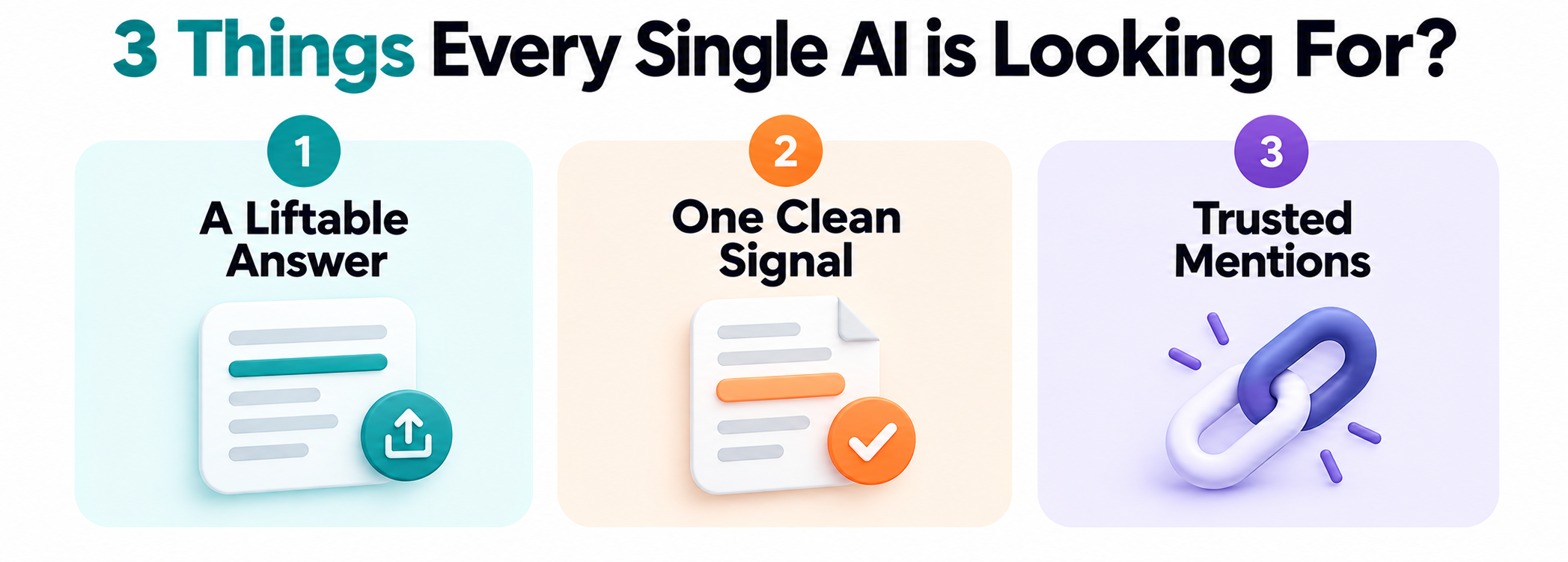
An AI assistant or a large language model is always looking for these three things when answering a query with citations:
-
A liftable answer: Providing a concise, highly structured, definition-style statement that the AI can easily cite for its final response.
-
One Clean Signal: Maintain a single, definitive truth across your page by removing any conflicting data and contradictory formatting.
-
Trusted Mentions: Build authority by securing citations, reviews, and links from reputable external industry platforms that AI models use to validate your brand's credibility.
How to Optimize Your Website for Claude
To properly optimize your website for Anthropic’s Claude, you have to look directly at how Claude interacts with the live web in 2026. Claude does not use Google for its live web retrieval backend; instead, it relies heavily on Brave Search
Brave Search is an independent, privacy-focused search engine with an independent web index and more than 2.4 billion queries per month.
Anthropic lists Brave as a web-search subprocessor, making it an important discovery channel for brands seeking visibility in Claude’s live, cited answers. While Google maintains a humongous database of hundreds of billions of pages, Brave operates on a significantly smaller index of around 40 billion webpages.
Because of this constrained scale, Claude cannot rely on sheer indexing brute force to pull information. Instead, it actively prioritizes and finds high-quality pages that Claude already trusts, ensuring its AI-generated answers remain accurate and data-secure.
Furthermore, Claude is heavily optimized for the enterprise market—holding roughly 29% of the enterprise assistant market share (LLM Vlab)—meaning it prioritizes objective, highly verifiable information over standard marketing fluff.
How Claude Interprets Content
Claude evaluates content based on accessibility, trust, structure, and authority. The factors below are crucial for ranking:
Whatever you feed Claude—text, code, a PDF, an image—first gets broken into tokens (roughly word-pieces, not full words). Each token is converted into a vector that includes its position in the sequence.
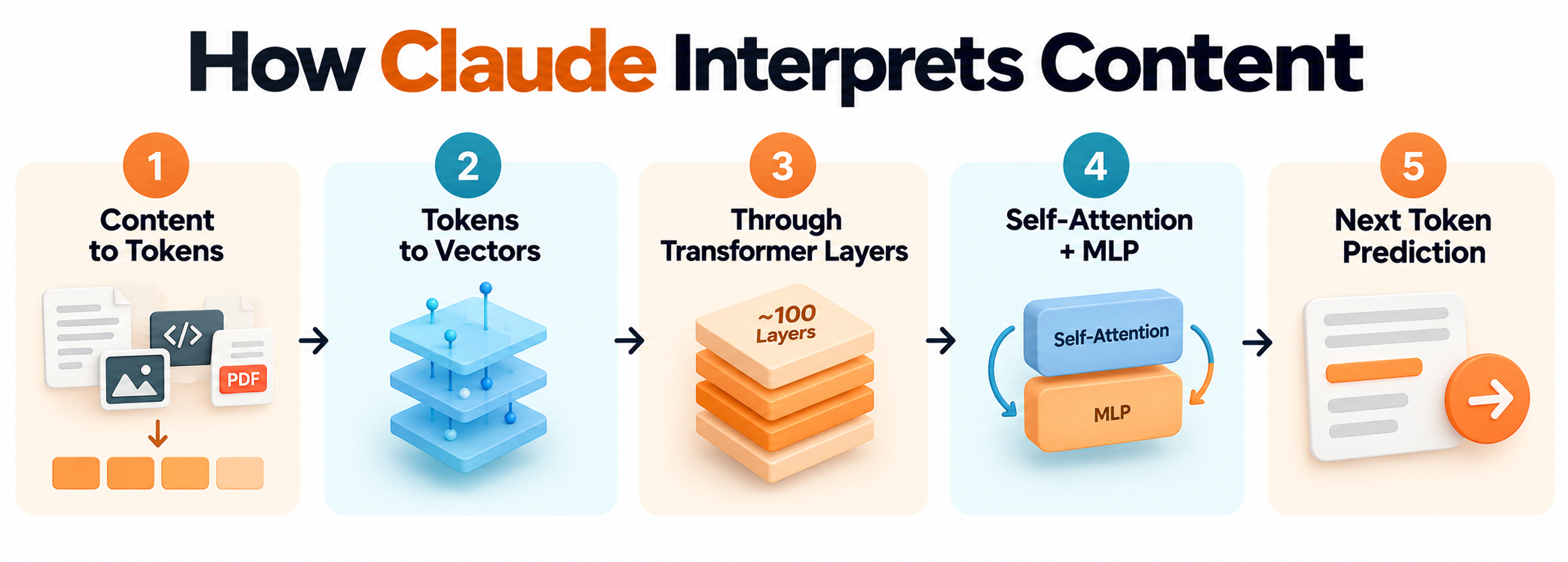
These vectors pass through approximately 100 transformer layers.
-
Self-attention: Each token evaluates other tokens to determine how much context to borrow.
-
Feedforward MLP block: This recombines the information gathered through attention for each token.
Each layer performs two main functions:
-
The results are added to a "residual stream" that maintains information throughout the process.
-
The final vector is transformed into a probability distribution for the next token, which is then sampled and added to the context for the next iteration.
-
Claude does not maintain a persistent state between calls; each interpretation is reconstructed from the token sequence, necessitating that all relevant information resides within the context window.
It's not really what makes Claude's behavior particularly compelling, though—and it's not what Anthropic has actually spent the last couple of years digging into.
What Anthropic's interpretability research adds:
Anthropic’s research offers a glimpse into how Claude processes information and plans ahead. This video explains the findings.
Individual neurons turned out to be polysemantic: one neuron fires for a mix of unrelated concepts because the model is packing more concepts into its space than it has dimensions for (a phenomenon Anthropic calls superposition).
Their fix was sparse autoencoders, which decompose those messy activations into sparser, more monosemantic ""features"—internal variables that correspond much more cleanly to actual concepts (a specific entity, negation, a syntactic pattern, and so on).
The bigger leap came in 2025 with circuit tracing and attribution graphs.
Attribution graphs let researchers partially trace the chain of intermediate steps a model uses to turn a specific input into a specific output, essentially stitching individual features into full computational circuits that extend the earlier feature work into graphs of how information actually flows through the network.
Anthropic applied this to Claude 3.5 Haiku in "On the Biology of a Large Language Model," and some of what came out directly answers "how does it interpret content?"
-
It plans ahead, not just token-by-token. When writing a poem, the model doesn't just generate the next word—it looks ahead for a rhyming or fitting end word first, holds several candidates in mind, and works backward to construct the line that lands on it.
-
It builds intermediate representations for multi-step reasoning. Answering a multi-hop question like "what's the capital of the state containing Dallas?" involves the model internally forming an intermediate concept—Texas—before arriving at Austin, rather than pattern-matching straight to the answer.
-
Operates in a language-agnostic conceptual space. Multilingual input activates a lot of shared, abstract circuitry rather than fully separate per-language pathways—closer to a universal internal "language of thought" than to translation-then-processing.
-
Its default is to abstain, not answer. Claude's baseline tendency is to decline uncertain answers; hallucinations often trace back to a misfire in the "do I actually know this entity" check that would normally suppress a response.
-
Chain-of-thought isn't always faithful. The same circuit-tracing work can catch cases where the model's stated reasoning doesn't match the reasoning its internals actually ran on—i.e., post-hoc rationalization, visible at the mechanism level rather than just inferred from the output.
-
Safety and fluency can conflict under pressure. Under adversarial prompting, mechanisms that keep output grammatically/contextually coherent can override safety-relevant circuits, which is part of how certain jailbreaks work mechanically.
This method doesn't explain how attention patterns themselves get computed, often missing the most interesting part of the computation as a result, and attribution graphs capture only a fraction of a model's total computation Anthropic calls the rest "dark matter."
Fully understanding even one behavior currently takes an interpretability researcher one to two hours of manual work, plus more for validation, so the process is closer to exploratory neuroscience on an alien brain than a finished map.
Nobody, Anthropic included, can currently give you a complete causal account of why Claude produced any specific sentence. What they have is a growing set of confirmed mechanisms—not the whole picture.
Does Optimizing for Claude Replace Traditional SEO?
No. Traditional SEO remains the foundation. Technical SEO, internal linking, schema, and content structure are essential prerequisites.
Claude SEO is an additional layer that enhances traditional SEO by getting more visibility to your website from its user base.
Traditional SEO Vs. Claude Optimization
|
Factor |
Traditional SEO |
Claude Optimization |
|
Goal |
Rank pages in search |
Appear as AI-cited sources |
|
Signals |
Keywords, backlinks, traffic |
Entity clarity, trust, citations, extractable answers |
|
Focus |
Rankings and clicks |
AI retrieval, brand understanding, answer trust |
|
Measurement |
SERP positions, CTR |
Mentions in AI answers, citations, prompt visibility |
For B2B brands, this combination ensures that content drives traffic, gains AI visibility, and contributes to the sales pipeline.
How Claude Differs From Other LLMs
Claude is Anthropic’s family of general-purpose AI models and assistants; it is specifically optimized to serve as a retrieval and answer engine for business content, technical SEO insights, and B2B decision-making queries.
Here’s a quick overview:
|
Feature / Model |
Claude |
ChatGPT (Search) |
Perplexity |
Grok |
|
Primary Live Index |
Brave Search backend |
Bing index / OpenAI web crawler |
Continuous custom web crawlers |
X (Twitter) firehose + web search |
|
Core Citation Style |
Precise inline hyperlink brackets directly match the text |
Numbered footnotes; often blends live text with baseline knowledge |
Top-level visual source chips + immediate footnotes |
Links directly to X posts, trends, and live articles |
|
What it Prioritizes |
Highly formal documentation, technical specs, and verified entities |
Wikipedia, mainstream media outlets, and massive brand authority |
Freshness, forums (Reddit), and real-time blog content |
Real-time virality, public discourse, and breaking news |
|
Algorithm Bias |
Rejects marketing fluff, hyperbole, and biased claims |
Favors highly established informational hubs |
Favors speed, recency, and community consensus |
Favors high engagement and immediate social buzz |
|
How to Optimize for It |
Entity Engineering: Define clear terms and structures using clean HTML tables/lists. |
Digital PR: Secure high-authority mentions and optimize cleanly for Bing. |
Recency & Community: Drive active discussions on forums and publish timely content. |
X Engagement: Create highly shareable, authoritative real-time content on X. |
While models like GPT-4 and Claude's competitors can generate or summarize text, Claude's architecture prioritizes accuracy, trust, and source-aware recommendations, making it ideal for AI SEO and GEO-driven content strategies.
1. Source Awareness and Citation Priority
Unlike many LLMs, which generate text without linking to authoritative sources, Claude actively considers trust signals and citations when producing answers.
For B2B brands, this means that structured, cited, and verified content is more likely to be mentioned in AI Overviews, increasing visibility for AI-driven lead generation, ABM, and technical SEO efforts.
2. Extraction-Focused Comprehension
Claude is intended to efficiently parse, extract, and summarize content, distinguishing it from LLMs that primarily produce generative text.
This extraction capability enables it to identify precise answers from structured data, FAQs, technical documentation, and "money pages" on a website, which is critical for ranking in AI Overviews and driving AI-assisted decision-making.
3. Emphasis on Semantic Understanding
While many LLMs concentrate on keyword matching or contextual generation, Claude prioritizes semantic comprehension.
It can interpret entities, relationships, and hierarchical content structures, allowing it to comprehend complex B2B topics like technical SEO audits, website migrations, lead generation pipelines, and CRO workflows. This makes it a more reliable tool for determining the most authoritative sources to cite in AI-driven summaries.
4. Integration With Live Data
Claude can work with live search data tools such as Ahrefs, SEMrush, Screaming Frog, and other SEO platforms to cross-reference content with current indexing, technical SEO status, and competitor performance.
This dynamic integration enables Claude to generate answers that are more relevant to real-world scenarios than static text generation, providing B2B companies with actionable insights to improve AI visibility.
5. Alignment With AI SEO and GEO Principles
Claude's capabilities are closely aligned with AI SEO, GEO, and lead generation workflow. Unlike other general-purpose LLMs, Claude supports:
-
Identification of high-value content for AI citations
-
Structured content analysis for AI Overviews
-
Entity recognition for brand clarity
-
Prioritization of technical SEO signals like schema, redirects, and crawlability
This integration ensures that businesses that invest in Claude-optimized content generate AI-friendly content while also reinforcing their ABM, website migration, and technical SEO strategies.
6. Safety, Accuracy, and Business Context
Claude is optimized for accuracy and business context, which reduces the likelihood of hallucinations or irrelevant output when compared to other LLMs.
For B2B brands, this means the answers are more likely to align with buyer intent and AI-driven lead generation goals, which is critical for pipelines, CRO, and conversion-focused content strategies.
Technical Prerequisite: Make Your Content Accessible to Claude
Before optimizing individual pages, confirm that Anthropic’s search and user-directed crawlers can access the content you want Claude to retrieve. Review your robots.txt, CDN, firewall, and bot-protection settings for Claude-SearchBot and Claude-User.
You can block ClaudeBot from potential model-training use while permitting the other crawlers:
|
User-agent: ClaudeBot Disallow: / User-agent: Claude-SearchBot Allow: / User-agent: Claude-User Allow: / |
8 Strategies to Rank on Claude
Ranking on Claude requires a clear strategy that combines technical SEO, content planning, and AI-focused improvements. These methods help B2B businesses show up in AI-generated responses, get referenced often, and reach decision-makers before they visit your site.
1. Build Entity Authority
-
Clearly identify your company, products, services, audience, industry, and locations. Keep essential business information accurate across your website and verified external profiles.
-
Add applicable Organization schema and sameAs links to genuine company, social, and review profiles. Google says these details can help it identify and distinguish an organization.
-
Support important company and product claims with independent coverage, customer evidence, and authoritative sources.
-
Entity clarity can make your brand easier to identify, but Anthropic does not describe it as a direct Claude ranking factor..
2. Do Not Bury the Main Answer
-
“Lost in the middle” is a structural limitation in LLMs where Claude recalls information placed at the very beginning or end of a context window much more reliably than facts buried in the midsection.
-
The effect is documented research, not a theory. Named after a Stanford-led paper by Nelson F. Liu and colleagues, the lost-in-the-middle effect shows large language models perform worse when the answer sits in the middle of a long context rather than at the start or end.
-
Begin each important section with a direct answer to the question in its heading. Follow that answer with evidence, qualifications, examples, and implementation details.
-
The fix is structural, not stylistic: put the direct answer and the key fact in the first and last few sentences of a section, not buried three paragraphs in.
-
Use short, self-contained sections so key claims retain their context when extracted, since each section becomes its own retrievable unit instead of one small piece of a much longer document
3. Build Credibility Through Trusted Third-Party Sources
-
Support product claims, statistics, comparisons, and performance statements with reliable evidence. Prioritize original research, official documentation, government sources, standards organizations, and relevant independent publications.
-
A Wikipedia article needs three or more independent sources to survive notability review before it starts feeding citations. Treat this as infrastructure, not a nice-to-have.
-
Moving from sourcing to citation pickup on Wikipedia typically takes two to six months, so it needs to start well before the content it's meant to support goes live.
-
Do not claim that Claude automatically favors .edu, government, or Wikipedia pages.
4. LLM Query Fan-Out: Cover Related Questions Around Your Main Topic
-
Query fan-out is the retrieval technique that AI search systems use to break one complex prompt into several distinct sub-queries, run them in parallel, and merge the results into a single answer. conductor
-
One 2026 GEO analysis found this behavior triggers on a majority of complex AI search prompts, generating three to seven sub-queries for each original question.
-
The practical risk: a page can rank for the head-term query and still be invisible to the sub-queries that actually decide citation, because it never answers the adjacent questions.
-
The fix is coverage, not keyword density: build content clusters around a topic (definitions, comparisons, pricing, reviews) so one page or page group answers multiple fan-out branches instead of one.
5. Build Your Presence on Relevant Product & Review Platforms
-
A 2026 industry analysis found that every B2B SaaS tool in ChatGPT-named categories had a Capterra listing, and 99% had one on G2. Review-site presence functions as a gate, not a bonus signal.
-
Your brand should have complete profiles on the review sites, directories, and product platforms that customers actually use.
-
G2 acquired Capterra, Software Advice, and GetApp in February 2026, so one G2 profile now has influence across the acquired sites as well, not just G2 itself.
-
Ratings need to be earned, not incentivized. Purchased or incentivized reviews violate platform terms and get filtered before an AI model ever sees them.
6. Passage-Level Context
-
Write each important passage so it remains understandable when viewed separately from the full page. Name the relevant product, plan, version, region, audience, and limitations within the paragraph where the claim appears.
-
Avoid pronoun-only references. A paragraph should not depend on "it," "this plan," or "here" pointing back to something stated three paragraphs earlier.
-
Restate the qualifier where the claim lives. If a benefit only applies to the Enterprise plan or the US market, say so in that paragraph, not only in the intro.
-
Keep one claim per passage, with its full context attached, rather than splitting a single fact across two paragraphs.
7. Claim-Evidence Proximity
-
Place the source next to the claim it supports, not only in a footnote or a bibliography at the bottom of the page.
-
Name the source specifically. A dated, named citation carries more weight with an AI model than "studies show" or "research indicates."
-
An unsourced number reads as unverifiable, and unverifiable claims are the ones models are built to avoid repeating.
-
Keep the citation immediately beside the sentence it backs, so a passage extracted on its own still carries its own proof.
8. Build Topical Clusters
-
Create pillar pages with supporting content.
-
Connect internal pages to show topical depth and expertise.
-
Cover relevant subtopics to show AI that your brand owns the domain.
Common Mistakes B2B Brands Make When Optimizing for Claude
Many B2B brands struggle to rank in Claude because they focus on surface-level SEO tactics without addressing how AI interprets content, entity authority, or structured signals. Understanding these common pitfalls helps companies avoid lost visibility, missed citations, and reduced lead generation opportunities.
-
Publishing generic, unfocused content
-
Ignoring technical SEO or schema
-
Failing to provide proof, case studies, or structured examples
-
Neglecting external citations or community mentions
-
Treating AI visibility as separate from lead gen or ABM strategy
Avoiding these mistakes ensures that Claude and other AI tools recognize your brand as a credible source.
Conclusion
Ranking on Claude is not optional for modern marketing & lead gen strategies.
-
Audit AI citations for your brand across relevant prompts.
-
Optimize technical SEO, structured data, and internal linking.
-
Build answer-first content and topical clusters with proof and case studies.
-
Strengthen entity clarity and third-party mentions.
-
Track AI performance alongside SEO, ABM, lead gen, and CRO metrics.
The goal is simple: make your content discoverable, trusted, and citable by Claude. When done consistently, AI SEO improves lead generation, ABM outcomes, CRO performance, and pipeline influence.



Your SEO, on autopilot
Saffron OS runs 15+ AI agents that audit your visibility across Google, ChatGPT, Gemini and Perplexity every day — then fix what's broken, automatically. Built over 18 months. Results in 2–15 minutes.
Explore Saffron OSFrequently Asked Questions
How can I make a B2B service page extractable by Claude without stuffing keywords?

Use one clear H1, question-based H2s, and a direct answer in the first 40–60 words of each section. Keep paragraphs short and add bullets, tables, and FAQs so the page is straightforward to parse and quote. Semantic structure and answer-first formatting help AI systems extract the right passage faster.
Why is my page ranking on Google but still not getting cited in AI Overviews or Claude-style answers?
High rankings do not guarantee AI citation because AI systems also evaluate extractability, entity clarity, and source trust. Pages that are generic, buried in dense prose, or lack proof often lose to clearer competitor pages. In one Ahrefs-based analysis, many cited pages were not even in the top 10, showing that ranking alone is not the full story.
What schema types actually matter for B2B pages trying to appear in AI answers
Start with FAQ, HowTo, Product, Organization, and Article schema where they fit the page's intent. Schema does not magically earn citations, but it gives machines clearer signals about page purpose and key entities. Pair schema with visible on-page Q&A because AI systems often favor text they can read directly.
How do I structure a B2B FAQ page so AI models can pull real answers from it
Use a question as each subheading, then answer it in 2–4 tight sentences before adding detail. Avoid long intros, marketing fluff, and nested explanations that hide the answer. Reddit discussions and AI-search guides both point to concise Q&A blocks as more citation-friendly than long narrative sections.
What should a B2B site do after a website migration to avoid losing AI visibility?
Audit redirects, canonicals, broken links, and changed URL paths immediately after launch. Then rebuild topical clusters and revalidate schema so the new site preserves entity signals and page relationships. Migration errors can weaken crawlability and make AI systems less confident about which page to cite.

Shreya Debnath

Shreya Debnath is a Marketing Manager at Saffron Edge with over 5 years of experience in SEO, AI-driven marketing, growth marketing, and technical SEO. She has hands-on expertise in optimizing existing content, improving performance, and driving scalable growth through data-backed strategies. She has worked with international markets, especially the US and UK, and diverse teams to build effective marketing campaigns, strengthen brand positioning, and enhance audience engagement across multiple channels. Her approach focuses on aligning sales and marketing to ensure consistent and measurable results. Outside of work, Shreya enjoys exploring new cities, pursuing creative hobbies, and discovering unique stories through travel and local experiences.
Related Blogs
We explore and publish the latest & most underrated content before it becomes a trend.


8 min read
How to Automate Your Sales Process: 11 Proven Strategies
By Sabah Noor

Subscribe to Saffron Edge Newsletter!


Your SEO, on autopilot
Saffron OS runs 15+ AI agents that audit your visibility across Google, ChatGPT, Gemini and Perplexity every day — then fix what's broken, automatically. Built over 18 months. Results in 2–15 minutes.
Explore Saffron OS