


GTA 6 Marketing Strategy: What Businesses Can Learn From the Launch Hype


Nov 19, 2026

Contents
 19 min
- Key takeaways
- GTA 6 marketing timeline at a glance
- Lesson 1: Build anticipation before the launch
- Lesson 2: Make the story easy to understand and repeat
- Lesson 3: Earn attention rather than only buying it
- Lesson 4: Use partnerships to enter existing attention
- Lesson 5: Give interested people a simple next step
- Lesson 6: Coordinate every channel around one buyer journey
- Lesson 7: Measure business outcomes over buzz
- What businesses should not copy from GTA 6's marketing
- The Launch Hype System: a practical framework
- Conclusion: What CEOs, CMOs, and product leaders should take from GTA 6
- The seven lessons, one line each
- What this means for your role


TL;DR: The biggest lesson from GTA 6's marketing strategy is that you can build anticipation deliberately. Over almost three years, Rockstar released only a handful of big assets, kept the same story running through all of them, showed up where its fans had already spent time, and always gave people something to do next, first pre-order and then preload. B2B companies can apply the same approach at their scale.
Key takeaways
-
Build anticipation 60 to 90 days before launch, with a planned sequence of content.
-
Tell one simple story everywhere, including the places AI tools learn about you from.
-
Earn attention with assets buyers want, and use paid media to amplify them.
-
Partner with brands and communities that already have your buyers' trust.
-
Give every buyer stage one clear, low-friction next step.
-
Run every channel and team using a single launch map.
-
Measure pipeline and revenue, and treat views and MQLs as signals.
On November 19, 2026, Grand Theft Auto VI was finally released on PlayStation 5 and Xbox Series X|S. I say finally, because the first trailer came out in December 2023, and people have been waiting for this game for a very long time. The night before launch, the Miami Heat walked out against the Milwaukee Bucks as "Vice City," in uniforms they had never worn before, on a court built for that one game, live on ESPN.
For over a decade now, I have been helping businesses grow through consultation, strategy, and brand building, and the aim has always been the same: to help my customers scale and succeed. Today I do that as AVP Sales at Saffron Edge, where a lot of the work is about getting B2B companies found on Google and in AI tools like ChatGPT.
So, while most people were busy going through the trailers frame by frame, I kept looking at something else. How does a company get millions of people to wait this long, this patiently, and still pre-order a game they haven't played?
The easy answer is "go viral." But how many brands actually have a fan base like GTA's? Very few, if any. Copying the scale is not possible.
What can be copied is the way the campaign was put together. The anticipation was built over years. The story never changed from one trailer to the next. Partners brought in the audience, and fans always knew what to do next.
GTA 6 marketing timeline at a glance
Here is how Rockstar spread its big moments over almost three years and what each one would look like for a B2B company.
|
When |
What Rockstar did |
The B2B equivalent |
|---|---|---|
|
Dec 2023 |
Trailer 1: 93 million YouTube views in 24 hours |
Problem or category announcement |
|
May 2025 |
Trailer 2: 475 million cross-platform views in 24 hours, per Rockstar |
Proof: show the product working |
|
Jun 2026 |
Waitlist or early-access list |
|
|
Aug 2026 |
An Extended Look premieres on Netflix, six hours before YouTube |
Partner-hosted launch webinar |
|
Oct 2026 |
Launch-week announcement |
|
|
Nov 10, 2026 |
Onboarding before go-live |
|
|
Nov 18, 2026 |
Launch-eve customer event |
You don't need Rockstar's audience to do this. What you do need is a plan, and it has to start a lot earlier than most teams think.
Lesson 1: Build anticipation before the launch
Short answer: Rockstar Games built anticipation for GTA 6 by releasing a few major assets over nearly three years, with each release spaced out and contributing something new. For a business, that means the launch campaign starts months before the launch date.
The hype around GTA 6 did not begin on launch day. Trailer 1 arrived in December 2023, almost three years before the game came out.
Trailer 2 followed in May 2025, then An Extended Look in August 2026, and the launch trailer in October 2026. Pre-load opened on November 10, which gave people who had already committed something to do in the final week.
What I find more striking is that the game was delayed twice along the way, first out of 2025 and then from May 2026 to November. Delays usually kill momentum. Here, they didn't, and my reading is that each major release gave fans another reason to pay attention.
A lot of B2B launches work the other way round. The product is ready, a press release goes out, a few ads run for two weeks, and everyone moves on to the next quarter. If you want the launch to land, the runway has to come first:
-
Plan a 60- to 90-day pre-launch window. Fill it with education, proof, behind-the-scenes content, customer stories, and early access.
-
Release in sequence. Hold something back for each stage instead of publishing everything on day one.
-
Build your owned audience before you need it: your email list, LinkedIn following, community, and CRM segments.
-
Use the runway to test. Messaging, offers, and buyer objections are far cheaper to fix before launch spend than after it.
A good go-to-market strategy should define the audience, the value proposition, the channels, and what success looks like before a single piece of launch content gets scheduled.
|
Role |
The question to ask before your next launch |
|---|---|
|
CEO |
Are we building anticipation for our category, or waiting until launch day to explain why we matter? |
|
CMO |
Do we have a 60- to 90-day launch sequence, or one announcement and a few ads? |
|
Product manager |
Have we validated the problem, the buyer, and the positioning before investing in launching creative? |
What this looks like for a B2B company: a SaaS company launching an AI workflow product could run a 90-day runway, with a six-week content sequence leading up to launch. Week one is market problem research, week two a benchmark report, and week three a founder's perspective on LinkedIn. A customer teaser follows in week four, a webinar in week five, and the launch itself in week six.
Lesson 2: Make the story easy to understand and repeat
Short answer: GTA 6's story fits in one breath: two people in a fictional version of Florida, with the odds stacked against them. A business needs a story just as simple, one that says what problem it solves, for whom, why now, and what changes after, told the same way everywhere.
Ask anyone who's seen a trailer what GTA 6 is about, and you'll hear the same thing. Two people, Jason and Lucia. A sunny state called Leonida with Vice City at its heart. A job that goes wrong. Rockstar's own description puts it simply: "Jason and Lucia have always known the deck is stacked against them." Every trailer since has added detail to that world, and none of them has replaced it.
Now try the same test with your own company. Ask five people on your team what you do and see how many different answers come back. Heck, just compare your homepage with your sales deck.
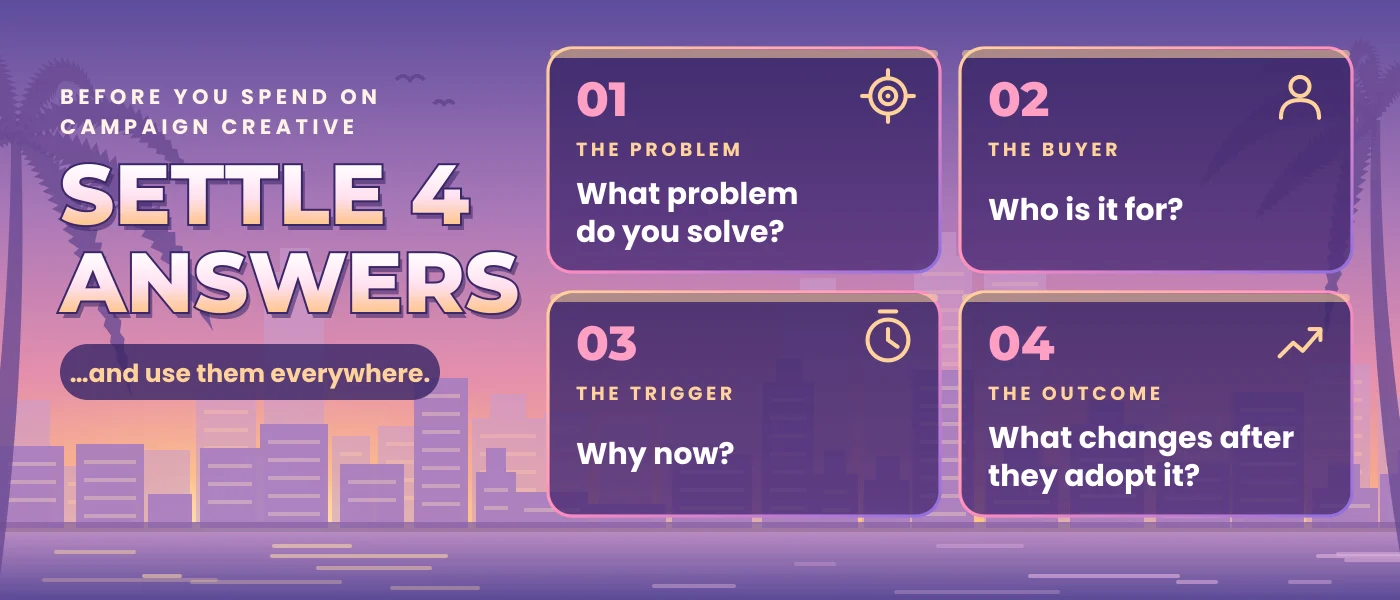
Before you spend on campaign creative, settle four answers and use them everywhere:
-
What problem do you solve?
-
Who is it for?
-
Why now?
-
What changes after they adopt it?
Here is the difference it makes. "AI-powered revenue intelligence" sounds impressive, but it tells the buyer nothing. Compare it with "We help B2B revenue teams find and prioritize accounts showing buying intent before competitors do. " Your reps, customers, and partners can repeat the second one.
There is a search side to this process as well. AI tools may draw on your website, listings, reviews, and third-party coverage when answering questions about your business. Inconsistent descriptions can make it harder to understand what you offer. So, keep the core message the same across ads, decks, landing pages, emails, and sales calls, and don't rewrite it every time a new channel or trend shows up.
Lesson 3: Earn attention rather than only buying it
Short answer: GTA 6 generated enormous attention as people chose to watch, share, and discuss its trailers. Public view counts alone do not show how much reach was paid or organic. For a B2B company, earned attention comes from things buyers actually want, such as original research, benchmarks, a clear perspective, and customer proof, put in front of buyers where they already spend their time.
When Trailer 1 dropped in December 2023, it pulled 93 million YouTube views in its first 24 hours. Trailer 2 went much further. Rockstar told The Hollywood Reporter it reached 475 million views across platforms in a single day, beating the 365 million that the Deadpool & Wolverine trailer had managed.
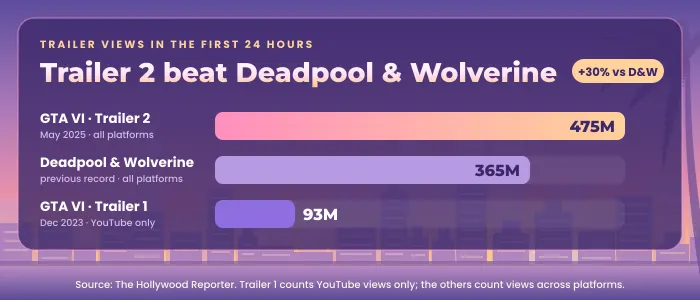
The cross-platform total and the YouTube-only figure measure different distribution scopes, so they are not a like-for-like comparison. Then came the GTA 6 Miami marketing push. Rockstar brought in-game restaurants, branded vehicles, and a promotional blimp into the real city. People photographed and shared those activations, extending the campaign beyond the physical locations.
Now, to be fair, GTA has had a loyal fan base for over two decades. Most B2B companies will never see numbers anywhere close to these figures, and honestly, they don't need to. The goal is to be the name that keeps coming up in your own market, among the few hundred or few thousand accounts that can actually buy from you.
What earns that kind of attention in B2B?
-
Original research or benchmark data that nobody else has
-
A clear point of view, even a slightly contrarian one
-
Customer proof with real numbers behind it
-
Practical templates and tools that people can use the same day
Then put those assets where your buyers already are. That could be a community, a trade publication, a creator they follow, a partner's newsletter, an event, or your team posting on LinkedIn. Paid media still has a job. It can amplify a strong idea, but it cannot make up for not having one.
Such creativity matters even more in AI search. Paid distribution and organic citations are different outcomes. Clear, factual content and consistent information about your business can support discoverability, but they do not guarantee a citation in an AI-generated answer. Our generative engine optimization approach focuses on improving those foundations.
That is the thinking behind our AI SEO services and generative engine optimization work. It covers visibility on Google, in AI Overviews, across AI assistants, and on social media, with rankings as only one part of the picture. For one U.S.-based ENT practice, our published case study describes combining local SEO, AI search work, and conversion improvements to support patient acquisition.
Lesson 4: Use partnerships to enter existing attention
Short answer: Rockstar took GTA 6 to places its audience already was, like a streaming platform, an NBA arena, and the streets of Miami, instead of waiting for people to come to it. B2B companies can do the same by partnering with the analysts, publications, complementary vendors, and communities their buyers already trust.
Think about where people were spending their time in 2026. A lot of them were on Netflix. So, Rockstar premiered An Extended Look there on August 27, six hours before it reached YouTube and Rockstar's own site.
Sports fans were watching the NBA. On November 18, the Miami Heat played as "Vice City" on ESPN, with a themed court, new uniforms, and a Vice City merchandise collection.
None of these partners had to be told who GTA's audience was. They already had it.
Now flip that over to B2B. Your buyers already trust someone. It might be an analyst firm, a trade publication, a complementary software vendor, an industry association, a Slack community, or a handful of respected practitioners on LinkedIn. In fact, your existing customers are likely the most trusted source of all.
A common mistake is treating partnerships as a logo swap. A partnership earns attention when both sides make something together: joint research, a co-hosted webinar, a benchmark report, an integration launch, a shared customer story, or an event.
And choose partners for audience overlap and credibility rather than follower count. A partner with 5,000 followers who all fit your ICP is worth more than one with 500,000 who don't.
What this scenario looks like for a B2B company: a cybersecurity company could partner with a cloud platform, an industry publication, and a respected CISO community. Together, they publish a threat report and host a practitioner roundtable. Each partner brings its audience, and the report gives all of them something worth sharing.
Lesson 5: Give interested people a simple next step
Short answer: GTA 6 never left people with just awareness. Later campaign assets directed interested buyers toward pre-ordering, followed by pre-loading once it became available. Businesses should match their call to action to the buyer's stage and make the next step as easy as possible.
Go to Rockstar's GTA 6 page, and the next step is hard to miss. There are pre-order buttons, a reminder that the preorder bonuses won't last, details of the Vintage Vice City Pack, and a pre-load section. There are two editions, Standard at $79.99 and Ultimate at $99.99. That's about it. No maze.
Then from November 10, digital buyers on PlayStation 5 and Xbox Series X|S could start pre-loading. Pre-loading doesn't let anyone play early, and the game still went live with the midnight launch rollout on November 19. But it gives a committed buyer something useful to do and makes their launch day smoother. The business gets its commitment, and the customer gets a real benefit out of it.
Now compare that with a typical B2B website. There are five CTAs on the homepage, a "Contact us" form with eleven fields, and a reply from sales three days later. Sigh.
Here is how to fix it:
-
Match the CTA to the buyer's stage. Someone who just found you is not ready for a pricing call.
-
Cut friction. Use fewer form fields and offer a clear value exchange. Make it mobile-friendly and follow up the same day.
-
Use one primary CTA and one secondary CTA. Five choices usually means no choice.
-
Keep the next step consistent everywhere, across social posts, ads, emails, landing pages, sales sequences, and the website.
|
Buyer stage |
What they need |
What to offer |
|---|---|---|
|
Problem-aware |
A clear explanation of the issue |
Benchmark, guide or research report |
|
Solution-aware |
Proof that a better approach exists |
Webinar, comparison page or demo video |
|
Product-aware |
Confidence in fit and credibility |
Case study, ROI calculator or product tour |
|
Decision-ready |
A reason to act now |
Demo, assessment, pricing conversation or pilot |
We saw this with JOP, an OKR and performance management SaaS company. Content brought in new visitors, but conversions picked up once Google retargeting started re-engaging people who had already shown interest. Within three months of starting the retargeting campaigns, JOP's conversion rate went up 30%.
Across B2B, the closest thing to a pre-load is letting buyers experience the value before they ever talk to sales. That could be a free assessment, an interactive product tour, a sandbox trial, or an ROI calculator. The buyer gets something useful straight away, and you get a much clearer signal of intent than another whitepaper download.
At Saffron Edge, we offer this as an add-on through Saffron OS, our own auditing tool. It helps B2B teams find visibility gaps across search results and AI-generated answers, checking more than 50 points per page.
Lesson 6: Coordinate every channel around one buyer journey
Short answer: GTA 6's trailers, streaming premiere, sports tie-in, merchandise, and pre-order offers all pointed at the same world and the same release date. For a business, that means mapping every channel, asset, and team to one launch story and one sequence before anything goes live.
Look at all the pieces side by side. The campaign included Trailer 1, Trailer 2, an extended look, and a launch trailer, plus retail pre-orders, pre-loading, a Netflix premiere, a merchandise line, a city-wide takeover in Miami, and an NBA game the night before release. Different channels and different partners, and yet it all felt like one campaign.
The Heat game is the clearest example. Rockstar could have done it at any point in the season. It picked November 18, the eve of launch, so all that excitement had somewhere to go the very next morning.
In most B2B companies, the problem is rarely a lack of channels. Marketing runs the launch campaign, and sales gets the deck the night before. Customer success hears about it from a customer, and the partner team is not in the loop at all.
So, before launch, build a campaign map. Here is what two rows might look like:
|
Audience |
Message |
Channel |
Asset |
CTA |
Owner |
Timing |
Success metric |
|---|---|---|---|---|---|---|---|
|
ICP accounts, problem-aware |
The cost of the problem |
LinkedIn and email |
Benchmark report |
Download |
Demand gen |
T-45 days |
Downloads from ICP accounts |
|
Same accounts, now engaged |
Proof it can be solved |
Webinar and ABM ads |
Live demo session |
Register |
PMM and sales |
T-14 days |
ICP registrations, meetings booked |
Then get marketing, sales, customer success, product, and partners all working from the same launch story. Sequence the channels so awareness content goes out first, followed by consideration assets, then intent-stage offers and sales enablement. And take one core idea and adapt it to each channel, instead of pasting the same asset everywhere.
|
Timeline |
Focus |
|---|---|
|
T-minus 90 days |
Validate positioning, ICP, messaging, and launch goals |
|
T-minus 60 days |
Build content, sales enablement, partner, and distribution plans |
|
T-minus 30 days |
Activate pre-launch demand, early-access offers, and targeted ABM |
|
Launch week |
Coordinate announcements, events, sales outreach, paid amplification, and customer communication |
|
Post-launch |
Measure pipeline, adoption, feedback, and message performance, and iterate quickly |
If you need help connecting positioning, channel execution, and measurement, our go-to-market services bring all of this into one coordinated launch plan. And if your launch targets a defined list of accounts, these account-based marketing examples show how sales and marketing can work the same list together.
Lesson 7: Measure business outcomes over buzz
Short answer: Views and mentions only matter if they turn into action. For GTA 6, that action was pre-orders. For most businesses, it is qualified pipeline, revenue, retention, and expansion, so launch KPIs need to track the full journey from first touch to closed revenue.
It's tempting to call a launch a success once the views come in. No, a launch is a success when people act on it.
Take-Two, Rockstar's parent company, seems to think the same way. In its November 9 earnings update, the GTA 6 headline was pre-orders: Take-Two said pre-orders were tracking far in excess of its initial expectations. The cited statement does not disclose a pre-order count.
Even so, CEO Strauss Zelnick has pointed out that pre-orders can be cancelled, and the company has not shared a number.
I find that last part quite refreshing.
That distinction matters. A pre-order is a demand signal, not proof of final sales or recognized revenue. The same goes for an MQL, a demo request, or even a first sales meeting. They are signals. Pipeline and closed revenue are the outcomes.
Here is a KPI hierarchy that keeps both in view:
|
Level |
What to measure |
|---|---|
|
Attention |
Reach among your ICP, branded search, share of voice, and AI-engine visibility |
|
Engagement |
Content engagement, webinar attendance, repeat site visits, community participation |
|
Demand |
MQLs, SQLs, booked meetings, demo requests, pipeline created |
|
Revenue |
Opportunities, win rate, revenue influence, CAC, payback period |
|
Retention |
Activation, product adoption, expansion, renewal, advocacy |
Be careful with attribution, though. No single channel "causes" a B2B sale. A buying group might touch a LinkedIn post, a webinar, a review site, and three sales emails before anyone signs. But channel-level contribution and how accounts move from stage to stage still tell you where to put your money.
Then, two to four weeks after launch, sit down and run a proper review. What created demand? What converted it? What should you scale, and what should you stop?
This is where an integrated growth system matters. At Saffron Edge, we bring AI search visibility, paid media, outbound, content, conversion and automation into one accountable system. Isolated campaigns are hard to measure and even harder to improve.
What businesses should not copy from GTA 6's marketing
The plan is to never copy the scale, the tone, or the idea that going viral equals demand. GTA 6 has a long-running franchise and a global audience behind it, and its mature, edgy creative doesn't translate to most B2B, healthcare, finance, or enterprise brands.
-
Don't copy the scale. GTA 6 had years of franchise equity and a global fan base working for it before a single trailer went out. Build your launch plan for your market size, not Rockstar's.
-
Don't copy the tone. A crime game can do things your compliance team never will.
-
Don't treat going viral as demand. Broad attention is not the same as interest from buyers who have the budget, authority, need, and timing to buy.
-
Don't rely on one launch moment. Launch buzz fades, so ongoing SEO, AI search visibility, ABM, sales enablement, and customer marketing are what keep the pipeline moving. An AI SEO strategy helps here by organizing your content around the questions buyers ask while they research and compare.
-
Don't chase trends without relevance. Yes, I'm aware of the irony, given what you are reading. But a GTA 6 reference should help explain a business idea. Otherwise, it's just borrowed attention.
The Launch Hype System: a practical framework
If I had to boil everything above into one framework, it would be five questions asked in order. Each stage has its own job, its own actions and its own way of measuring progress.
|
Stage |
The question to answer |
Actions |
What to measure |
|---|---|---|---|
|
Anticipation |
Why should our market care now? |
Market research, positioning, pre-launch content, early-access lists |
Engagement, email list growth, share of voice |
|
Attention |
Where do our buyers already spend time? |
SEO, AEO/GEO, LinkedIn, PR, creators, communities, events |
Reach among ICP, branded search, AI visibility |
|
Interest |
Is our story clear and useful? |
Category narrative, proof points, demos, customer stories, webinars |
Content engagement, return visits |
|
Action |
What is the easiest next step? |
Landing pages, CTAs, demos, assessments, events, nurture |
Conversion rate, MQLs, meetings booked |
|
Revenue |
Did attention create business value? |
CRM integration, attribution, sales feedback, pipeline analysis |
Pipeline, opportunities, revenue, CAC, retention |
The attention stage is deceptively simple to underinvest in because some of the work behind it is technical and takes time. In one healthcare SaaS SEO engagement, organic traffic grew 24% in six months, alongside faster page loads and a better site health score. Pair that groundwork with answer engine optimization to make your content easier to discover and interpret, while recognizing that citations are never guaranteed.
Conclusion: What CEOs, CMOs, and product leaders should take from GTA 6
GTA 6's November 19 launch is the culmination of a campaign that began almost three years earlier. Your launch won't have that audience, and honestly, it doesn't need it. What it needs is the system underneath. Here is that system in a form you can take into your next planning meeting.
The seven lessons, one line each
-
Build anticipation early. Demand builds over time, so start 60 to 90 days before launch day.
-
Keep the story simple. Use one clear narrative everywhere, including the sources AI tools learn from.
-
Earn attention. Create things your buyers actually want and put them where those buyers already are. Use paid media to amplify them.
-
Borrow trust through partners. Choose partners for audience overlap and credibility, and make something together.
-
Make the next step obvious. Give each buyer stage one primary CTA, keep friction low and follow up fast.
-
Run one journey. Every team and channel works from the same map, story and timeline.
-
Measure outcomes. Views, MQLs and even pre-orders are signals. Pipeline and revenue are the result.
What this means for your role
|
Role |
The takeaway |
|---|---|
|
Where to start |
CEOs and founders |
|
A launch is a growth decision, and owning the category narrative is your job. |
Ask for the 90-day launch plan and the pipeline target it is accountable to. |
|
CMOs and growth leaders |
Visibility now spans Google, AI answers, social and partner channels, and earned attention can keep contributing beyond a paid campaign. |
|
Find out where buyers come across you today, including in AI tools, before planning spend. |
Product managers and product marketers |
|
Validate the problem, buyer and positioning before investing in creative, and let buyers experience value early. |
Lock in the four-question narrative and a "pre-load" style offer, such as an assessment, a product tour or a trial. |
|
RevOps, demand gen and sales leaders |
One campaign map and one way of measuring progress from first touch to closed revenue. |
|
Agree on the KPI hierarchy and set a post-launch review date before the launch goes live. |
Noise is easy to create. Demand takes a plan. Rockstar spent almost three years on theirs. You probably have ninety days, and that is enough if you start now. |
Is your business visible where buyers search, ask AI tools, and make decisions? Request an SEO and AI visibility audit from Saffron Edge.
Planning a launch? Read our SaaS marketing playbook or talk to us about your launch plan.



Your SEO, on autopilot
Saffron OS runs 15+ AI agents that audit your visibility across Google, ChatGPT, Gemini and Perplexity every day — then fix what's broken, automatically. Built over 18 months. Results in 2–15 minutes.
Explore Saffron OS
Shreya Debnath

Shreya Debnath is a Marketing Manager at Saffron Edge with over 5 years of experience in SEO, AI-driven marketing, growth marketing, and technical SEO. She has hands-on expertise in optimizing existing content, improving performance, and driving scalable growth through data-backed strategies. She has worked with international markets, especially the US and UK, and diverse teams to build effective marketing campaigns, strengthen brand positioning, and enhance audience engagement across multiple channels. Her approach focuses on aligning sales and marketing to ensure consistent and measurable results. Outside of work, Shreya enjoys exploring new cities, pursuing creative hobbies, and discovering unique stories through travel and local experiences.
Related Blogs
We explore and publish the latest & most underrated content before it becomes a trend.




Subscribe to Saffron Edge Newsletter!


Your SEO, on autopilot
Saffron OS runs 15+ AI agents that audit your visibility across Google, ChatGPT, Gemini and Perplexity every day — then fix what's broken, automatically. Built over 18 months. Results in 2–15 minutes.
Explore Saffron OS