


How to Do an Enterprise SEO Audit the Best Way


Jan 07, 2026

Contents
 7 min
7 min
- What Is An Enterprise SEO Audit?
- Why is Enterprise SEO Audit Important?
- What Does An Enterprise SEO Audit Include?
- How To Do An Enterprise SEO Audit?
- Enterprise Website SEO Audit Report: Metrics & KPIs
- How Often Should You Conduct an Enterprise SEO Audit?
- What Are The Tools To Conduct An Enterprise SEO Audit?
- How Much Does An Enterprise SEO Audit Cost?
- Conclusion
When you manage a large enterprise website with thousands of pages, multiple teams, and several subdomains, SEO challenges multiply quickly.
One broken redirect can affect thousands of URLs. One missed canonical tag can trigger duplicate content chaos.
That’s where an Enterprise SEO Audit becomes your best defense and your biggest growth opportunity.
It’s like getting an MRI scan for your owned digital ecosystem. It gets an in-depth analysis of your website to identify the elements working and broken of your website along with time and impact of organic visibility.
In this comprehensive guide, you’ll acquire knowledge on enterprise SEO audit, steps to conduct, tools to use, and interpretation process of Enterprise Website SEO Audit Report to make smart decisions.
What Is An Enterprise SEO Audit?
An enterprise SEO audit is a comprehensive, data-driven analysis of a large-scale website built to find technical, structural and content specific blockers that impact organic visibility.
It extends beyond the basics of meta tags or keyword checks. Enterprise audits involve multi-layered analysis across technical infrastructure, content ecosystems, and domain authority signals.
Unlike smaller websites, enterprise sites typically have:
- Thousands (or millions) of URLs
- Complex internal linking and navigation systems
- Multiple stakeholders (marketing, IT, product, content)
- Regional or multi-language domains
- Large CMS frameworks (like Adobe Experience Manager, Salesforce, or Sitecore)
Hence, any conducted audit must include scalability, crawl efficiency, automation, and cross-functional SEO alignment as part of comprehensive SEO audit services.
Why is Enterprise SEO Audit Important?
With high chances of SEO issues doubling up when handling an enterprise website, considering performing an enterprise SEO audit is the needed choice. Issues like broken redirects across 10,000 pages or inconsistent canonical tags make it difficult for Google to choose the site’s version for ranking.
A Few Reasons why enterprise SEO audits are critical:
- Sustain visibility at scale: Keep your massive content ecosystem discoverable.
- Prevent technical debt: Find crawl and indexation errors before they stretch or become a core issue.
- Align SEO with business targets: Make sure each page contributes to awareness, engagement and conversions.
- Data-driven decision-making: Proceed with fixes that deliver measurable outcomes by leveraging audit insights.
Make SEO audits a quarterly habit to stay ahead of algorithm shifts.
More than being a nice-to-have element, an SEO audit is now a necessity for enterprises these days. With sites having thousands of pages, even a minor SEO error can lead to a significant loss of traffic and a decline in revenue.
Here are a few ways to skip it:
1. Protects Organic Visibility at Scale
If certain aspects or elements of your website aren’t crawlable or indexable, then Google fails to comprehend them and search engines, which majorly depend on content structure for ranking.
Performing an enterprise audit will ensure that your website architecture is backed by immense support for the discoverability of 10 to 100,000 pages.
2. Identifies Technical Bottlenecks Before They Escalate
Any misconfiguration of robots.txt, or non-performing or slow, or broken server responses and redirects can severely lead to a decline in performance. Early detection and configuration of such errors prevents them from affecting user experience and search engine ranking.
3. Aligns SEO with Business Goals
Conducting audits will help you improve your website’s technical health, enabling you to measure KPIs like leads, traffic quality and conversions. For example, facing issues with missing schema markup from high-intent landing pages could significantly improve click-through rates.
4. Enables Data-Driven SEO Decisions
Instead of making assumptions or interpretations based on data, an audit generates clarity backed by data insights, identifying pages that need optimization and de-indexing or consolidation.
Pro Insight: Several enterprise brands discover that 20-30% of their URLs barely add any value to SEO. Performing audits helps identify such errors and cleans the slate.
What Does An Enterprise SEO Audit Include?
An enterprise audit covers five major pillars. Each one dives deep into a specific part of your SEO ecosystem:
| Category | Key Tasks |
| Technical | Crawl, fix broken links, ensure canonicalization, optimize Core Web Vitals |
| On-Page | Review title tags, meta descriptions, schema, and keyword use |
| Content | Audit for thin/duplicate pages, evaluate content intent alignment |
| Off-Page | Check backlinks, disavow toxic links, and identify authority gaps |
| Analytics | Verify GA4, GSC setup, and create dashboards for audit metrics |
1. Technical SEO
This is the support of your entire audit, ensuring your website operates swiftly, healthily and crawlable. Crucial checkpoints include:
- Crawl errors (404s, 500s)
- Indexation and canonical conflicts
- Robots.txt and sitemap validation
- HTTPS consistency and redirect logic
- Core Web Vitals (LCP, CLS, INP)
- Mobile responsiveness
- JavaScript rendering issues
If you’re an enterprise website, to understand the interaction of your site with Googlebot, prioritize analyzing your log files.
2. On-Page SEO
This section emphasizes revamping your content to align with search intent and user experience. It includes:
- Meta title and description optimization
- H1–H6 hierarchy consistency
- Keyword placement and density checks
- Internal linking depth and anchor text balance
- Structured data/schema validation
3. Content Audit
Enterprises often have thousands of blog posts, landing pages, and resources. The goal here is to:
- Identify outdated or duplicate content
- Find keyword cannibalization (multiple pages targeting the same query)
- Measure performance (CTR, impressions, bounce rate)
- Improve E-E-A-T (Experience, Expertise, Authoritativeness, Trustworthiness) signals
Example: If your SaaS brand has five blogs targeting “enterprise CRM software,” your audit should reveal which one ranks best—and how to consolidate the rest.
4. Off-Page SEO
Analyze the backlink ecosystem surrounding your domain:
- Evaluate referring domains and link authority
- Identify spammy or irrelevant links
- Analyze anchor text diversity
- Check link velocity and historical trends
For enterprises with global subdomains (such as us.brand.com and uk.brand.com), consistency in link authority distribution is crucial.
5. Analytics & Tracking Setup
Finally, you’ll want to ensure tracking accuracy. Check:
- Google Analytics 4 setup
- Search Console integration
- Conversion goal configuration
- Tag Manager and event tracking
Turn Enterprise SEO Complexity into Measurable Growth
Designed for large, complex websites, our enterprise SEO audit services identify performance leaks, automation gaps, and ranking opportunities at scale.
How To Do An Enterprise SEO Audit?
We make it easy for you to remember. See the checklist below:
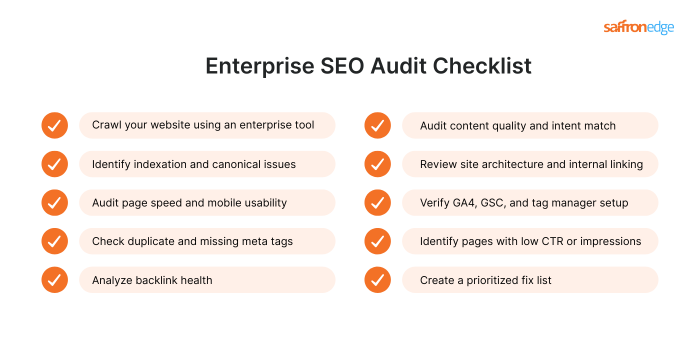
Let’s break it down step by step so your brand can follow it easily.
Step 1: Crawl Your Website
Start by running a full crawl using Screaming Frog, Deepcrawl, or Botify. Identify:
- Broken pages and redirects
- Missing meta tags
- Non-indexable URLs
- Orphaned pages
Export this data and group issues by severity.
Step 2: Review Site Architecture and Indexation
Check your site hierarchy. Ask:
- Are key pages accessible within 3 clicks?
- Do all indexable pages appear in the sitemap?
- Are canonical tags and hreflang attributes correct?
Use Google Search Console’s “Coverage” report to validate indexed vs. excluded URLs.
Step 3: Assess Page Speed and Core Web Vitals
Run PageSpeed Insights or Lighthouse reports. Pay special attention to:
- Largest Contentful Paint (LCP)
- Interaction to Next Paint (INP)
- Cumulative Layout Shift (CLS)
Enterprises with heavy design elements or JS frameworks often suffer here. Optimize image delivery, caching, and lazy loading.
Step 4: Evaluate Content and Keywords
Pull keyword data from GSC and Ahrefs. Identify:
- Pages ranking below position 20
- Content gaps compared to competitors
- Duplicate keyword targeting
- Opportunities for content clusters or pillar pages
Step 5: Audit Backlink Profile
Run backlink audits using Ahrefs or Majestic. Filter for:
- Toxic or spammy links
- Lost backlinks
- Brand mentions without links (outreach opportunities)
Create a disavow file if necessary and plan link reclamation strategies.
Step 6: Validate Analytics and Reporting Setup
Ensure your GA4 property is correctly tracking sessions, events, and conversions. Verify goal tracking consistency between GA4, GSC, and CRM dashboards.
Create an “SEO Health Dashboard” for monthly visibility into audit metrics.
Step 7: Compile Your Enterprise Website SEO Audit Report
Structure your report by category:
1. Overview & Executive Summary
2. Key Findings by SEO Pillar
3. Data Visualizations (Charts, Tables)
4. Actionable Recommendations
5. Priority List (High, Medium, Low Impact)
[Visual Suggestion] – Example report template layout with sample graphs and pie charts.
Enterprise Website SEO Audit Report: Metrics & KPIs
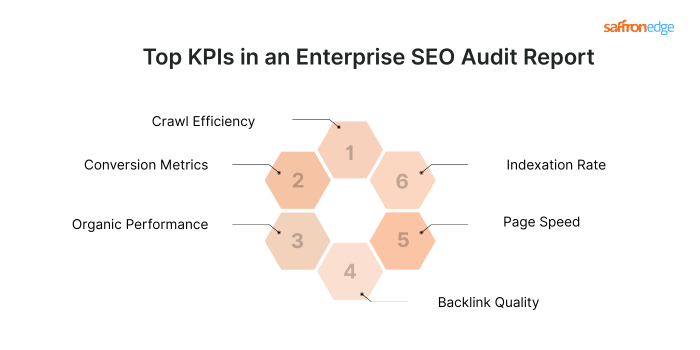
A great audit report doesn’t just list problems; it quantifies them. Here are the metrics that matter most:
- Crawl Efficiency: Pages crawled vs total URLs
- Indexation Rate: Indexed pages percentage
- Page Speed: LCP, CLS, FID metrics
- Backlink Quality: Referring domains, toxicity ratio
- Organic Performance: Clicks, impressions, CTR
Conversion Metrics: Leads, transactions, assisted conversions
Your audit report should not just identify issues; it should measure impact.
How Often Should You Conduct an Enterprise SEO Audit?
For most enterprises, quarterly audits are ideal. However, you should also run audits after:
- Major website redesigns
- Domain migrations
- Google core updates
- CMS upgrades or architecture changes
Recommendation: Monthly crawl automation leveraging Botify or Deepcrawl for regular monitoring. Quarterly audits are the best fit for enterprise websites. However, primary updates such as redesigns, CMS migrations, or Google core updates require an instant audit.
What Are The Tools To Conduct An Enterprise SEO Audit?
Here are some trusted enterprise-grade SEO audit tools:
| Tool | Best For | Notable Feature |
| Screaming Frog Enterprise | Full-site crawl | Log file analysis |
| Botify | Large-scale SEO tracking | Crawl budget management |
| Deepcrawl (Lumar) | Technical insights | Cloud-based scalability |
| Ahrefs / SEMrush | Backlink & content audit | Domain authority metrics |
| Google Search Console | Indexation & performance | 100% free data source |
How Much Does An Enterprise SEO Audit Cost?
Pricing varies by scope and complexity. Typically:
- Basic Enterprise Audit: $2,000 – $5,000
- Full Technical + Content + Link Audit: $7,000 – $15,000+
- Ongoing SEO Management: $3,000 – $10,000/month
Costs depend on:
- Site size (number of URLs)
- Tool stack used
- Depth of analysis
- Consultant or agency experience
Always ask for a sample report before committing to ensure deliverables match expectations.
Factors influencing cost include:
- Number of URLs and domains
- Tech stack (CMS, servers, etc.)
- Industry competitiveness
- Depth of reporting and recommendations
Always ask for a sample Enterprise Website SEO Audit Report before onboarding an agency.
Conclusion
An Enterprise SEO Audit provides a comprehensive roadmap to consistent and lasting growth rather than just another checklist.
You give your brand a competitive edge to overpower search results by identifying and resolving technical gaps, content issues, and missed opportunities.
Consistent auditing ensures your SEO engine operations align with long-term performance goals, whether you’re handling an eCommerce giant or a SaaS platform.
An Enterprise SEO Audit is not a one-time thing; it’s an ongoing process that strengthens your strategy for improved search visibility.
This is how global brands align with search intent at scale, enabling websites to achieve seamless crawlability and optimization.
Contributing to SEO performance, your audit report is the blueprint for organic growth when done right, as it is more than a list of errors; it eventually supports every stakeholder (from tech to marketing).
Design an internal SEO playbook that leverages audit insights so that resolutions become repeatable across departments.
What’s your roadblock in ranking #1 on Search engines?
From crawl efficiency to cross-team SEO alignment, our enterprise SEO audit delivers data-backed recommendations you can execute with confidence.
Share


Get The SaaS Marketing Toolkit
FAQs
What is an Enterprise SEO Audit and why do businesses need it?

An enterprise SEO audit evaluates the health elements of large-scale websites, helping to identify blockers that impact the visibility and implement continuous fixes for ongoing optimization.
What does an Enterprise Website SEO Audit Report include?
A detailed enterprise website SEO audit report encompasses crawl data, indexation issues, backlink profiles, Core Web Vitals analysis, and preferred action plans to convert your data insights into results.
How to do an Enterprise SEO Audit efficiently?
Firstly, start by performing a full crawl to validate technical aspects, evaluate content quality, review backlinks, and confirm the analytics setup. Leverage tools such as Screaming Frog, Ahrefs, and Botify for accuracy.
How often should an Enterprise SEO Audit be performed?
An enterprise SEO audit should ideally be performed once every quarter or after significant updates, such as redesigns or migrations, to maintain a healthy and aligned SEO foundation in response to Google’s updates.
How much does an Enterprise SEO Audit cost?
The cost of an enterprise SEO audit varies depending on website size and complexity; the price typically ranges between $2,000 and $15,000 for a comprehensive audit. Monthly retainers may be required for ongoing audits of large-scale organizations to ensure continuous optimization.
Nishant Ahlawat

Nishant Ahlawat is a marketing professional specializing in SaaS, SEO, and content strategy. He has experience working with B2B companies to improve online visibility, develop content frameworks, and implement data-driven SEO practices. His work focuses on helping businesses grow their organic presence through search optimization, strategic planning, and performance tracking. Outside of work, Nishant enjoys traveling to offbeat destinations, trekking in the mountains, and exploring local cultures and landscapes.
Related Blogs
We explore and publish the latest & most underrated content before it becomes a trend.

5 min read
Driving Engagement and Conversions with Google Display Ads
By Vibhu Satpaul



Subscribe to Saffron Edge Newsletter!


Get The SaaS Marketing Toolkit