


What is Account-Based Sales? The Right Way to Account-Based Selling


Dec 08, 2025

Contents
 6 min
6 min
- What is Account-Based Selling?
- What Are The Features Of Account-Based Selling?
- What Are The Benefits Of Account-Based Selling?
- How Account-Based Sales Works?
- How has the Account-Based Selling Model evolved?
- What Is The Difference Between Account-Based Marketing And Sales?
- What Is The Process Of Implementing Account-Based Sales?
- What Is The Process Of Implementing Account-Based Marketing?
- How To Create A Successful Account-Based Sales Strategy?
- How To Use Content In Account-Based Selling?
- Conclusion
Are you struggling to close high-value deals despite a huge lead list? Many B2B sales teams waste time chasing the wrong prospects, sending generic messages, or failing to engage multiple stakeholders.
Account-Based Selling (ABS) is the approach that changes that by focusing only on the accounts that truly matter and crafting highly personalized engagement strategies.
If you want to boost conversions, increase deal size, and align sales and marketing, learning how ABS works is the first step. This guide breaks it down in simple, actionable terms.
What is Account-Based Selling?
Account-Based Selling is a strategic, focused approach to sales where efforts are concentrated on high-value accounts rather than broad lead lists.
It is about understanding the unique needs, pain points, and decision-making process of each account.
- It prioritizes quality over quantity, targeting accounts with high revenue potential.
- Engagement is personalized and multi-touch, considering each stakeholder’s role.
- Sales and marketing teams work closely, sharing insights, messaging, and strategies.
- Data and analytics guide outreach, helping teams focus on accounts with the highest likelihood to close.
ABS is especially effective for B2B businesses targeting enterprise clients or high-value accounts where generic sales approaches fall short.
Account-based selling is a focused B2B sales method. It targets specific companies that match your ideal customer profile.
Instead of chasing random leads, you pick 50-200 dream accounts and treat each like a separate market. This approach requires deep research. You study the company’s goals, challenges, and key people.
Then you create custom messages that speak directly to their needs. Sales teams use multiple channels to reach buyers.
They send personalized emails, make warm calls, share relevant content, and meet at events. Every touchpoint builds trust and moves the deal forward.
Account-based selling works best for enterprise deals. These sales often involve 6-10 stakeholders and last 6-12 months.
The method aligns perfectly with complex buying processes. Teams see higher win rates because they focus on quality.
They spend 80% less time on unqualified prospects. This laser focus drives real revenue growth.
What Are The Features Of Account-Based Selling?
Account-based sales have distinct features that make them highly effective compared to generic sales approaches. Understanding these features helps organizations design a system that consistently drives results.
- Targeted Account Focus:Concentrates efforts on a select list of high-value accounts instead of pursuing a broad lead pool.
- Personalized Engagement:Every message, email, and content asset is tailored to the account’s specific needs.
- Multi-Stakeholder Approach:Engages decision-makers, influencers, and champions within the account.
- Sales-Marketing Alignment:Marketing and sales teams collaborate to create a consistent, account-focused approach.
- Data-Driven Decisions:Uses research, intent signals, and analytics to guide strategy and measure success.
- Full-Funnel Coverage:Manages the account from awareness to closing, treating each account as its own market.
- Continuous Measurement & Optimization:Engagement, deal size, conversion rate, and ROI are tracked and used to refine strategies.
What Are The Benefits Of Account-Based Selling?
Implementing ABS provides measurable advantages for your sales organization.
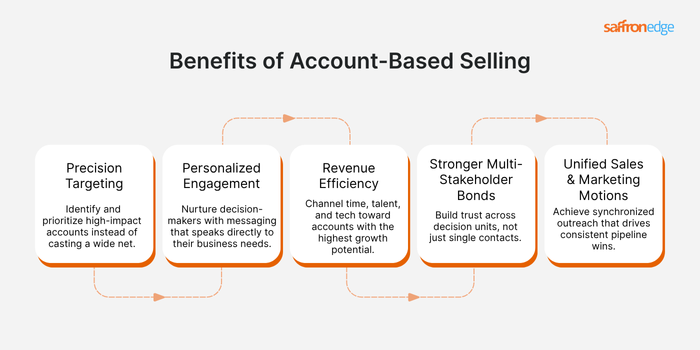
When your team focuses on the right accounts and engages them strategically, it can lead to better results across the board.
- Higher conversion rates:Focusing on the right accounts increases the chances of closing deals.
- Larger deal sizes: High-value accounts typically result in bigger contracts.
- Improved ROI: Resources are spent on accounts with the most potential, reducing wasted effort.
- Stronger relationships:Tailored engagement builds trust with multiple stakeholders.
- Sales and marketing alignment:Ensures both teams work toward the same objectives for each account.
Account-based sales not only increase revenue but also improve operational efficiency by focusing effort on accounts that matter most.
How Account-Based Sales Works?
Account-based sales is structured around a step-by-step process that ensures every account is approached with strategy and precision.
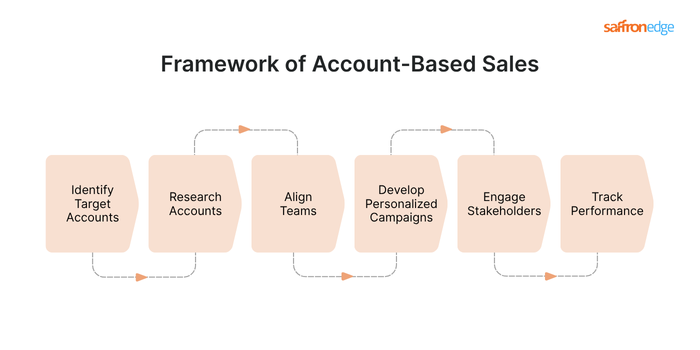
This process allows sales teams to manage accounts as individual markets.
Key steps include:
1.Identify target accounts: Define your Ideal Customer Profile (ICP) based on revenue potential, industry, and strategic importance.
2.Research accounts: Understand the company structure, key stakeholders, challenges, and buying process.
3.Align teams: Coordinate sales, marketing, and customer success to share insights and resources.
4.Develop personalized campaigns: Tailor emails, calls, presentations, and content to the account.
5.Engage stakeholders: Connect with decision-makers, influencers, and champions.
6.Track performance: Monitor metrics such as engagement, deal size, conversion rate, and pipeline progression.
ABS is effective because it treats each account as a unique market with its own strategy and engagement plan.
How has the Account-Based Selling Model evolved?
The account-based sales model has come a long way from traditional account management. Understanding its evolution helps sales teams adopt modern practices for higher efficiency.
- Traditional approach: Reactive account management with minimal personalization.
- Modern ABS: Proactive, data-driven, multi-stakeholder engagement using technology.
- Marketing integration: Sales and marketing collaborate to deliver relevant, personalized content.
- Full-funnel approach: Engages accounts from awareness through closing, treating each account as its own market.
With the evolution of digital tools, account-based sales has become more measurable, scalable, and effective, providing teams with actionable insights and higher chances of success.
What Is The Difference Between Account-Based Marketing And Sales?
Although often discussed together, ABM and ABS serve different purposes but are complementary. ABM warms accounts through marketing, while ABS focuses on closing deals through personalized sales engagement.
| Aspect | ABM | ABS |
| Focus | Marketing campaigns for target accounts | Sales engagement & deal closing |
| Goal | Build awareness & nurture leads | Engage decision-makers & close deals |
| Tactics | Personalized content, ads, events | Targeted emails, calls, demos, meetings |
| Alignment | Prepare accounts for sales | Works with ABM to drive conversion |
| Metrics | Engagement rate, pipeline contribution | Deal size, conversion rate, revenue |
When used together, ABM prepares accounts for ABS, ensuring smoother, more effective engagement and higher success rates.
What Is The Process Of Implementing Account-Based Sales?
Implementing ABS involves careful planning and coordination. Each account requires a customized strategy to maximize success.
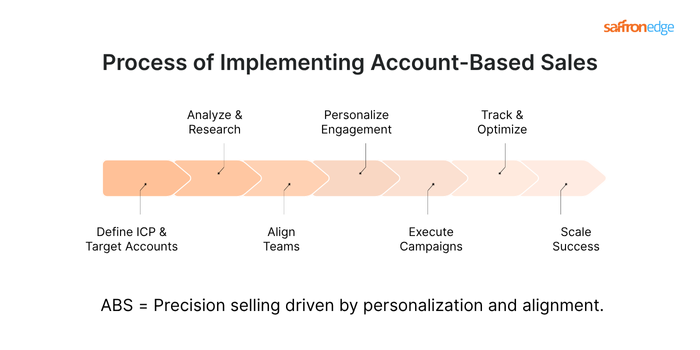
Steps include:
1. Define ICP and target accounts: Focus on accounts with high strategic and revenue value.
2. Research accounts: Map stakeholders, decision-makers, and account challenges.
3. Align cross-functional teams: Ensure collaboration between sales, marketing, and customer success.
4. Tailor engagement: Customize messaging, emails, content, and meetings for each account.
5. Execute campaigns: Engage via multi-channel touchpoints like email, LinkedIn, calls, and events.
6. Track and measure: Monitor engagement, deal progression, and account coverage.
7. Refine and scale: Adjust strategies based on results and expand to additional accounts.
Account-based sales is dynamic and iterative, requiring constant learning and adaptation to each account.
What Is The Process Of Implementing Account-Based Marketing?
ABM sets the stage for account-based sales by preparing and nurturing target accounts.
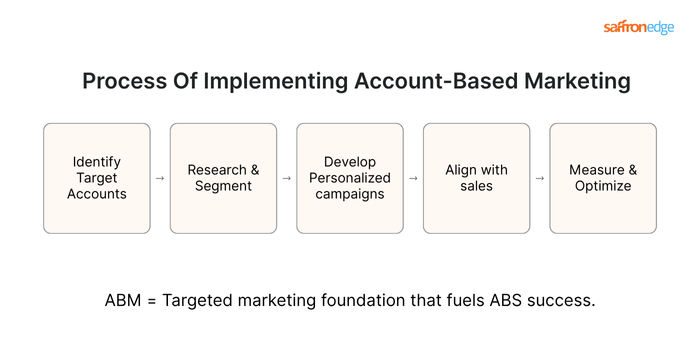
A strong ABM foundation ensures sales can close deals more effectively.
1. Build target account list: Identify high-value accounts that fit your ICP.
2. Research accounts:Study the company structure, goals, challenges, and stakeholders.
3. Create personalized campaigns: Develop content, events, and ads tailored to the account.
4. Coordinate with sales: Share insights and engagement data to support ABS.
5. Measure and optimize: Track engagement, pipeline contribution, and ROI to refine ABM strategies.
By aligning ABM with ABS, teams can maximize account engagement and conversion rates.
How To Create A Successful Account-Based Sales Strategy?
A successful account-based sales strategy requires planning, alignment, and personalization. It combines data, insights, and collaboration to drive results.
Key elements include:
- Clear ICP definition: Identify accounts with the highest revenue and strategic value.
- Sales and marketing alignment: Ensure teams share goals, messaging, and resources.
- Account planning: Map stakeholders, set objectives, timelines, and risk mitigation.
- Personalized outreach: Tailor messaging and content for each account.
- Technology and tools: Use CRM, intent data, engagement tracking, and analytics.
- Performance measurement: Monitor deal size, engagement, velocity, and ROI to optimize strategy.
How To Use Content In Account-Based Selling?
Content is at the heart of account-based sales. Personalized content helps engage stakeholders, educate them about your solution, and move the account through the sales process.
- Highly personalized: Tailor content for the account’s challenges and context.
- Multi-format delivery: Use emails, case studies, whitepapers, videos, and events.
- Consistent messaging: Ensure marketing and sales deliver a unified message.
- Account-level measurement: Track which assets drove engagement and pipeline growth.
- Enable sales: Equip sales teams with content to support stakeholder conversations.
Content ensures that each engagement adds value and strengthens relationships.
Conclusion
Account-based selling is the future of B2B revenue. It replaces spray-and-pray tactics with precision and personalization. Companies that master this method dominate their markets.
Start by aligning your teams and picking your first 50 accounts. Invest in data, tools, and training. Measure everything and improve constantly.
The results speak for themselves. Higher win rates, bigger deals, shorter cycles, and happier customers. In a world of noise, account-based selling helps you stand out.
Take the first step today. Your dream clients are waiting for a partner who truly understands them. Be that partner.
Accelerate Revenue With Account-Based Selling
Target high-value accounts, engage decision-makers, and close bigger deals with a strategic account-based sales approach. Let Saffron Edge guide your team to maximize conversions and ROI.
Share


10 Mistakes in Your GTM Strategy
FAQs
What is account-based selling and how is it different from an account-based sales strategy?

Account-based selling is the tactical process of engaging high-value accounts, while an account-based sales strategy defines the overall approach, target accounts, and goals for ABS.
How does account-based prospecting help in account-based selling?
Account-based prospecting identifies and engages high-value accounts early, creating warm leads that feed into the account-based selling strategy.
What are the key benefits of an account-based sales strategy?
Benefits of an account-based sales include higher conversion rates, larger deal sizes, better sales-marketing alignment, and stronger relationships with target accounts.
How do you implement account-based marketing before starting account-based selling?
Implement ABM by defining ideal accounts, researching stakeholders, creating personalized campaigns, and sharing insights with the sales team to support account-based sales.
How important is content in supporting an account-based selling strategy?
Content is critical in account-based sales as it nurtures accounts, builds credibility, and drives engagement throughout the sales process.

Shreya Debnath

Shreya Debnath is a dedicated marketing professional with expertise in digital strategy, content development and scaling with AI & Automation along with brand communication. She has worked with diverse teams to build impactful marketing campaigns, strengthen brand positioning, and enhance audience engagement across multiple channels. Her approach combines creativity with data-driven insights, allowing businesses to reach the right audiences and communicate their value effectively. She perfectly aligns sales and marketing together and makes sure everything works in sync. Outside of work, Shreya enjoys exploring new cities, diving into creative hobbies, and discovering unique stories through travel and local experiences.
Related Blogs
We explore and publish the latest & most underrated content before it becomes a trend.


7 min read
10 Effective Ways to Build a Strong Emotional Connection with Your Customers
By Sabah Noor
6 min read
CRM-based Enterprise Marketing Automation To Turn Clicks Into Conversions
By Sabah Noor

Subscribe to Saffron Edge Newsletter!


10 Mistakes in Your GTM Strategy