


Account-Based Marketing for Manufacturers: A Complete Guide to Targeted Growth


Dec 08, 2025

Contents
 8 min
8 min
- What Is Account-Based Marketing For Manufacturers?
- What Is The Importance Of Account-Based Marketing For Manufacturers?
- What Are The Benefits Of Account-Based Marketing For Manufacturers?
- Key Components Of A Successful Account-Based Marketing For Manufacturers
- How to Implement Account-Based Marketing In Manufacturing?
- What Are The Types Of ABM Campaigns?
- Measuring Success Of Account-Based Marketing For Manufacturers
- Best Practices for Implementing Account-Based Marketing For Manufacturers
- Conclusion
If you work in manufacturing, you know that typical broad-brush marketing often misses the mark. You might be reaching lots of companies, but not the right ones.
What if instead you treated a select few high-value prospective customers like individual markets of one? That’s exactly what account-based marketing (ABM) offers, especially for manufacturers.
In this guide to account-based marketing for manufacturers, we’ll walk from “what it is” to “how to do it well”, sharing benefits, best practices, campaign types, measurement and more.
By the end, you’ll be equipped to build an ABM programme that drives real enterprise-manufacturing deals rather than chasing generic leads. Let’s dive in.
What Is Account-Based Marketing For Manufacturers?
At its core, account-based marketing for manufacturers means you (as a manufacturer or industrial supplier) identify a defined set of high-value target companies (accounts).
Then treat each one as a market in itself, tailoring your marketing and sales efforts directly to the decision-making units, pain points and goals of that account.
Traditional lead-gen casts a wide net. ABM narrows it to the right few. In a manufacturing context, this is especially powerful because:
- Sales cycles are long.
- Buying committees are complex (engineering, procurement, operations).
- Product technicality is high.
- The total addressable market (TAM) may be narrow, but very high value.
So applying ABM for manufacturers means aligning marketing + sales, building custom outreach, and engaging accounts over time rather than generating many generic leads.
What Is The Importance Of Account-Based Marketing For Manufacturers?
Here are the key reasons:
- Efficiency of resources: Instead of spreading your budget across many low-value prospects, you focus on the high-potential accounts. This means better ROI.
- Aligning sales and marketing: With ABM, you force marketing and sales to operate in tandem on target accounts rather than separately chasing leads. That alignment is vital in manufacturing, where multiple stakeholders are involved.
- Shorter sales cycles and larger deals: Because you tailor messaging and interactions to specific accounts, you tend to move deals faster and land bigger contracts.
- Competitive differentiation: Many manufacturers still rely on broad outreach. Using ABM sends a message that you understand the account’s specific challenges and are positioning as a partner, not just a vendor.
- Creating lasting relationships: ABM isn’t a one-off. It’s about building deep relationships with strategic accounts, which lends itself to expansions, repeat business, and upsells.
In short, for manufacturers operating in complex B2B settings, account-based marketing isn’t a nice-to-have; it can be a differentiator.
What Are The Benefits Of Account-Based Marketing For Manufacturers?
Let's break down some concrete benefits you’ll see when you implement account-based marketing for manufacturers:
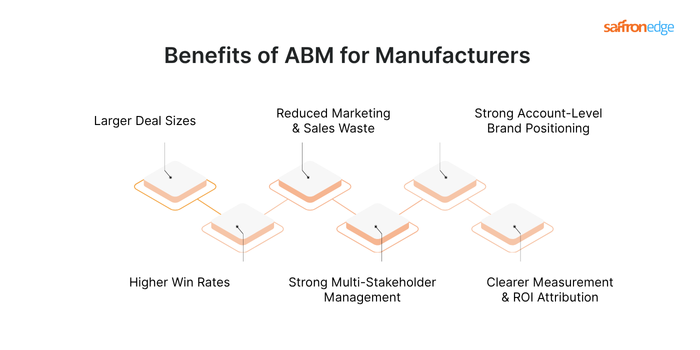
1. Higher win rates: Because you're focusing on the right accounts and delivering personalised content, your probability of winning goes up.
2. Increased average deal size: Targeting strategic accounts often yields larger contracts. For example, one article notes that manufacturers using ABM reported bigger deal sizes.
3. Reduced waste in marketing and sales: Instead of thousands of generic leads, you allocate effort where it matters.
4. Better stakeholder engagement:Since manufacturing deals require buy-in from multiple roles (procurement, engineering, operations), ABM enables you to engage each relevant stakeholder with tailored messaging.
5. Stronger brand for key accounts: By treating your target companies as strategic partners, you elevate your reputation and become part of their ecosystem rather than just another supplier. /p>
6. Improved measurement and attribution: Because you target discrete accounts, you can more clearly track and demonstrate ROI from your campaigns.
Key Components Of A Successful Account-Based Marketing For Manufacturers
Here are the major elements you’ll need to get right when executing ABM for manufacturing:
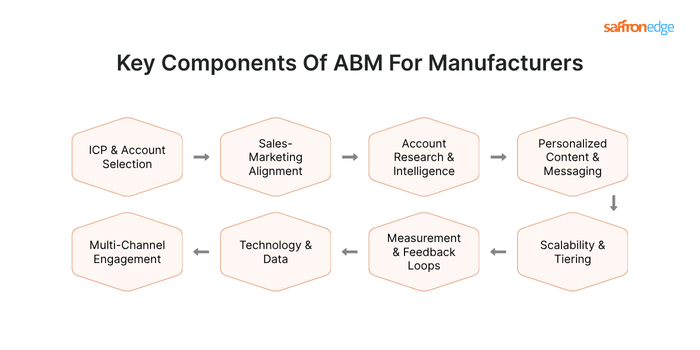
- Ideal Customer Profile (ICP) & account selection: Define what makes a great account: industry vertical (e.g., aerospace, automotive, heavy machinery), geography, size, tech stack, pain points (e.g., supply chain constraints, downtime). Then select target accounts (Tier 1, Tier 2, Tier 3) accordingly.
- Sales & marketing alignment: Marketing and sales must jointly own the account list, the messaging, the pathways. Weekly check-ins, shared KPIs.
- Deep account research & intelligence: For each account you choose, gather: who are the decision-makers, what are their KPIs, what challenges are they facing, what solution would resonate, what tech or process they already have.
- Personalised content & messaging: Create tailored content for each account: case studies in their vertical, ROI-focused data relevant to their production use-case, videos, webinars focusing on their challenges.
- Multi-channel engagement: Use several touchpoints: LinkedIn ads, personalised email, direct mail, events or site visits, webinars, digital ads specific to that account.
- Technology & data: Use ABM platforms and intent data to identify engaged accounts, monitor behaviour, score engagement and trigger actions.
- Measurement & feedback loops: Define KPIs (engagement, pipeline created, pipeline velocity, win rate, deal size, retention) and review regularly. Use data to optimise campaigns.
- Scalability & tiering: Recognise that not every account will get the same level of investment. Organise Tier 1 (highly personalised, 1:1), Tier 2 (1:few), Tier 3 (1:many) approaches.
How to Implement Account-Based Marketing In Manufacturing?
Implementing ABM in the manufacturing sector can feel complex, but breaking it down into clear steps makes it manageable. Here’s a practical roadmap:
1. Get Company-Wide Buy-In
Start by getting leadership, sales, and marketing aligned on why ABM matters. Present it as a growth initiative, not just a marketing project.
Define success metrics like pipeline value, deal size, and win rate. Once everyone understands their role and the shared goals, execution becomes smoother.
2. Define Your ICP and Target Accounts
Collaborate across teams to outline your Ideal Customer Profile (ICP), industry, company size, geography, production capacity, and typical challenges (like downtime or procurement delays).
Then, shortlist accounts that best fit this profile.
Segment them into:
- Tier 1: High-touch, one-to-one outreach
- Tier 2: Clustered, semi-personalized campaigns
- Tier 3: Programmatic or automated campaigns for scalability
This segmentation helps allocate effort and budget efficiently.
3. Conduct Deep Account Research
Dive into each target company’s structure, decision-makers, pain points, technologies, and ongoing projects. Understand their production goals and operational bottlenecks.
The more you know about each account’s ecosystem, the more precise and impactful your messaging becomes.
4. Create Personalized Value Propositions & Content
Translate your insights into tailored messaging that demonstrates clear, measurable value. Instead of generic claims, focus on outcomes:
- “Reduced change-over time by 30%”
- “Lowered maintenance costs using predictive analytics”
- “Improved operational efficiency through automation”
Develop industry-relevant materials like custom case studies, product demos, and ROI calculators that directly address those pain points.
5. Choose the Right Outreach Channels
Meet your prospects where they are. For Tier 1 accounts, use direct and personal outreach, such as one-on-one emails, LinkedIn messages, or executive events.
For Tier 2 or 3, consider targeted ads, webinars, or curated email sequences.
A balanced mix of digital and offline touches keeps your brand visible across multiple engagement points without overwhelming the audience.
6. Launch, Engage, and Coordinate
Roll out your campaigns with synchronized efforts between sales and marketing. Ensure both teams share data, feedback, and communication consistently.
This alignment builds trust with prospects and strengthens the overall experience; every touchpoint should feel connected.
7. Monitor, Measure, and Iterate
Track engagement metrics such as content interactions, meeting requests, and pipeline progression. Evaluate which messaging or channels are driving conversions.
Use these insights to refine your campaigns, update your account tiers, and identify new opportunities for personalization.
8. Scale and Optimize
Once you’ve proven success with pilot accounts, start scaling. Move Tier 3 accounts up the ladder based on engagement, replicate successful campaigns, and increase investment in personalization for high-value accounts.
Over time, your ABM strategy evolves into a repeatable, data-driven growth engine.
What Are The Types Of ABM Campaigns?
When you’re doing account-based marketing for manufacturers, you’ll typically find three types (tiers) of ABM campaigns, each suited for different investment levels and account priority:
- One-to-One (Strategic ABM): Fully custom campaigns for a handful of Tier 1 key accounts. Deep personalisation, dedicated resources, and potentially custom events/site visits.
- One-to-Few (Cluster ABM): Personalized but not fully bespoke. A small group of similar accounts (same vertical or similar challenges) gets tailored content and outreach.
- One-to-Many (Programmatic ABM): More scalable; many accounts get semi-personalised content and outreach using ABM platforms and automation. Ideal for Tier 3.
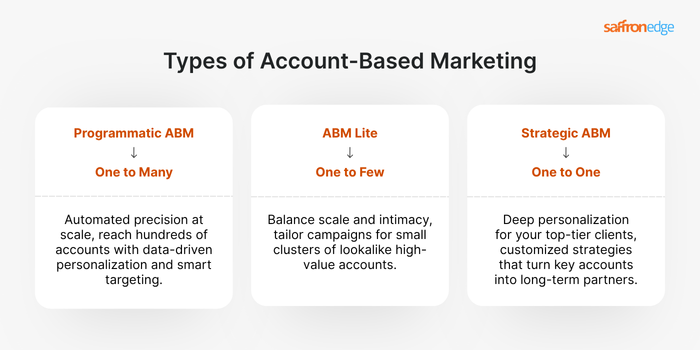
For a manufacturer, you may use Strategic ABM for your dream accounts (e.g., top 5 aerospace OEMs), One-to-Few for mid-market verticals (e.g., automotive Tier 2 suppliers), and Programmatic ABM for lists of target accounts you engage at scale (e.g., heavy equipment manufacturers in targeted geographies).
Measuring Success Of Account-Based Marketing For Manufacturers
Measurement is critical to justify ABM investment and evolve your programmes. Here are key metrics and how to apply them in manufacturing:
Key metrics to track:
- Account engagement: number/quality of interactions with your target accounts (site visits, content downloads, meetings).
- Pipeline influenced/created: value of opportunities in the pipeline that are tied to targeted accounts.
- Deal size: Compare the average deal size of ABM accounts vs non-ABM accounts.
- Win rate: percentage of targeted accounts won vs non-targeted.
- Sales cycle length: Is your ABM shortening the time to close?
- Revenue growth or expansion in target accounts: repeat business or upsell to accounts you targeted.
- ROI: revenue from ABM accounts divided by cost of ABM campaigns (resources, tech, events).
- Customer lifetime value: for accounts you’ve targeted, is lifetime value higher?
Tips for manufacturers:
- Because deals take longer, measure early-stage metrics (e.g., engagement, meetings) as well as lagging metrics (revenue), so your programme shows value sooner.
- Segment metrics by tiers: you may expect different metrics for Tier 1 vs Tier 3.
- Use attribution models that link multiple touches across channels and over time (especially relevant for manufacturing’s complex buying processes).
- Set benchmarks: e.g., if the average deal size for non-targeted accounts is $X, aim for 20-30% higher in ABM accounts. One source noted ABM campaigns improved MQL→SAL conversion by 25%.
Best Practices for Implementing Account-Based Marketing For Manufacturers
Here are some best practices, drawn from what the top-ranked blogs on ABM for manufacturing include (and what is often missing!). So you can apply them and stand out.
1. Start with a pilot programme: Choose 5-10 target accounts, run ABM, learn quickly, then scale.
2. Cross-functional teams: Create a dedicated ABM task force including marketing, sales, customer success, operations maybe even engineering.
3. Create account mapping documents: For each account, map the decision-making unit (DMU), what business outcomes matter, and fast versus slow wins.
4. Use intent data + firmographic + technographic data: To identify which accounts are showing interest or have the “fit”. Many beginner guides touch on this, but the top ones emphasise using data.
5. Tailor content by role within the account: Engineering cares about ROI and downtime, while procurement cares about cost and supplier risk, operations about efficiency.
6. Leverage sales enablement: Provide sales with the tools, content, and account insights to have meaningful conversations, not just generic brochures.
7. Stay persistent: Manufacturing buys take time. ABM isn’t a short campaign; it’s sustained engagement.
8. Use technology wisely—but don’t rely solely on it: ABM platforms help with scaling and tracking, but for Tier 1 accounts, human relationships matter. The top blogs emphasise this nuance.
9. Measure and optimise: Set KPIs from the start, review monthly or quarterly, refine your approach, test channels, content, and messaging.
10. Document results and scale gradually: As you prove success, expand the programme, moving Tier 3 to Tier 2, etc.
Conclusion
Account-Based Marketing for manufacturers isn’t just another marketing tactic. It’s a mindset shift. It moves your strategy from chasing leads to cultivating long-term, high-value relationships with the right accounts.
By aligning sales and marketing, focusing on quality over quantity, and building tailored engagement plans, manufacturers can shorten long sales cycles, strengthen buyer trust, and grow deal sizes significantly.
Start small, identify your top accounts, personalize your outreach, and measure every interaction. As you refine and scale, ABM becomes more than a strategy; it turns into a predictable, repeatable growth engine built around your ideal customers.
Once you’ve validated your ABM framework, scaling becomes easier with the right support system.
Saffron Edge’s ABM experts can help manufacturers identify high-value accounts, create personalized campaigns, and integrate data-backed automation tools to streamline the entire ABM workflow.
Share


10 Mistakes in Your GTM Strategy
FAQs
What is account-based marketing for manufacturers and why is it important?

Account-based marketing for manufacturers is a strategy where marketing and sales work together to target a defined set of high-value manufacturing accounts, deliver personalised outreach, and treat each account as a “market of one.” It’s important because manufacturers face long sales cycles, complex buying committees and high-value deals; this approach improves efficiency, conversion and ROI.
How do you build an account-based marketing strategy for manufacturers?
To build an account-based marketing for manufacturers strategy, you must first define your ideal manufacturing customer profile (ICP), select target accounts, align sales and marketing, conduct account research, create personalised content and rollout multi-channel campaigns, then measure and optimise results.
What types of campaign work in account-based marketing for manufacturers?
In account-based marketing for manufacturers, you’ll typically run three types of campaigns: one-to-one (deep customisation for top Tier 1 accounts), one-to-few (clusters of similar accounts) and one-to-many (scalable outreach to broader list). Choosing the right campaign type depends on account tier and resource allocation.
How do you measure success in account-based marketing for manufacturers?
You measure success in account-based marketing for manufacturers by tracking metrics such as account engagement, pipeline created/influenced, average deal size, win rate, sales cycle length, repeat business from key accounts and ultimately ROI. Because manufacturing deals can take time, monitor early indicators (meetings, content engagement) as well as lagging metrics (revenue).
What are the best practices for executing account-based marketing for manufacturers?
Best practices for account-based marketing for manufacturers include: starting with a pilot programme; aligning sales, marketing and customer success; creating account-specific research and content; engaging multiple stakeholders within target companies; using data and intent signals; measuring regularly and refining; and including post-sale expansion in your ABM strategy.

Shreya Debnath

Shreya Debnath is a dedicated marketing professional with expertise in digital strategy, content development and scaling with AI & Automation along with brand communication. She has worked with diverse teams to build impactful marketing campaigns, strengthen brand positioning, and enhance audience engagement across multiple channels. Her approach combines creativity with data-driven insights, allowing businesses to reach the right audiences and communicate their value effectively. She perfectly aligns sales and marketing together and makes sure everything works in sync. Outside of work, Shreya enjoys exploring new cities, diving into creative hobbies, and discovering unique stories through travel and local experiences.
Related Blogs
We explore and publish the latest & most underrated content before it becomes a trend.



3 min read
3 Highly Effective Social Media Optimization Tips You Might Not Know
By Praveen Kumar

Subscribe to Saffron Edge Newsletter!


10 Mistakes in Your GTM Strategy