


Top 8 Account-Based Campaign Examples & ABM Ideas


Apr 26, 2025

Contents
 11 min
- TL;DR
- What is an Account-Based Marketing Campaign?
- Why Businesses Need an ABM Campaign?
- What Are The Benefits Of Running an ABM Campaign?
- What Are Some Good Account-Based Marketing Ideas?
- Top 8 Account-Based Marketing Examples
- How To Craft A Successful Account-Based Campaign?
- How To Measure The Success Of ABM Campaign?
- Conclusion
TL;DR
Account-based marketing (ABM) flips the traditional marketing approach by focusing on the accounts that matter most.
Instead of casting a wide net, ABM prioritises high-value companies, personalises every touchpoint, and aligns sales and marketing to drive meaningful engagement.
Here’s a quick snapshot of what you’ll learn in this guide:
- ABM flips the traditional marketing funnel by focusing on key accounts.
- Learn what an ABM campaign is and why your business needs it.
- Discover the benefits of ABM and practical account-based marketing ideas.
- Dive into detailed account-based marketing examples with real strategies and results.
- Understand how to craft successful ABM campaigns and measure their success.
- FAQs guide you on starting, scaling, and optimising ABM efforts.
What is an Account-Based Marketing Campaign?
An account‑based campaign is a highly targeted initiative where sales and marketing align to engage selected high‑value companies as individual “markets”.
Instead of broad demand‑gen, you pick target accounts, map decision‑makers, personalise messages and orchestrate multi‑channel touches. Such campaigns focus on deep engagement, not just lead volume.
ABM campaigns often follow a “multi-touch” approach. For example, you might start with a personalised email, follow up with a LinkedIn ad, and then send a direct mail piece to reinforce your message.
Each touchpoint is tailored to the account’s specific needs, which dramatically improves engagement compared to traditional campaigns.
Why Businesses Need an ABM Campaign?
High-value accounts often contribute a disproportionate amount of revenue. ABM ensures your resources go toward these accounts, not the masses.
By aligning marketing and sales teams, ABM campaigns create a seamless journey for prospects, making it easier to navigate complex B2B sales cycles.
Consider a scenario where a company targets a Fortune 500 client. Generic campaigns might fail to reach the right stakeholders.
But an ABM approach ensures every touchpoint, from a custom landing page to a personalised gift, addresses the company’s needs, boosting the chances of conversion.
Additionally, ABM enables measurable results at the account level. You can track engagement, pipeline contribution, deal size, and even revenue from individual accounts, helping you justify marketing spend while proving ROI.
Ultimately, businesses need ABM because it drives focus, efficiency, and impact. It transforms marketing from a numbers game into a strategic effort that builds long-term relationships with the right accounts.
What Are The Benefits Of Running an ABM Campaign?
Now that you know why ABM matters, let’s explore the concrete benefits businesses gain from running account-based campaigns.
1.Higher ROI: Personalised outreach resonates better, so every marketing dollar has a greater chance of driving revenue. Many companies report that ABM generates higher ROI than broad-based campaigns.
2.Shorter Sales Cycles: Because you’re talking to the right stakeholders with the right message, deals move faster.
3.Larger Deal Sizes: Strategic accounts often have bigger budgets. Engaging them personally can increase deal size significantly.
4.Better Alignment: ABM forces marketing and sales to collaborate, creating shared ownership of account success.
5.Focused Resources: Rather than spreading efforts thin, you invest in accounts with the most potential.
Take DocuSign as an example. They targeted 450 enterprise accounts with industry-specific content, personalised ads, and customised landing pages.
The result? A 22% increase in sales and 60% higher engagement rates. This is the power of ABM in action.
In essence, ABM benefits aren’t just theoretical; they’re measurable. From revenue impact to team alignment, the advantages make it a must-have strategy for companies aiming for sustainable growth.
What Are Some Good Account-Based Marketing Ideas?
Here are some tried-and-tested account-based marketing ideas that have worked across industries:
- Personalised Direct Mail or Gifts: Sending custom packages or handwritten notes to key decision-makers shows thoughtfulness and attention.
- Dedicated Landing Pages: Build microsites or pages tailored to the company’s industry or challenges.
- Targeted Ads: Use LinkedIn or display ads featuring the company name, logo, or messaging specific to that account.
- VIP Webinars or Small Events: Invite only select accounts to an exclusive discussion or demo session.
- Website Personalisation: Adapt your site experience based on visitor IPs from target accounts.
- Intent Data Triggered Outreach: When an account shows interest signals, trigger personalised follow-ups.
- Co-Created Content: Develop case studies or whitepapers featuring insights or collaboration with the target account.
- Expansion Campaigns: After conversion, focus on upselling and cross-selling within the same account.
- Multi-Channel Orchestration: Align email, ads, events, and content across all touchpoints for maximum impact.
The key to ABM success is creativity combined with strategy. Each of these account-based marketing ideas can be adapted to your resources, audience, and target account size, ensuring engagement feels personal and relevant.
Turn ABM Ideas into High Value Wins.
From research to execution, Saffron Edge applies the best account-based marketing ideas to convert top accounts and maximise ROI.
Top 8 Account-Based Marketing Examples
There’s nothing more inspiring than real-world success stories. Let’s look at eight account-based marketing examples that illustrate how thoughtful campaigns can generate massive impact.
1. GumGum
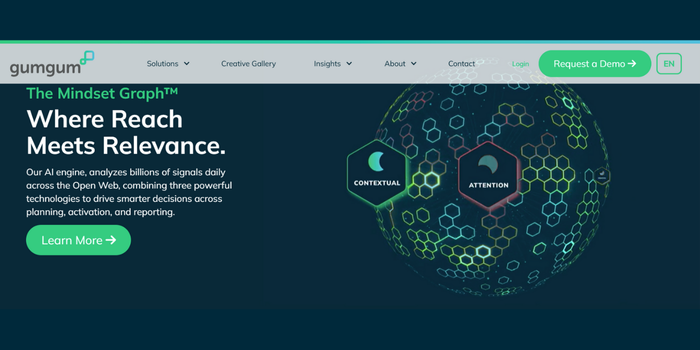
GumGum, an AI-driven advertising company, wanted to win T-Mobile, a high-profile client that had ignored traditional outreach. They needed a creative way to break through the noise.
After researching T-Mobile’s leadership, GumGum discovered that the CEO was a huge Batman fan. They designed a custom comic book called “T-Man and Gums”, featuring the CEO as the superhero saving the day.
They mailed the comic personally and added a QR code linking to a personalised landing page with GumGum’s capabilities.
The CEO loved the gift and shared it on social media, creating organic buzz. The campaign successfully initiated conversations that ultimately helped GumGum secure the client.
The key lesson: deep research + highly personalised, creative execution can turn even cold accounts into opportunities.
2. Intridea
Intridea, a digital agency, wanted to engage Ogilvy, a high-value account with a history of ignoring standard outreach emails.
Instead of sending an email, Intridea took a bold approach: they rented a billboard directly outside Ogilvy’s NYC headquarters. The billboard had a humorous message teasing their expertise
They paired it with a personalised landing page featuring GIFs and an interactive “why we should work together” section.
The campaign succeeded in getting the CEO’s attention, who personally reached out for a meeting. It showed that sometimes, risk-taking and clever visual creativity can succeed where traditional outreach fails.
This example underlines that account-based campaign examples don’t always require massive budgets; they require precision, timing, and creativity.
3. LiveRamp
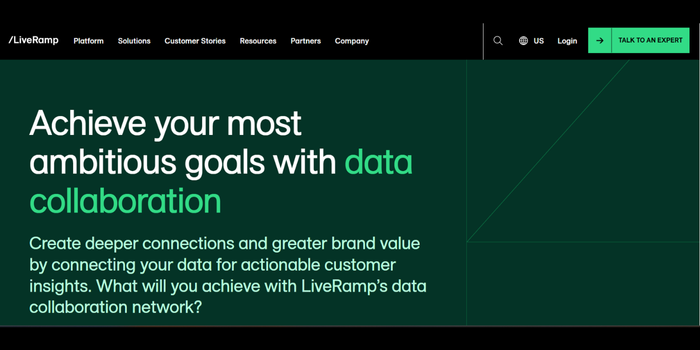
LiveRamp, a data connectivity platform, wanted to accelerate growth by targeting top enterprise accounts that were unlikely to respond to generic campaigns.
LiveRamp selected around 15 high-value accounts and created tailored campaigns. Each account received personalised email sequences, industry-specific content, LinkedIn ads, and one-to-one outreach from sales.
They used intent data to time follow-ups, ensuring each touchpoint addressed the real-time needs of the account.
Within four weeks, they achieved a 33% conversion rate. Beyond immediate results, this approach strengthened relationships and expanded opportunities within these accounts.
The takeaway: ABM works not just for “one-off wins” but also for structured, multi-account campaigns.
4. Salsify
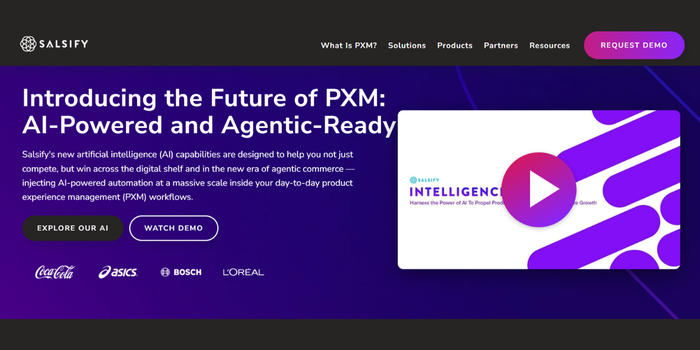
Salsify needed to increase attendance and engagement for a major New York event, targeting enterprise clients.
They segmented the target audience by industry and role, sending personalised emails and LinkedIn invitations.
They created a landing page that displayed dynamic content based on the company's visit. The team also ran retargeting ads showing account-specific benefits for attending.
Attendance exceeded targets by 37%, and feedback showed high engagement from targeted accounts.
This campaign demonstrates the power of multi-channel ABM and how personalisation can extend across email, ads, and web.
5. DocuSign
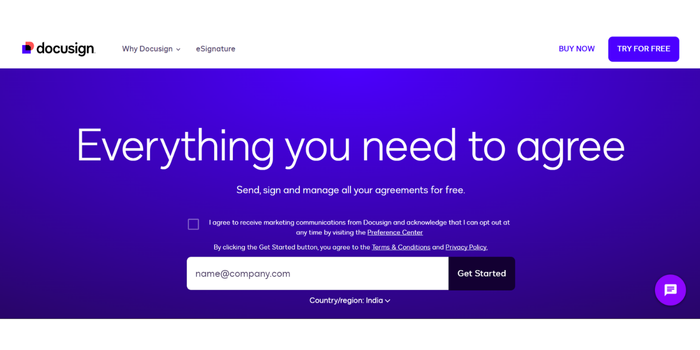
DocuSign wanted to engage 450 enterprise-level accounts across industries and boost conversion rates.
The marketing team created industry-specific content and case studies tailored to each account’s pain points.
Personalised ads and targeted email sequences complemented one-to-one sales outreach.
Landing pages were customised with company logos and messaging relevant to their specific challenges.
The campaign led to a 22% increase in sales and a 60% rise in engagement. DocuSign’s success underscores that even large-scale ABM campaigns can feel personalised when executed with careful research and creative application.
6. ComplyAdvantage
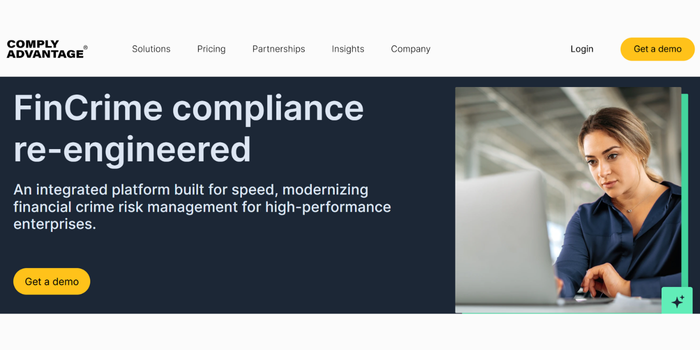
ComplyAdvantage targeted financial services accounts to boost conversion and meetings in a competitive space.
They built account-specific buyer personas and mapped out the decision-making chain. Marketing sent personalised emails, direct mail, and LinkedIn messages, while sales followed up based on intent data triggers
Each outreach referenced the account’s industry-specific challenges, creating a sense of relevance and urgency.
The company saw a 15% increase in conversions and booked meetings with 10% of target accounts.
The key lesson: combining data-driven insights with personalised execution produces measurable ABM results.
7.RollWorks
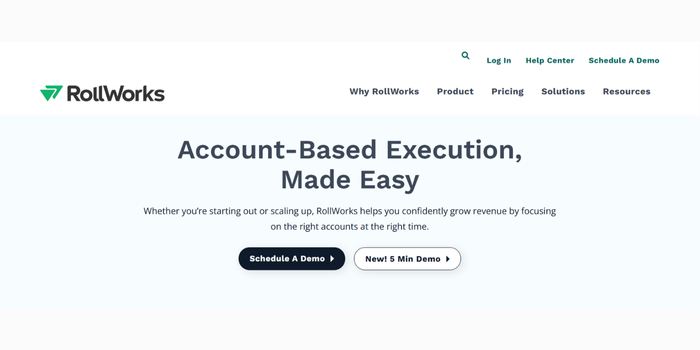
RollWorks wanted to demonstrate ABM’s value internally before scaling campaigns.
They identified key pilot accounts, designed multi-channel campaigns with ads, emails, and direct mail, and aligned sales follow-up for account-specific touchpoints.
Tracking was done at the account level to measure engagement.
The pilot achieved a 41% campaign close rate, proving ABM’s potential to internal stakeholders.
This example highlights that ABM is not only client-facing but also a tool for internal alignment and confidence-building in marketing strategy.
8.Personify
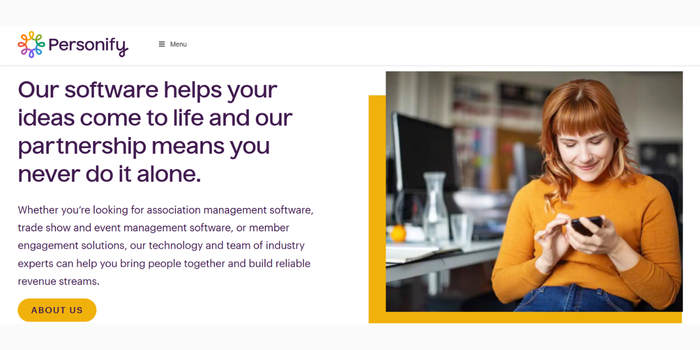
Personify wanted to increase engagement from high-value accounts for their software solution.
They segmented their target list into buyer personas and created dynamic ads tailored to each account. Ads included account-specific messaging and imagery.
The campaign also included personalised emails and direct LinkedIn outreach.
The campaign produced a 39× increase in engaged sessions among target accounts. Personify’s example shows that when you combine segmentation, personalisation, and multi-channel coordination, ABM can dramatically increase engagement without relying solely on mass marketing tactics
How To Craft A Successful Account-Based Campaign?
Crafting a successful account-based campaign is not just about sending personalised emails; it’s about understanding your accounts deeply, aligning your teams, and orchestrating every touchpoint to build relationships that convert.
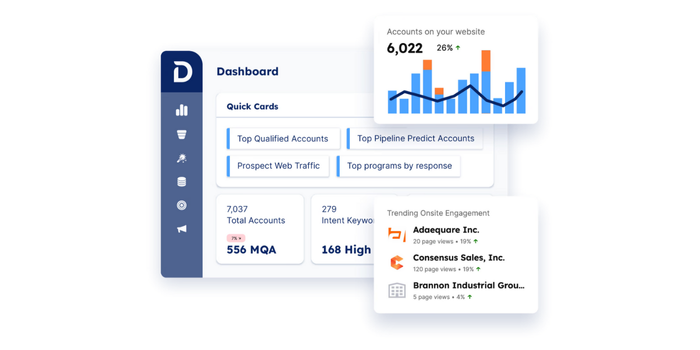
Here’s a step-by-step approach to designing a winning ABM campaign:
1. Define Your Ideal Account Profile (ICP):
Start by identifying the accounts that will bring the most value. Look beyond revenue, consider industry, company size, buying intent, and alignment with your solution.
For example, a SaaS company might prioritise high-growth mid-market firms with 50–200 employees in tech and finance sectors. A clear ICP ensures every effort is focused on the right targets.
2. Align Marketing and Sales:
ABM succeeds only when marketing and sales work hand-in-hand. Share your account lists, insights, messaging, and KPIs across teams.
Schedule regular syncs to ensure everyone is aligned on who to target, what content to share, and how to follow up. The more cohesive your teams, the more personalised and consistent the experience for the account.
3. Gather Deep Account Insights:
Research each account thoroughly. Understand company pain points, industry trends, decision-makers’ roles, and recent developments.
Tools like LinkedIn, Crunchbase, and intent data platforms can reveal actionable insights. The better you know the account, the more relevant your messaging becomes.
4. Personalise Content and Messaging:
Use the insights to create content that resonates. This could be a case study that mirrors the account’s challenges, a custom video, or a personalised landing page.
Personalisation at this stage is key; it demonstrates that you’ve done your homework and truly understand the account’s needs.
5. Select Multi-Channel Touchpoints:
ABM campaigns thrive across multiple channels. Combine email, LinkedIn ads, retargeting display ads, direct mail, events, and website personalisation. Ensure each channel reinforces your message.
For instance, a personalised email can introduce a solution, a LinkedIn ad can reinforce it, and a direct mail piece can grab attention creatively.
6. Orchestrate Execution:
Timing is everything. Map out a cadence of touches that feels natural and engaging rather than overwhelming. Multi-channel orchestration ensures the account receives consistent messaging without being bombarded.
7. Measure and Optimise:
Track every interaction and outcome. Measure engagement at the account level, pipeline contribution, conversion rates, and ROI.
Use insights to tweak messaging, channels, or timing. ABM is iterative; success comes from continuous refinement.
8. Scale Thoughtfully:
Start with 1:1 campaigns for top accounts, then expand to 1:few for clusters of similar accounts, and 1:many for broader segments.
Scaling ABM requires maintaining personalisation without losing precision.
A successful ABM campaign is a blend of strategy, creativity, and discipline. By defining your accounts, aligning teams, personalising outreach, orchestrating touchpoints, and measuring results, you can turn targeted efforts into meaningful conversations and lasting business wins.
How To Measure The Success Of ABM Campaign?
Measuring ABM success isn’t just about counting leads or clicks; it’s about tracking real impact at the account level.
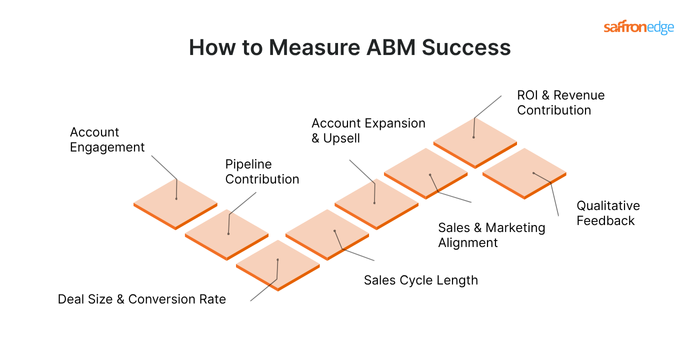
Since ABM focuses on high-value accounts, you need metrics that reflect engagement, influence, and revenue contribution. Here’s a detailed guide to measuring ABM success:
1. Account Engagement
Look beyond simple clicks or opens. Measure how target accounts interact across multiple channels. Did decision-makers download content, attend webinars, or visit account-specific landing pages?
Tools like account-based analytics or CRM integrations can provide insights into engagement depth per account.
2. Pipeline Contribution
Track how many target accounts have moved into your sales pipeline. ABM is about quality over quantity, so even a small number of highly engaged accounts entering the funnel signals success.
Compare this to historical benchmarks to understand ABM’s influence.
3. Deal Size and Conversion Rate
Are your target accounts closing larger deals than typical leads? ABM campaigns often result in bigger contracts because you’re engaging the right stakeholders with tailored messaging.
Monitor conversion rates for these accounts versus generic campaigns to evaluate effectiveness.
4. Sales Cycle Length
ABM often shortens complex sales cycles by providing personalised, relevant content to decision-makers at the right time.
Compare the sales cycle of ABM-targeted accounts with traditional leads to see if alignment and personalisation are accelerating deal closure.
5. Account Expansion / Upsell Potential
Success isn’t just winning an account; it’s growing within it. Track additional product/service adoption, cross-sell, and upsell opportunities in target accounts after initial wins.
ABM campaigns that strengthen account relationships often lead to higher customer lifetime value.
6. Marketing and Sales Alignment Metrics
ABM requires coordination between teams. Track metrics like lead hand-off efficiency, joint pipeline targets achieved, and collaboration on personalised campaigns.
Strong alignment often correlates directly with ABM success.
7. ROI / Revenue Contribution
Ultimately, ABM success is measured by revenue. Calculate the ROI by comparing the revenue generated from targeted accounts versus the cost of running personalised campaigns.
For example, if targeting 50 accounts generated $500,000 in new business at a campaign cost of $50,000, your ROI is 10x.
8. Qualitative Feedback
Don’t ignore feedback from sales teams or account stakeholders. Anecdotal evidence of increased engagement, interest, or improved relationships can highlight wins that numbers alone don’t show.
Measuring ABM success is a combination of quantitative and qualitative tracking.
By focusing on account-level metrics and outcomes, you can continuously optimise campaigns, refine personalisation, and prove the true value of ABM beyond generic lead metrics.
Conclusion
Account-based marketing is more than a campaign; it’s a mindset. By treating each top account as a market of one, businesses can focus on personalisation, alignment, and measurable impact.
From GumGum’s creative comic book outreach to DocuSign’s enterprise-level campaigns, these account-based marketing examples show that research, creativity, and multi-channel coordination drive results.
ABM doesn’t just generate leads; it shortens sales cycles, increases deal size, and strengthens long-term relationships.
With careful measurement and iteration, ABM becomes a strategic growth engine, turning high-value accounts into loyal, long-term clients.
Start small, experiment, and scale. Precision beats volume every time.
Proven Account-Based Marketing Ideas That Get You Results
Saffron Edge turns top account insights into actionable ABM campaigns. Explore personalised strategies that engage high-value accounts and drive results.
Share


10 Mistakes in Your GTM Strategy
Frequently Asked Questions
What are some good account‑based marketing ideas for small businesses?

Even small businesses can apply account‑based marketing ideas: start with 5–10 target accounts, personalise outreach (direct mail, custom landing page), use LinkedIn display ads tailored to those companies, and host a virtual round‑table for decision‑makers in those accounts.
Can you share account‑based campaign examples that cost little budget?
Absolutely. For example, the Intridea billboard campaign was bold but simple: a personalised billboard plus a custom landing page. Similarly, direct‑mail gifts to a single account or personalised videos to decision‑makers are low‑volume but high‑impact account‑based campaign examples.
What features define successful account‑based marketing examples?
Successful account‑based marketing examples typically include: a narrow target account list, deep research into account pain‑points, personalised content/messaging, multi‑channel orchestration, sales‑marketing alignment, and measurement at the account level.
What metrics should I track using ABM platforms?
Track engagement rates, pipeline value, and ROI using ABM platforms. The best Account-Based Marketing tools provide account-level analytics to measure impact precisely.
How many accounts should I target in an account‑based marketing campaign?
It depends on your resources and goals. For 1:1 ABM, you might target 1‑10 high‑value accounts; for 1:few, perhaps a cluster of 20‑50 similar accounts; for 1:many ABM it could be hundreds. Choose the scale that fits your capacity.
Improve Lead Engagement with Marketing Automation!
Streamline your marketing & sales workflows with AI-driven automation. From lead nurturing to CRM integration, Saffron Edge helps you boost conversions, save time, and drive revenue.
Nishant Ahlawat

Nishant Ahlawat is a marketing professional specializing in SaaS, SEO, and content strategy. He has experience working with B2B companies to improve online visibility, develop content frameworks, and implement data-driven SEO practices. His work focuses on helping businesses grow their organic presence through search optimization, strategic planning, and performance tracking. Outside of work, Nishant enjoys traveling to offbeat destinations, trekking in the mountains, and exploring local cultures and landscapes.
Related Blogs
We explore and publish the latest & most underrated content before it becomes a trend.

6 min read
The Complete B2B SaaS Renewal Strategy to Maximize Retention
By Sabah Noor

10 min read
The Ultimate Guide to Omnichannel Marketing: Tips, Benefits, and Real-World Examples
By Sabah Noor

Subscribe to Saffron Edge Newsletter!


10 Mistakes in Your GTM Strategy