


How To Create An Effective SaaS ABM Strategy?


Dec 08, 2025

Contents
 8 min
8 min
- What is Account-Based Marketing for SaaS?
- How is ABM different from SaaS Marketing?
- What are The Benefits Of Account-Based Marketing for SaaS?
- What are Some Unique Challenges of ABM SaaS?
- How To Create An Effective SaaS ABM Strategy?
- 3 ABM SaaS Case Studies
- Few ABM SaaS Metrics to Measure Your SaaS Success
- Conclusion
Imagine landing a deal with a top-tier enterprise account, one that’s been on your radar for months.
What if your marketing and sales teams were aligned perfectly to target that one account, crafting every piece of communication to address their exact needs? That’s the power of Account-Based Marketing (ABM) for SaaS.
Unlike traditional marketing, where you cast a wide net and hope for the best, ABM is all about precision, focusing on a select group of high-value accounts that are most likely to bring in long-term revenue.
With ABM, you move from broad outreach to deep, personalized engagement. But crafting a winning ABM strategy for SaaS requires more than just targeting big names; it demands careful planning, effective team collaboration, and the right tools to measure success.
In this guide, we’ll break down the exact steps to create an ABM strategy that not only attracts high-value clients but turns them into loyal, long-term customers.
Ready to make your SaaS ABM strategy a game-changer? Let’s dive in.
What is Account-Based Marketing for SaaS?
Account-Based Marketing for SaaS is a strategic approach where businesses target specific, high-value accounts with highly personalized marketing efforts.
This method is highly effective for SaaS companies that rely on long-term customer relationships and subscriptions, rather than one-off sales.
ABM focuses on precision targeting, selecting companies that would benefit most from your solution and crafting marketing messages that resonate specifically with their needs.
It involves cross-functional collaboration between marketing and sales teams to engage these accounts in a personalized and cohesive manner.
ABM is different from traditional SaaS marketing in that it is a more direct, high-touch approach aimed at a select audience, offering the potential for deeper engagement and higher conversion rates.
How is ABM different from SaaS Marketing?
Traditional SaaS marketing methods typically involve broad strategies like inbound marketing, SEO, content marketing, and lead generation tactics designed to attract a wide variety of potential customers.
The aim is to reach as many people as possible and cast a wide net to generate leads, with the hope that a few will convert into paying customers.
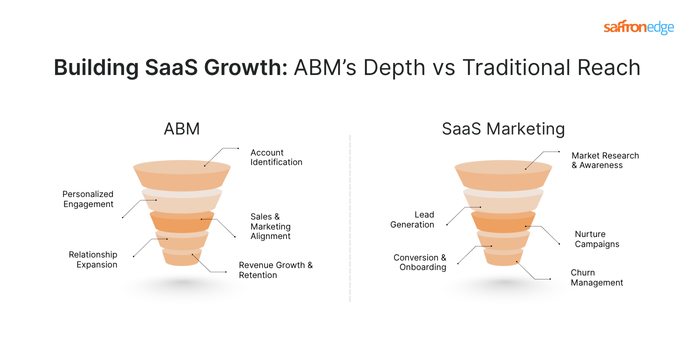
ABM, in contrast, is highly targeted. Instead of trying to reach thousands of leads, ABM focuses on a carefully selected group of high-value accounts.
These are companies that are most likely to benefit from your product or service, and your marketing efforts are personalized specifically for them.
ABM campaigns involve deep research, personalized outreach, and sustained engagement to move target accounts through the sales funnel.
This method often yields higher-quality leads and ultimately better ROI.
What are The Benefits Of Account-Based Marketing for SaaS?
Account-Based Marketing offers more than just targeted outreach; it transforms how SaaS companies attract, engage, and retain their most valuable customers.
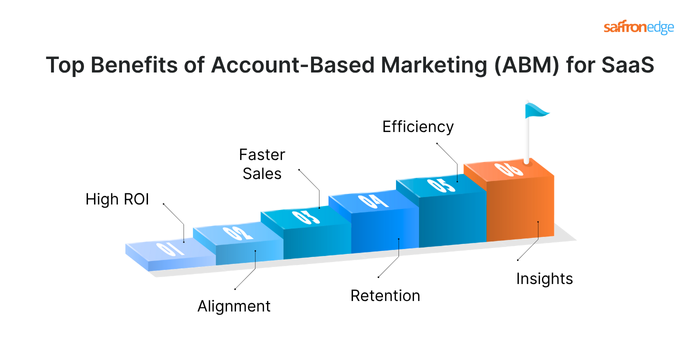
Here are some of the biggest advantages ABM brings to SaaS growth:
1.Higher ROI
One of the biggest benefits of ABM for SaaS is its ability to deliver a higher ROI. Since ABM focuses on high-value accounts that are more likely to convert, marketing efforts are more focused and efficient. Rather than casting a wide net, you’re concentrating your resources on the accounts that matter most.
2.Better Alignment Between Sales and Marketing Teams
ABM helps align your sales and marketing teams, encouraging them to work together towards a common goal: securing high-value accounts.
Sales teams benefit from having highly qualified leads, and marketing teams get to see the impact of their personalized campaigns in real-time. This collaboration leads to more efficient workflows and better conversion rates.
3.Improved Customer Retention
ABM doesn’t just stop after a deal is closed. The personalized engagement continues post-sale, helping to build stronger relationships and improve customer retention.
By continuing to understand and address the evolving needs of your accounts, ABM helps create loyal customers who are more likely to renew their subscriptions.
4.Scalability
While ABM focuses on a targeted group of accounts, it’s also scalable. With the right technology, tools, and strategies in place, ABM can be expanded to target more accounts as your business grows.
By automating certain elements of the ABM process, you can maintain personalized outreach while increasing the volume of accounts you target.
What are Some Unique Challenges of ABM SaaS?
While ABM offers a range of benefits, SaaS companies should also be aware of the challenges before implementing an ABM strategy.
1.Data Overload
One of the most significant challenges of ABM is the sheer amount of data generated. Since you’re targeting a smaller group of high-value accounts, you’ll need to track a lot of detailed information about each one.
Managing this data effectively can be overwhelming without the right tools, and it’s essential to ensure your sales and marketing teams are aligned and have access to actionable insights.
2.Sales and Marketing Alignment
ABM requires close collaboration between your sales and marketing teams. Without this alignment, there can be communication gaps, leading to mismanaged campaigns or missed opportunities.
Regular check-ins and shared metrics are essential to maintaining alignment and ensuring both teams are working toward the same goals.
3.Long Sales Cycles
ABM SaaS often leads to longer sales cycles, especially for enterprise-level customers.
Since ABM is relationship-driven, building trust and nurturing accounts through the funnel can take more time than traditional methods.
However, this investment in time can lead to stronger, longer-term relationships that ultimately drive more revenue.
4.Resource Intensity:
ABM is resource-heavy, requiring significant time, effort, and technology. From personalized content creation to account tracking and outreach, ABM requires dedicated resources.
Smaller SaaS companies may find it difficult to implement ABM without the necessary support in place, so it's essential to weigh the potential return on investment before diving in.
How To Create An Effective SaaS ABM Strategy?
Building an effective ABM strategy for SaaS isn’t about running a few personalized ads or sending custom emails.
It’s about designing a scalable, insight-driven framework that connects the right accounts with the right message at the right time.
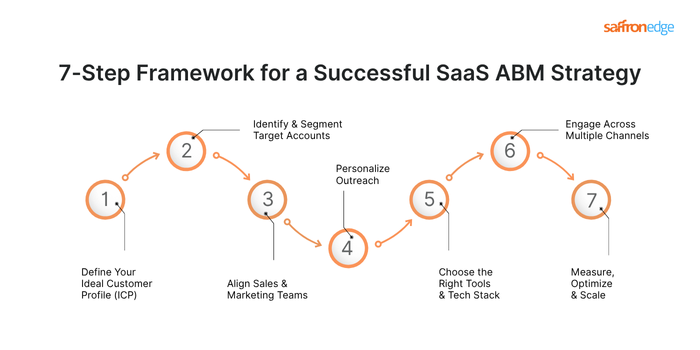
Here’s a step-by-step breakdown of how to craft an ABM strategy that actually drives SaaS growth:
1. Define Your Ideal Customer Profile (ICP)
Every successful ABM strategy starts with clarity, knowing exactly who you’re targeting. Your ICP should represent companies that align perfectly with your product’s value proposition.
Consider factors like industry, company size, revenue, tech stack, decision-makers, and existing pain points.
For SaaS, focusing on usage behavior or integration potential can also refine your ICP accuracy.
Example: If your SaaS solution helps automate customer onboarding, your ideal customers might be mid-sized tech firms with growing support teams and complex customer flows.
2. Identify and Segment Target Accounts
Once you have a clear ICP, move to account selection and segmentation.
Use CRM data, intent tools, and firmographic filters to shortlist accounts that match your ICP.
Then, group them into tiers, for example:
- Tier 1: High-value enterprise accounts (require 1:1 personalization)
- Tier 2: Mid-market accounts (1:few campaigns)
- Tier 3: Scalable, programmatic campaigns (1:many targeting)
This helps allocate resources efficiently and tailor engagement based on potential value.
3. Align Sales and Marketing Teams
ABM thrives only when sales and marketing move in sync. Both teams should share account data, communication plans, and performance metrics.
Develop joint KPIs like account engagement score, opportunity creation, and deal velocity to ensure everyone works toward the same outcomes.
Weekly syncs between both teams also help adjust targeting and messaging based on real-time feedback.
4. Personalize Outreach for Each Account
Personalization is the heart of ABM SaaS. Create hyper-relevant campaigns that address an account’s specific goals or challenges. Use personalized landing pages, dynamic email content, or tailored LinkedIn ads to deliver messages that resonate.
For SaaS, including use-case-driven demos or industry-specific case studies can significantly boost conversion.
Tip: The deeper the personalization, the shorter the sales cycle.
5. Choose the Right ABM Tools and Tech Stack
Technology enables scale in ABM. Use account intelligence tools like Demandbase, Terminus, or 6sense to identify buying intent signals.
Integrate your CRM (like HubSpot or Salesforce) with marketing automation tools to manage campaigns seamlessly.
Analytics dashboards help track engagement, measure ROI, and refine targeting continuously.
6. Engage Across Multiple Channels
SaaS buyers interact across several platforms before making a decision. Your ABM strategy should therefore include multi-channel engagement, email, LinkedIn, personalized ads, webinars, and even direct mail.
Consistent, account-specific messaging across these touchpoints reinforces credibility and accelerates trust.
7. Measure, Optimize, and Scale
Finally, ABM is never “set and forget.” Track metrics such as engagement rate, pipeline influence, and revenue contribution to evaluate performance.
Identify which campaigns or channels drive the highest conversions, then double down on what works.
As you scale, automate where possible but retain personalization for your top-tier accounts; that’s where long-term SaaS relationships are built.
By combining deep insights, personalized experiences, and team alignment, you create a predictable revenue engine built on trust and value.
The result? Fewer wasted efforts, stronger relationships, and sustainable SaaS growth that compounds over time.
3 ABM SaaS Case Studies
Real-world examples often reveal what strategies truly work in ABM.
Here are three SaaS brands that nailed their account-based marketing approach and what you can learn from their success.
1.HubSpot’s ABM Campaign
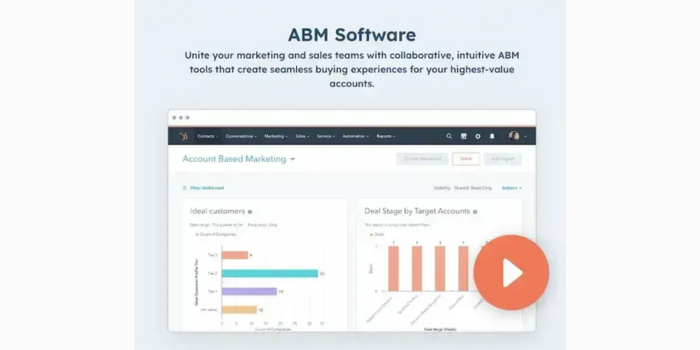
HubSpot’s ABM campaign targeted mid-market businesses that could benefit from its inbound marketing software.
By aligning their sales and marketing teams, HubSpot was able to increase engagement from their target accounts by 40% and saw a 25% increase in pipeline revenue.
Their personalized content and outreach helped position them as trusted partners for these businesses.
2.Zoom’s Strategic Targeting
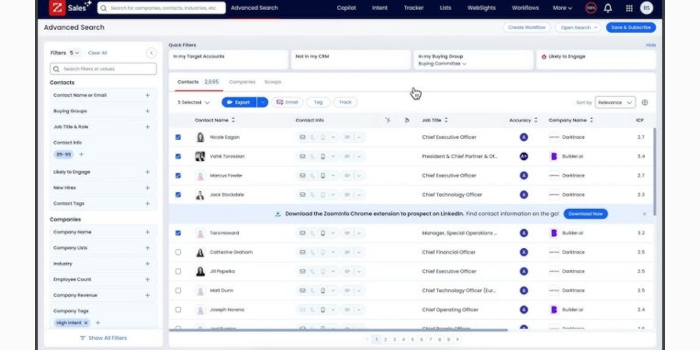
Zoom’s ABM strategy focused on large organizations that needed enterprise-grade video conferencing solutions.
By targeting high-value accounts with personalized ads, email campaigns, and direct outreach, Zoom was able to secure several key accounts, including large educational institutions and corporations, significantly boosting its growth during the pandemic.
3.Pardot’s ABM Success Story
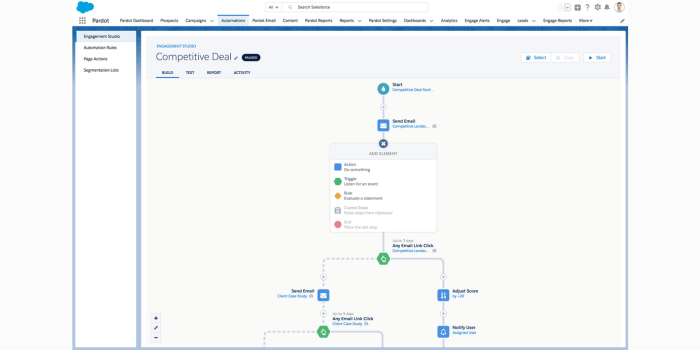
Pardot, a B2B marketing automation platform, successfully used ABM to target accounts in industries like technology and retail.
Their personalized outreach, including tailored email campaigns and case studies, resulted in a 30% increase in demo requests and a higher conversion rate from lead to customer.
Few ABM SaaS Metrics to Measure Your SaaS Success
To measure the true impact of your ABM efforts, tracking the right metrics is crucial. These KPIs help you understand which accounts are engaging, converting, and driving the highest lifetime value for your SaaS business.
Customer Acquisition Cost (CAC):
ABM SaaS should help reduce your overall CAC by targeting only the most relevant accounts. Tracking this metric ensures that your investment in personalized outreach is yielding cost-effective results.
Engagement Rate:
The engagement rate tracks how many target accounts are interacting with your content, emails, and ads. A high engagement rate indicates that your personalized messaging is resonating with your target audience.
Conversion Rate:
Measure how many of your target accounts move from lead to paying customer. This metric is a direct indicator of how successful your ABM campaigns are at converting high-value leads into long-term clients.
Customer Lifetime Value (CLV):
CLV is a critical metric for any SaaS business. ABM aims to attract high-value customers who stay longer and generate more revenue. Tracking CLV helps assess whether your ABM strategy is yielding the kind of long-term relationships that are vital for SaaS growth.
Sales Cycle Length:
ABM typically leads to longer sales cycles, but by measuring this metric, you can determine how quickly or slowly accounts are progressing through the sales funnel. Shortening the sales cycle while maintaining the personalized touch is the ultimate goal.
Conclusion
Account-Based Marketing is more than just a strategy; it’s a mindset shift for SaaS businesses that want to grow smarter, not broader.
By focusing on high-value accounts, aligning sales and marketing, and delivering personalized experiences, you can build stronger relationships that translate to recurring revenue.
At Saffron Edge, we’ve seen firsthand how the right ABM framework can help SaaS brands cut through the noise, boost retention, and create meaningful, long-term growth.
Whether you’re just starting out or refining your existing approach, our data-driven ABM strategies are designed to help you nurture the right accounts—not just chase more leads.
Share


10 Mistakes in Your GTM Strategy
FAQs
What is Account-Based Marketing for SaaS?

Account-Based Marketing for SaaS is a targeted growth strategy that focuses on engaging specific, high-value accounts through personalized outreach. It helps SaaS companies shorten sales cycles, improve win rates, and drive long-term retention by aligning sales and marketing around shared goals.
How does ABM help improve SaaS customer retention?
ABM enhances SaaS customer retention by delivering highly personalized experiences and continuous engagement. Instead of treating clients as one-time conversions, ABM nurtures them with tailored solutions, upsell opportunities, and consistent value delivery — ensuring long-term loyalty and renewals.
Can small SaaS startups benefit from ABM?
Yes, small SaaS startups can significantly benefit from ABM. While ABM was once viewed as an enterprise-only strategy, modern tools and automation platforms make it scalable for startups. It allows smaller teams to focus their limited resources on accounts with the highest growth potential.
What role does personalization play in a SaaS ABM campaign?
Personalization is the foundation of a successful SaaS ABM campaign. It involves tailoring every touchpoint — from emails to demos — to an account’s specific challenges and objectives. This approach builds stronger trust, boosts engagement, and improves deal conversion rates.
How do I know if my SaaS ABM strategy is working?
You can measure ABM performance using metrics like engagement rate, deal velocity, conversion rate, and account revenue growth. If your targeted accounts are progressing through the funnel faster and showing higher retention, your ABM strategy is delivering measurable success.

Shreya Debnath

Shreya Debnath is a dedicated marketing professional with expertise in digital strategy, content development and scaling with AI & Automation along with brand communication. She has worked with diverse teams to build impactful marketing campaigns, strengthen brand positioning, and enhance audience engagement across multiple channels. Her approach combines creativity with data-driven insights, allowing businesses to reach the right audiences and communicate their value effectively. She perfectly aligns sales and marketing together and makes sure everything works in sync. Outside of work, Shreya enjoys exploring new cities, diving into creative hobbies, and discovering unique stories through travel and local experiences.
Related Blogs
We explore and publish the latest & most underrated content before it becomes a trend.


Subscribe to Saffron Edge Newsletter!


10 Mistakes in Your GTM Strategy