


SEO Conversion Optimization: How to Turn Organic Traffic Into Leads and Revenue


Oct 27, 2026

Contents
 11 min
- Who should use this SEO conversion framework?
- What is SEO conversion optimization?
- What is a good organic conversion rate in 2026?
- Set the target from unit economics.
- The Traffic to Revenue framework
- How to find the pages with the largest revenue opportunity
- How to run SEO-safe conversion tests
- What should you test first?
- How AI search changes conversion optimization
- A 90-day SEO conversion plan
- Implementation process for improving SEO conversion


A practical guide for founders, CMOs, growth leaders, and practice owners who rank in search but cannot see the same growth in pipeline, appointments, or sales.
Your organic traffic is growing. Your revenue is not. That does not automatically mean SEO has failed. It usually means the path between the search query and the business outcome has a leak.
The leak may sit in the keyword strategy, the page, the offer, the form or the handoff to sales. Increasing traffic before finding that leak can simply send more people into the same broken journey.
I use a five-part diagnostic for this problem: Traffic, Intent, Offer, Evidence and Revenue. It works because it starts with the person behind the query and ends with an outcome the business can measure.
A SaaS company may measure a qualified demo. A medspa may measure a consultation that becomes a treatment plan. An HVAC company may measure a booked service call. An ecommerce brand may measure contribution margin from a first order. 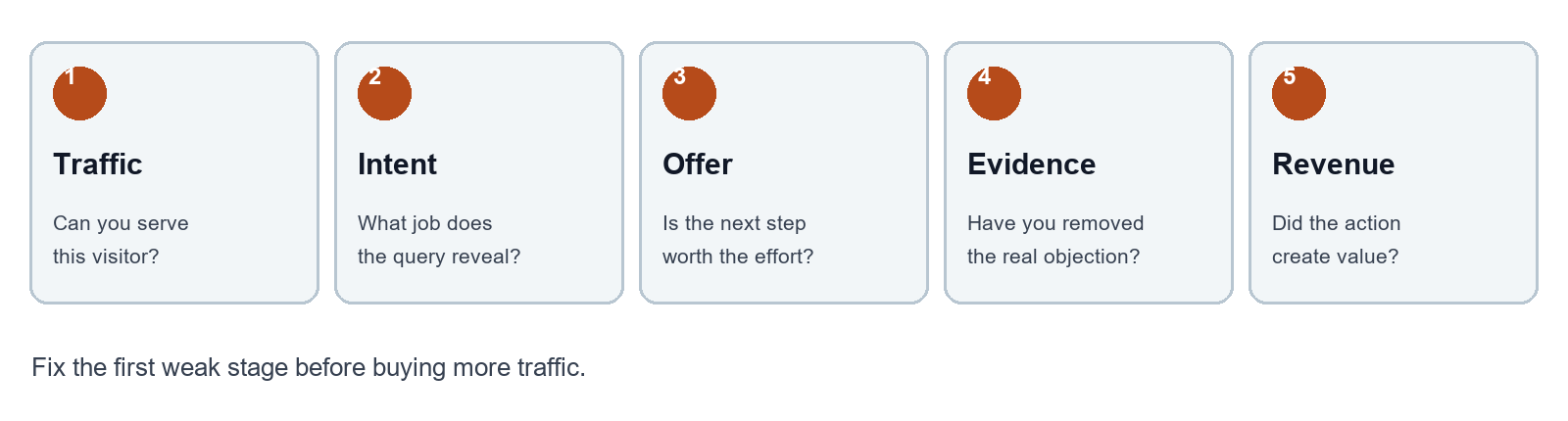
Traffic → Intent → Offer → Evidence → Revenue. Find the first weak stage before buying more traffic.
Who should use this SEO conversion framework?
This is for teams that already earn organic visibility but have one of these problems:
-
Founders and CEOs see traffic in the monthly report but cannot connect it to customer acquisition or pipeline.
-
CMOs and VPs of Marketing have separate SEO, content, paid media and CRO teams that optimize different metrics.
-
Heads of Growth and Demand Generation generate form fills, but sales rejects too many of them or the opportunities do not progress.
-
Practice owners and multi-location operators rank for services but still depend on referrals or paid ads to fill the calendar.
-
Ecommerce leaders attract non-branded traffic but struggle with product discovery, first-order conversion or repeat purchase economics.
The common question is not “How do I get more SEO traffic?” It is “How do I make the traffic I already have produce more of the outcomes I need?”
What is SEO conversion optimization?
SEO conversion optimization is the process of matching an organic visitor’s search intent with the right page, offer and next action, then measuring whether that action creates business value.
It combines two disciplines. SEO earns qualified discovery. Conversion rate optimization improves what happens after the click. The work succeeds when both teams use the same query, page and revenue data.
A page can rank and still fail commercially. It may answer an informational question when the visitor wants to compare vendors. It may send a first-time visitor directly to a high-commitment sales form. It may attract a buyer with a strong offer, then hide the proof needed to trust it. It may generate inquiries without sending source, landing page and campaign data into the CRM.
The useful unit of analysis is therefore not the sitewide conversion rate. It is the query-to-revenue path for a specific landing page.
What is a good organic conversion rate in 2026?
There is no single good conversion rate because different reports use different definitions. A purchase, form submission, phone call and newsletter signup are not equivalent outcomes.
A 2026 SmartSites analysis of 1,160 websites reported a median organic conversion rate of 3.3%. Organic search accounted for 21.5% of visits and 28.9% of conversions at the median site in that dataset. The study defines conversions using each site’s own GA4 key event, so the number is useful as a broad reference rather than a revenue target.
Ruler Analytics’ 2026 benchmark covers more than 110 million sessions and five million conversions. Its 2025 organic-search data shows how much the result changes by industry: 1.5% for B2B ecommerce, 2.3% for B2B services, 2.5% for B2B tech, 2.7% for cosmetic and dental, 2.4% for healthcare, 3.0% for legal and 5.0% for professional services.
|
Business model |
Use this as the meaningful conversion |
Why the sitewide rate can mislead |
|---|---|---|
|
B2B SaaS or managed IT |
Sales-accepted demo, assessment or qualified opportunity |
A content download may look like a conversion but carry little buying intent. |
|
Healthcare, dental or medspa |
Booked and attended consultation that meets service eligibility |
Calls and forms can include insurance, recruiting and out-of-area demand. |
|
HVAC and local services |
Service call booked inside the service area |
Emergency and maintenance intent have different urgency and economics. |
|
Ecommerce |
First order at an acceptable contribution margin |
A purchase rate can look healthy while discounts and returns erase profit. |
|
Professional services |
Qualified consultation that progresses to a proposal |
High form volume may include low-budget or poorly matched buyers. |
Databox found a 1.42% median B2B goal-conversion rate across 432 contributors and 2.5% for B2C across 250 contributors. These figures reinforce the same point: compare like with like, then build your target from your own funnel.
Set the target from unit economics.
Start with the result the business can afford, then work backward:
Required customers ÷ close rate ÷ qualified-lead rate ÷ visitor-to-lead rate = required organic sessions.
Suppose a B2B SaaS company wants 10 new customers, closes 20% of qualified opportunities and turns 40% of qualified demos into opportunities. At a 2% visitor-to-qualified-demo rate, it needs about 6,250 relevant visits. If the page converts at 1%, the traffic requirement doubles. That is why conversion work can be as commercially important as ranking growth.
For a clinic, replace customers with completed treatment plans. For a home-services company, use completed jobs. For ecommerce, use profitable first orders and include returns, discounts and fulfillment costs.
The Traffic to Revenue framework
Work through the five stages in order. Fix the first weak stage before changing everything downstream.
1. Traffic: Are you attracting people the business can serve?
Traffic quality starts before the click. A high-volume keyword can be a poor commercial target if the searcher is outside your geography, cannot buy the service or wants a job, template or free answer.
Segment Search Console and analytics data by:
-
brand and non-brand queries;
-
service, problem, comparison and educational intent;
-
location and service area;
-
new and returning visitors;
-
device, because urgent local searches often happen on mobile;
-
landing page and page type.
For B2B teams, add firmographic fit once a visitor converts: company size, role, industry, geography and existing technology. A blog can generate hundreds of leads and still underperform if almost none match the ICP.
2. Intent: Does the page solve the job behind the query?
Classify the query before editing the page. Four intent groups cover most commercial searches:
|
Query intent |
Typical query |
Best page experience |
Reasonable next action |
|---|---|---|---|
|
Transactional |
Book HVAC repair near me |
Local service page with availability, service area and trust proof |
Call or book service |
|
Commercial investigation |
Best CRM for managed service providers |
Comparison or use-case page with criteria and limitations |
Compare, trial or request a demo |
|
Problem aware |
Why are my cold emails getting no replies? |
Diagnostic guide that separates deliverability, targeting and messaging |
Run an audit or use a checklist |
|
Informational |
What is laser skin resurfacing? |
Educational page with candid suitability, risks and alternatives |
Explore treatment options |
The page should answer the query quickly, then help the reader make the next decision. A hard “book a demo” CTA on every informational page ignores the buyer’s current task. A generic ebook on a high-intent pricing page creates the opposite problem.
3. Offer: Is the next step worth the visitor’s effort?
Most conversion problems described as “weak CTA copy” are offer problems. The visitor does not yet see enough value in the next step.
Match commitment to intent:
-
Early research: calculator, checklist, diagnostic, treatment guide or cost explainer.
-
Comparison: product tour, service comparison, migration plan, sample report or transparent consultation agenda.
-
Ready to act: live availability, assessment, quote, demo, trial or purchase.
The offer must also reflect the sales motion. Enterprise buyers may need a technical assessment or business case before a demo. A practice owner may need eligibility and financing information before booking. An ecommerce buyer may need delivery dates, returns and product fit before adding to cart.
4. Evidence: Have you removed the reason to hesitate?
Evidence changes by industry. A logo strip alone rarely answers the buyer’s real objection.
|
If the buyer worries about |
Show this evidence near the decision |
|---|---|
|
Implementation risk |
Timeline, responsibilities, integrations, migration steps and support model |
|
Clinical or service suitability |
Credentials, eligibility, process, risks, recovery or service guarantees where appropriate |
|
Budget |
Price range, cost drivers, financing, expected scope and what is excluded |
|
Outcome credibility |
Named methodology, relevant case data, sample size, timeframe and limitations |
|
Privacy or security |
Security documentation, compliance details and data-handling practices |
Place proof beside the claim or action it supports. A testimonial about support belongs near implementation concerns. Before-and-after evidence belongs near an outcome claim. Pricing context belongs near the point where the visitor decides whether to proceed.
5. Revenue: Can you follow the visitor beyond the form?
A form fill is not revenue. The measurement path should carry the original source, landing page, offer and campaign into the CRM. It should then record qualification, appointment attendance, opportunity creation, sale and value.
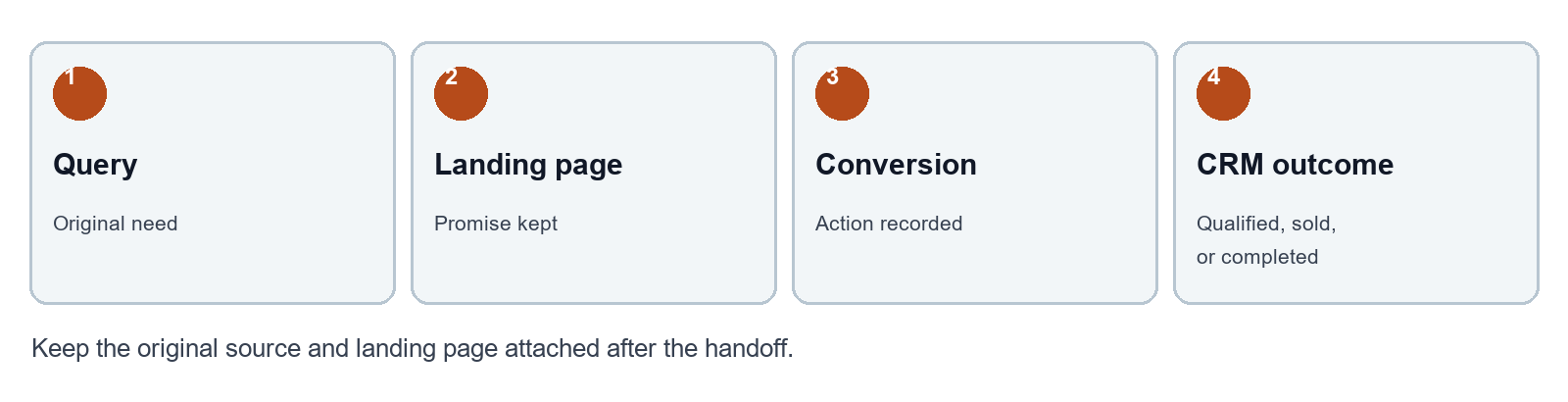
Query → Landing page → Conversion → CRM outcome. Keep the original source attached after the handoff.
At minimum, connect:
-
Google Search Console for query and landing-page visibility;
-
GA4 for onsite behavior and key events;
-
call tracking where phone inquiries matter;
-
the CRM for qualification, pipeline and revenue;
-
offline conversion imports where the advertising or analytics platform supports them.
For B2B, separate raw leads, marketing-qualified leads, sales-accepted leads, opportunities and wins. For appointment-led businesses, separate booked, attended, eligible, sold and completed. For ecommerce, track gross revenue, net revenue, margin, returns and repeat purchase.
How to find the pages with the largest revenue opportunity
Build a landing-page report for organic traffic and include sessions, impressions, clicks, conversion rate, qualified conversions and revenue or pipeline. Then sort pages into four groups.
|
Page pattern |
Likely problem |
First action |
|---|---|---|
|
High traffic, low qualified conversion |
Intent, offer or audience mismatch |
Review the queries and conversion definition before redesigning. |
|
Low traffic, high qualified conversion |
Strong page with limited visibility |
Improve internal links, content depth and relevant authority. |
|
High traffic, high qualified conversion |
Proven commercial asset |
Protect rankings, expand adjacent queries and test carefully. |
|
Low traffic, low conversion |
Weak demand, weak page or both |
Validate the opportunity before investing more. |
Prioritize high-traffic pages where a small improvement changes enough revenue to matter. A 0.5 percentage-point lift on 20,000 qualified visits can be more valuable than doubling conversion on a page with 200 visits.
How to run SEO-safe conversion tests
Testing is compatible with search when it is implemented correctly. Google’s A/B testing guidance says not to show Googlebot a different experience from human visitors. It also recommends ending the experiment and removing test elements after a reliable result.
Follow these rules:
-
Do not cloak content or serve a different promise to search crawlers.
-
Use a canonical tag when a test uses alternate URLs.
-
Use temporary redirects for experiments rather than permanent redirects.
-
Keep the test running only as long as needed.
-
Monitor rankings, organic sessions and conversions together.
Low-traffic pages often cannot support a classic page-level A/B test. In that case, test a consistent change across a group of similar pages, use a time-based rollout with a comparison group, or collect qualitative evidence before investing in a large redesign. Do not declare a winner from a handful of conversions.
What should you test first?
Test the assumption closest to the suspected leak:
-
Intent test: change the opening answer and page structure to match the query.
-
Offer test: replace a generic demo with a specific assessment, plan or calculator.
-
Evidence test: add pricing context, process, case evidence or credentials beside the CTA.
-
Friction test: shorten the form, explain what happens next or expose booking availability.
-
Qualification test: change the form and routing so the right inquiries receive a faster response.
How AI search changes conversion optimization
AI search creates a smaller but potentially more informed referral stream. The visitor may arrive after an answer engine has already summarized options, compared vendors or explained the problem.
Ahrefs reported that, during one 30-day period, AI search generated 0.5% of its visits but 12.1% of its signups. That produced a 23-times-higher conversion rate than its traditional organic traffic. Ahrefs also warns that this is its own small-channel dataset and may not scale. Treat the figure as evidence that AI referrals can carry strong intent, not as a universal benchmark.
For conversion work, this changes three things:
-
Answer the specific question immediately so the landing page keeps the promise made by the AI response.
-
Make entities, comparisons, methods and evidence easy to verify.
-
Track AI referral sources separately, but assess qualified conversions and revenue before reallocating budget.
Saffron Edge’s AI SEO services connect citation visibility with the page experience that receives the click. The citation has limited commercial value if the destination cannot move the visitor forward.
A 90-day SEO conversion plan
Days 1 to 15: establish the baseline
-
Define one primary business outcome for each page type.
-
Export organic landing-page data and connect it to CRM or transaction outcomes.
-
Group queries by intent and ICP fit.
-
Check forms, call tracking, booking flows and source persistence.
Days 16 to 30: repair obvious mismatches
-
Rewrite openings that do not answer the query.
-
Move high-intent queries to service, product or comparison pages.
-
Replace generic CTAs with offers matched to the decision stage.
-
Add missing price, process, proof and qualification information.
Days 31 to 60: test the largest opportunity
-
Choose one high-traffic page group with a clear commercial outcome.
-
Write one hypothesis tied to intent, offer, evidence or friction.
-
Define the decision metric before launching.
-
Watch organic visibility for unintended effects.
Days 61 to 90: connect the result to revenue
-
Compare qualified conversion and revenue, not only form completions.
-
Roll a winning pattern into pages with the same intent.
-
Document the pages where the change failed and why.
-
Feed sales objections, call transcripts and lost-deal reasons into the next content update.
Implementation process for improving SEO conversion
The work should begin with a shared measurement plan. SEO, content, CRO and sales need one definition of a qualified outcome. From there, the process moves through technical and content diagnosis, intent mapping, offer design, testing and CRM validation.
Saffron Edge can support this through SEO services that prioritize commercially relevant search demand, conversion rate optimization services that improve the onsite journey, and AI search work that prepares pages for both human and answer-engine discovery.
The goal is not to make every page sell. It is to give every qualified visitor the right next step, then prove whether that step produces pipeline, appointments or profitable sales.



Your SEO, on autopilot
Saffron OS runs 15+ AI agents that audit your visibility across Google, ChatGPT, Gemini and Perplexity every day — then fix what's broken, automatically. Built over 18 months. Results in 2–15 minutes.
Explore Saffron OSFAQs
Should I invest in more SEO traffic or improve conversion first?

Improve conversion first when high-traffic pages already attract relevant buyers but fail to produce qualified outcomes. Invest in visibility when strong-converting pages have low impressions or rank just outside the positions that earn meaningful clicks. Often the right plan does both, but the landing-page report tells you where the next dollar has more leverage.
Can CRO hurt SEO rankings?
Poor implementation can. Avoid cloaking, use correct canonical and redirect controls for alternate-URL tests, and stop tests after reaching a decision. Monitor search visibility beside conversion metrics.
Should informational blog posts have a sales CTA?
They should have a relevant next step. That may be a diagnostic, calculator, comparison guide or product path rather than an immediate sales call. The CTA should continue the visitor’s task.
How do I measure SEO revenue for a long B2B sales cycle?
Persist the original source and landing page in the CRM. Report lead quality, sales acceptance, opportunity creation, influenced pipeline, win rate, and revenue. Use a consistent attribution view and disclose where the model cannot prove causation.
What should a local healthcare or service business track?
Track calls and forms by landing page, then connect them to booked, attended, eligible, sold and completed outcomes. This separates marketing volume from the appointments and jobs that create revenue.
What is the fastest SEO conversion win?
There is no universal winner, but the fastest useful check is often query-to-page mismatch. Read the queries sending traffic to a high-volume page, compare them with the first screen and CTA, and fix any obvious gap before testing cosmetic changes.

Shreya Debnath

Shreya Debnath is a Marketing Manager at Saffron Edge with over 5 years of experience in SEO, AI-driven marketing, growth marketing, and technical SEO. She has hands-on expertise in optimizing existing content, improving performance, and driving scalable growth through data-backed strategies. She has worked with international markets, especially the US and UK, and diverse teams to build effective marketing campaigns, strengthen brand positioning, and enhance audience engagement across multiple channels. Her approach focuses on aligning sales and marketing to ensure consistent and measurable results. Outside of work, Shreya enjoys exploring new cities, pursuing creative hobbies, and discovering unique stories through travel and local experiences.
Related Blogs
We explore and publish the latest & most underrated content before it becomes a trend.


5 min read
E-commerce Marketplaces vs. E-commerce Platforms: Where Should You Sell?
By Praveen Kumar


Subscribe to Saffron Edge Newsletter!


Your SEO, on autopilot
Saffron OS runs 15+ AI agents that audit your visibility across Google, ChatGPT, Gemini and Perplexity every day — then fix what's broken, automatically. Built over 18 months. Results in 2–15 minutes.
Explore Saffron OS