





Enterprise SEO Tools: The Ultimate Guide for B2B Decision-Makers


Aug 25, 2026

 10 min


Today, AI-powered large language models, smart search boxes, and generative AI engines are changing the way buyers find information.
For the B2B companies, this change means that the old SEO metrics, like traffic, rankings, and backlinks, are not enough anymore.
Enterprise sites need tools that monitor visibility and leverage predictive insights, AI-powered content recommendations, and complex technical SEO analysis across thousands of pages.
Without an enterprise SEO platform, decision-makers can miss opportunities, have broken reporting, and delay responding to competitive signals, which can lead to broken businesses.
In this environment, selecting the right SEO tool is vital to protecting revenue, maintaining authoritative visibility, and ensuring that technical and content strategies are aligned across international markets.
What Is an Enterprise SEO Tool?
An enterprise SEO tool is a software platform designed for managing and improving organic search performance on large, complex websites.
Unlike basic SEO tools that focus on individual tasks, enterprise platforms can handle thousands or millions of pages, multiple domains, large keyword sets, and collaboration across the SEO, content, product, development, and marketing teams.
A good enterprise SEO tool puts all of these things together for a seamless process so that teams can spot problems, make fixes, and track ROI without a bunch of different platforms.
How to Choose the Right Enterprise SEO Tool for Your Business
When choosing an enterprise SEO solution, it’s important to match platform features to business goals. Consider the following:
1. Consider the Size of Your Website
What works well for a 200 page website can be a challenge when you’re dealing with tens of thousands of URLs. If you have a large site, don’t just do simple site audits and keyword tracking.
You’ll need a platform that can crawl complex site structures efficiently, surface issues at scale, and help you understand how search engines are interacting with your website over time.
2. Look Beyond Surface-Level Technical SEO
Most SEO platforms will flag broken links and missing metadata. The difference is how FAR they can dig into your site. Enterprise teams should look for tools that can spot redirect issues, validate canonical tags, audit structured data and identify architectural problems before they impact rankings.
3. Evaluate How Well It Supports Content Decisions
Enterprise SEO is not just a technical discipline anymore. Content is just as important as well. The best platforms enable teams to identify content gaps, uncover new opportunities, understand their competitors’ coverage and prioritize topics based on actual search demand rather than gut feelings.
4. Make Sure It Fits Into Your Existing Tech Stack
SEO data is valuable when it's part of the rest of your marketing ecosystem. Before you decide on a platform, you should check if it integrates with other tools your team already uses, such as Google Analytics 4, Google Search Console, HubSpot, Salesforce, or your internal reporting systems. The goal is to remove manual work, not create another data silo.
5. Think About Reporting and Stakeholder Visibility
Enterprise SEO often involves more than just marketing and content teams, including leadership and revenue operations.
A good platform will make it easy to report, and different stakeholders will be able to get the insights that are relevant to them without the need for ongoing manual updates.
6. Consider Global SEO Requirements
If your business operates in multiple countries or languages, international SEO capabilities become increasingly important.
Hreflang validation, country-specific tracking, and multilingual reporting are features that can help you save time and maintain visibility in regional search markets.
Top 10 Enterprise SEO Tools & Platforms
Here are some of the leading enterprise SEO platforms, each suited for large-scale B2B SEO operations.
1. Conductor
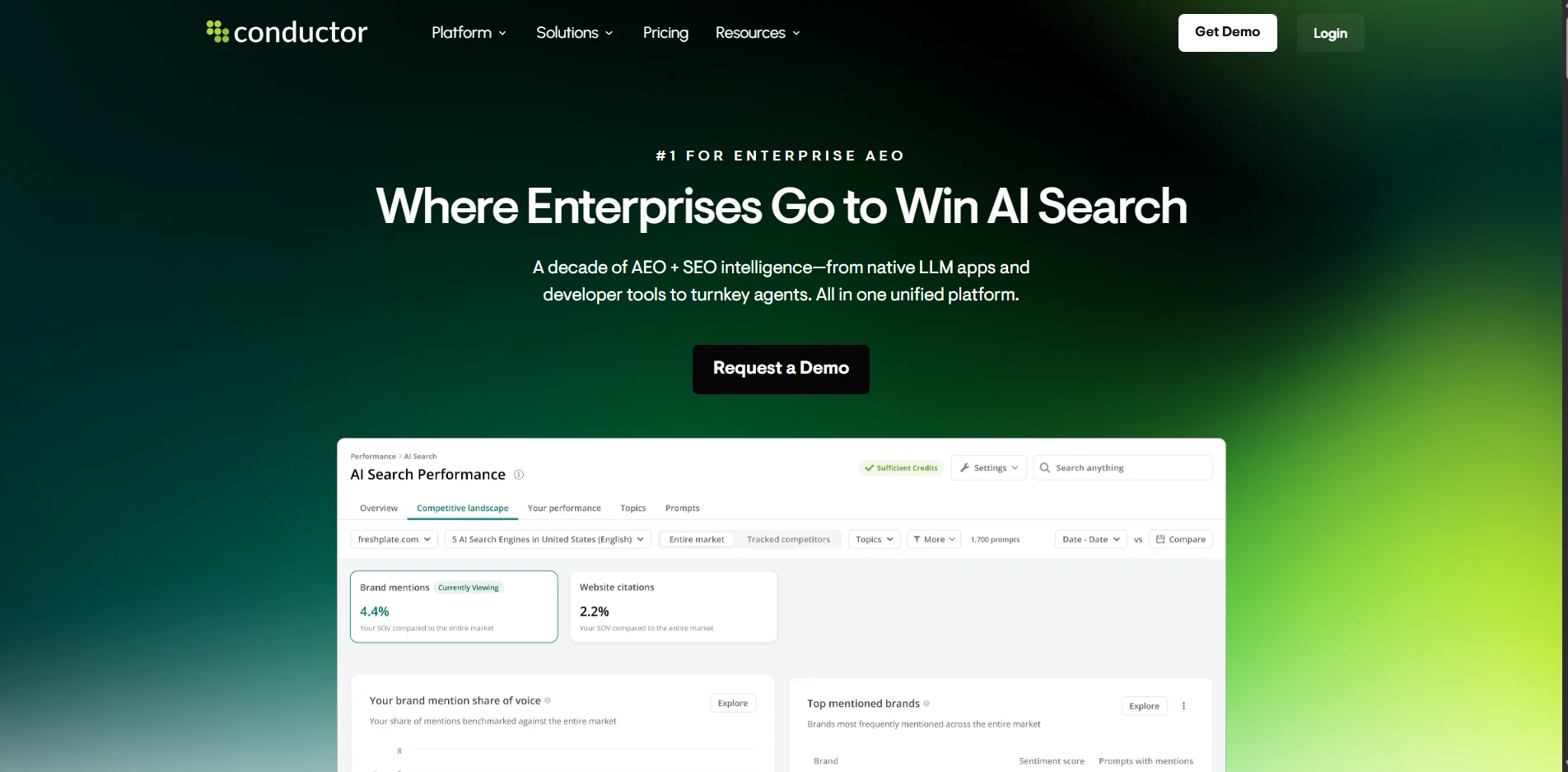
Conductor is an enterprise SEO and AEO tool for large teams who need to have visibility into organic search, AI search, content performance, technical health, and executive reports.
It’s ideal for B2B companies running multi-page, multi-brand, or multi-market SEO campaigns.
Pros
- Strong business SEO and AEO footprint.
- Great for AI search performance, content optimization and keyword intelligence
- Ideal for multi-brand and multi-site reporting.
- It integrates with Google Analytics, Google Search Console, Adobe Analytics, and other enterprise platforms.
Cons
- Dedicated link intelligence solutions enable much more profound backlink research.
- It can be too difficult for teams without sophisticated SEO skills.
- You may need to customize reporting workflows.
- The pricing feels more focused on company budgets than small teams.
If you're managing too many pages across multiple brands, regions, or product lines to track from one dashboard, Conductor is worth a look.
It pulls organic search, AI search, and content performance into one view, with native integrations into Google Analytics, Search Console, and Adobe Analytics.
That means you're not logging into ten separate tools to get one picture of performance.
G2 Rating: ⭐⭐⭐⭐⭐– 4.5/5
2. BrightEdge
If your rankings are dipping and actually affecting your lead generation and revenue chain, then BrightEdge is built to help you out to get ranked using high-volume keywords.
Its Data Cube ties keyword and content data directly to traffic, conversions, and revenue.
Your reports land in language a CFO understands instead of just rank movement.
Its Data Cube and AI-based recommendations are valuable for monitoring search demand, competitor movement, and content opportunities across large enterprise websites.
Pros
- It has pre-built templates on its dashboard features and enterprise SEO reporting.
- Great for keyword research and content performance and opportunity projection.
- Its AI-powered suggestions focus more on content and technology advancements.
- Ideal for large teams that need stakeholder-ready performance insights.
Cons
- It may be difficult for new users to learn.
- Some modules may appear difficult to navigate.
- Some users said it loads slowly and overloads data.
- It could be a premium for smaller or mid-market teams.
G2 Rating: ⭐⭐⭐⭐⭐ – 4.4/5
3. seoClarity
If your technical SEO problems go beyond a standard site audit, crawl budget issues, log file analysis, and indexation gaps across languages, seoClarity is the fit.
It combines large-site crawling, log file analysis, rank tracking, and content optimization in one platform.
This is why global teams running SEO across several markets tend to land here.
Pros
- Significant technical SEO experience with large sites.
- It includes rank tracking, audits, content improvement, and competition research.
- Great for global SEO teams that need to work across multiple markets / languages.
- Users often mention “robust onboarding and support."
Cons:
- UI might be confusing for new users.
- The data has a potentially steep learning curve.
- The platform may feel overwhelming for some teams.
- Higher prices may not be viable for smaller SEO teams.
G2 Rating: ⭐⭐⭐⭐⭐½ 4.5/5
4. Similarweb
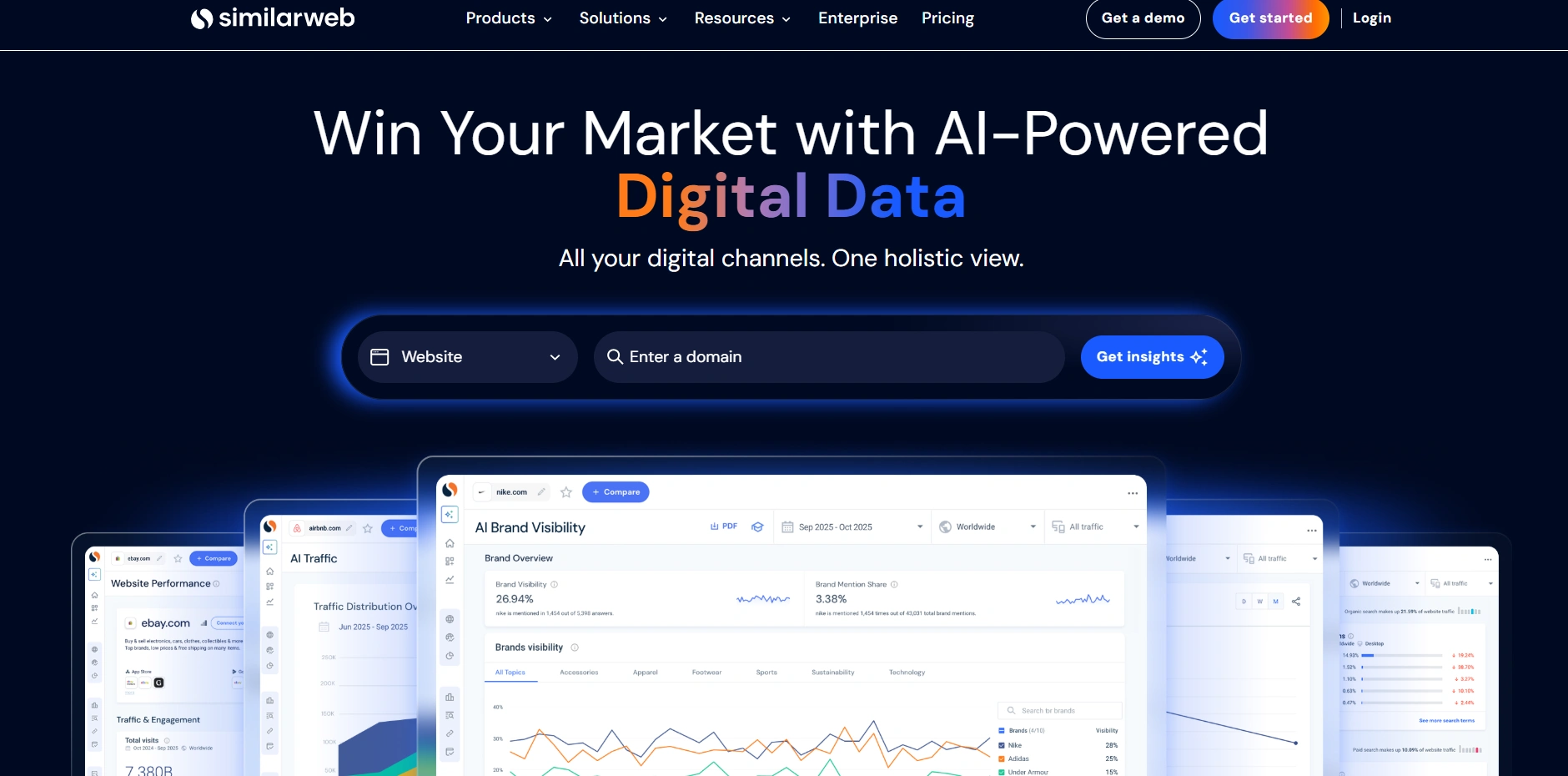
Similarweb is a digital intelligence and competitive analysis program that enables firms to assess website traffic, marketing channels, audience behavior & demographics, keyword potential, and market trends.
If your real question isn't which keywords a competitor ranks for but where their traffic is coming from and whether their market share is growing, Similarweb answers that.
It covers traffic channel analysis, audience demographics, and market trends across a whole competitive set.
It’s particularly valuable for decision-makers who need market intelligence and not simply keyword-level SEO data.
Benefits
- Strong market competitive intelligence and benchmarking
- Can be used to analyze traffic on channels.
- It helps to identify demand trends and growth patterns among competitors.
- Suitable alternative for executives seeking wider digital market visibility.
Cons:
- Less technical and less SEO-focused than SEO-dedicated platforms.
- Data accuracy may vary for smaller or low-traffic sites.
- Higher service levels may provide better data.
- Not as effective for standalone site audits or crawl management.
Rating on G2: ⭐⭐⭐⭐⭐ – 4.4/5
5. SE Ranking
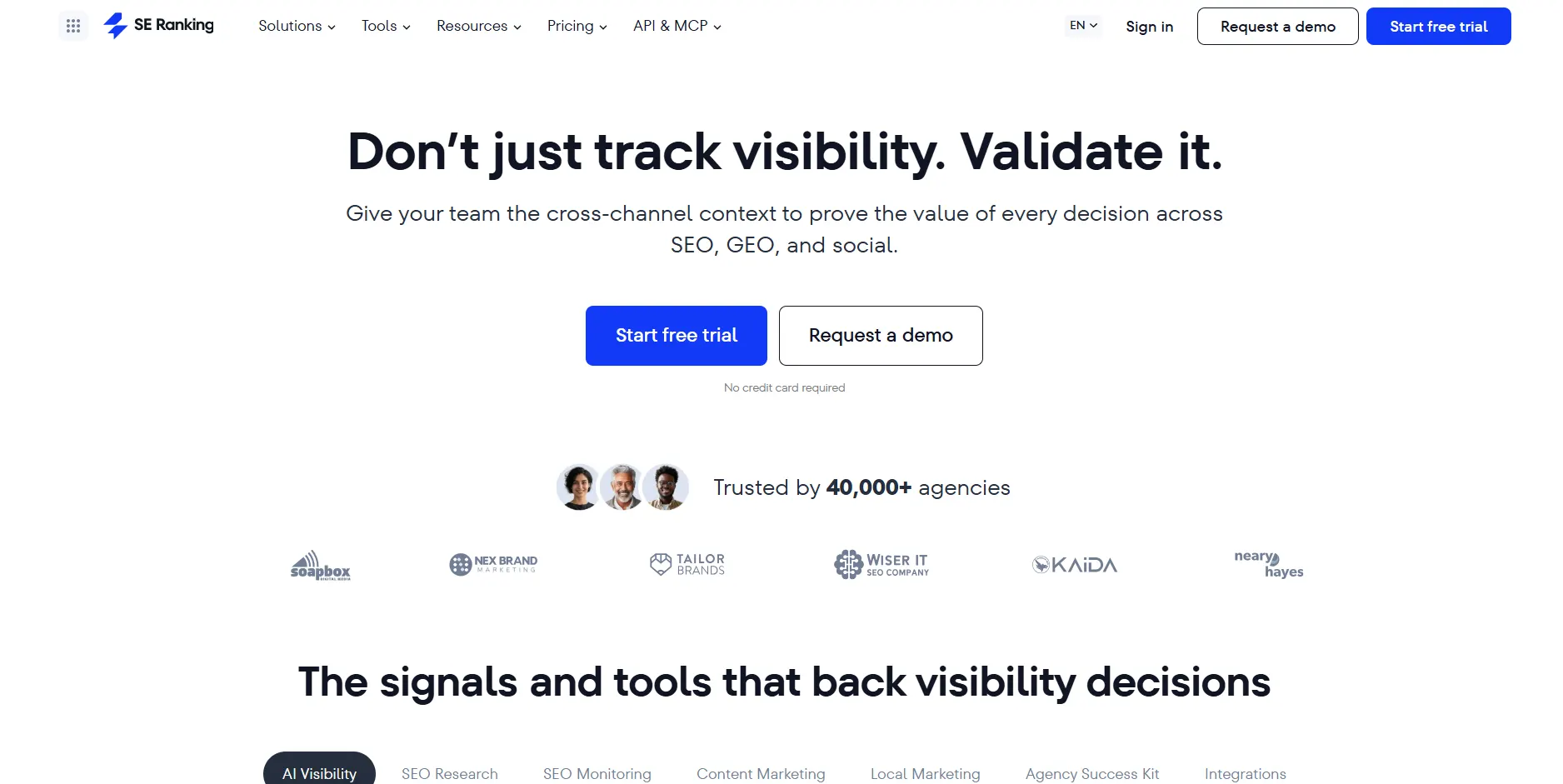
SE Ranking is an all-in-one SEO tool combining rank tracking, keyword research, technical audits, backlink monitoring, competitive intelligence, local SEO, content marketing, and AI search visibility insights.
If you need enterprise-level SEO coverage without an enterprise budget, SE Ranking fits.
It bundles rank tracking, technical audits, backlink monitoring, and AI content tools at a price built for mid-market teams.
Nothing gets cut down to a single function to hit that price.
Pros
- Easy-to-use interface for rank tracking and site audits.
- High value if you need the power of several SEO tools in one platform.
- Integrated AI content tools assist writers with optimization, generation, and more.
- Built-in website audit tools help identify technical issues.
Cons
- Backlink data might not be as deep as Ahrefs or Semrush.
- Certain advanced features are plan-restricted.
- It's less enterprise-focused than platforms like Conductor, BrightEdge, or seoClarity.
- Large companies may need more BI or workflow integrations.
Rating on G2: ⭐⭐⭐⭐⭐- 4.8/5
6. Surfer
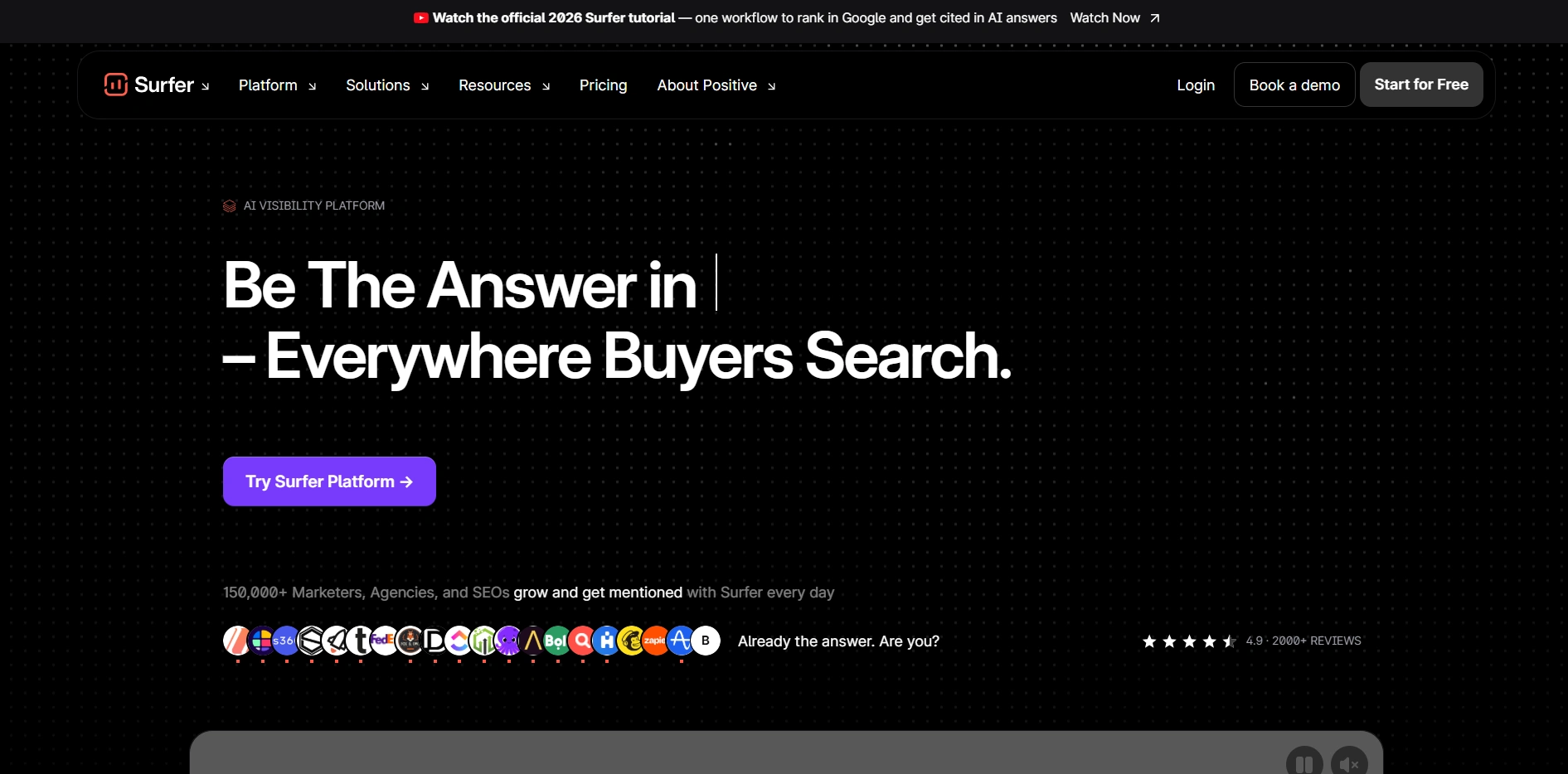
Surfer is a content optimization software that helps you improve your on-page SEO. It offers content score, SERP research, content audits, topical coverage, and real-time authoring recommendations.
If your content team is publishing or refreshing dozens of pages a month and manual on-page optimization has stopped scaling, Surfer solves that.
Its real-time editor scores pages against SERP competitors as you write and plugs directly into Google Docs and WordPress.
Pros
- It’s a powerful content editor for on-page SEO.
- Real-time recommendations assist writers in enhancing structure, keywords, and topical coverage.
- It’s useful for refreshing pages, but not as effective for other tasks.
- Works with writing and publishing tools like Google Docs, WordPress, Jasper, and Microsoft Word.
Cons
- Not a complete technical SEO solution compared with dedicated platforms.
- Pricing and content credit limits can be restrictive.
- Overdependence on recommendations can lead to keyword-heavy copy.
- Enterprise governance and reporting are lighter than those of larger SEO suites.
Rating on G2: ⭐⭐⭐⭐⭐ – 4.8/5
7. Moz Pro
Moz Pro is a good fit for teams that want a simple, guided SEO platform without a heavy enterprise learning curve.
If your team is mostly generalist marketers running SEO alongside other channels rather than dedicated technical SEOs, Moz Pro is built for that.
It's built around usability and Moz Academy's learning resources.
That matters more here than the deep configurability platforms like seoClarity or Conductor assume you already have.
Pros
- SEO teams and non-technical marketers will appreciate the ease of use.
- Tools that help with keyword research, rank tracking, and site crawling.
- Excellent learning resources through Moz Blog and Moz Academy.
- Good for smaller B2B teams developing structured SEO processes.
Cons
- Backlink index is smaller than Ahrefs or Semrush.
- Site crawling can be slower than more technical SEO platforms.
- Reporting might not have the depth required by advanced enterprise teams.
- Fewer enterprise workflow features than Conductor, BrightEdge, or seoClarity.
Rating on G2: ⭐⭐⭐⭐ – 4.3/5
8. SEO PowerSuite
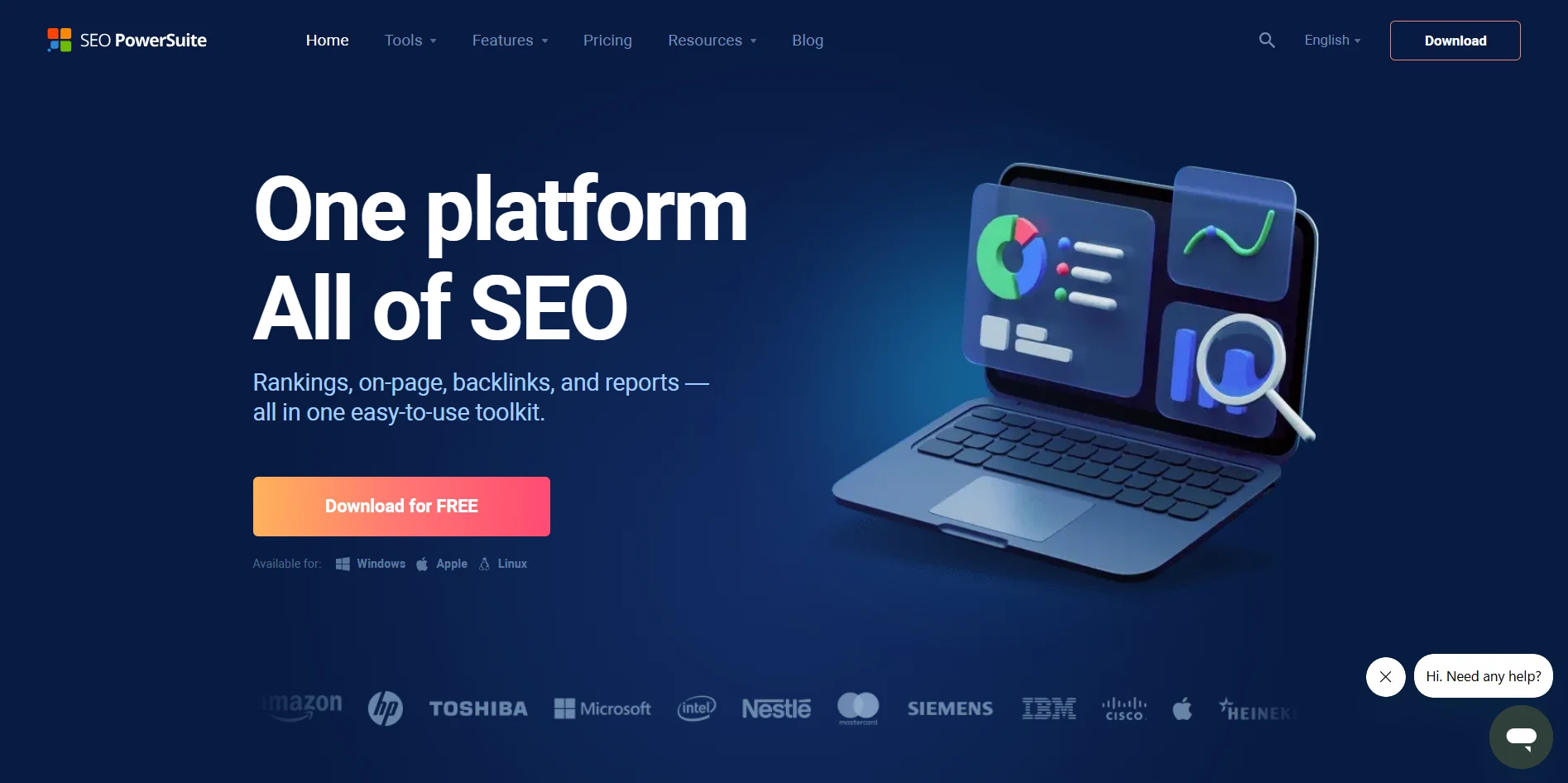
It’s a desktop-based SEO toolkit that provides its core tools, which include Rank Tracker, WebSite Auditor, SEO SpyGlass, and LinkAssistant.
It is designed to track your SEO rank, while you can audit your site and support link building.
If you're managing many client sites and want lower software costs with direct control over your own data, SEO PowerSuite is the option.
You get it at a lower price point than most cloud-first suites.
Pros
- It is more affordable than many cloud-based SEO suites.
- Tools for technical auditing, solid rank tracking, and backlink research.
- The desktop setup offers users more control over data and projects.
- Useful for consultants, agencies, and teams managing many websites.
Cons
- Desktop-based setups might not be as convenient for distributed teams.
- May require stronger local system resources.
- The interface could appear older than cloud-first platforms.
- Collaboration and real-time cloud reporting are more limited.
G2 rating - ⭐⭐⭐⭐⭐ – 4.5/5
Overall SEO Tools
These tools have been the cornerstone in the SEO, AEO, and GEO industries for more than a decade and still support major operations through their services and programs.
9. Semrush
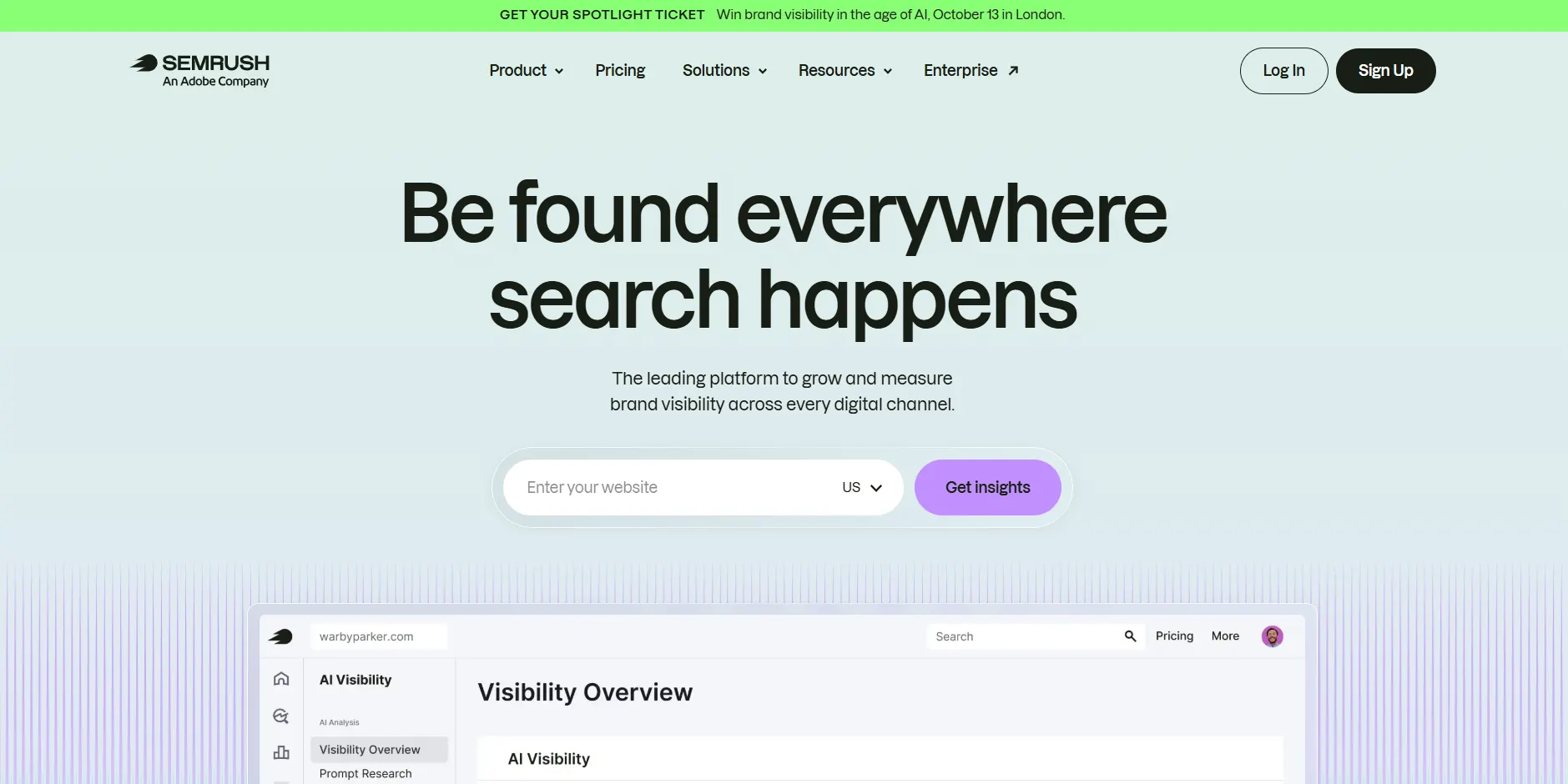
Semrush is an all-in-one SEO and digital marketing software platform for keyword research, competitor analysis, site audits, backlink analysis, rank tracking, local SEO, content marketing, and AI visibility.
It’s a good choice for B2B companies who want an all-in-one platform with robust SEO features.
Its major advantage is versatility, useful for B2B teams who desire one platform for both SEO execution and market research.
Pros
- It's a complete all-in-one SEO toolkit with keyword research, backlinks, audits, and more.
- Strong keyword research and content gap analysis.
- Useful for SEO and broader digital marketing intelligence.
- One of the top reporting solutions for agencies, in-house teams, and B2B marketers.
Cons
- Prices can rise with extras.
- There are many features, which can be a bit overwhelming.
- Some advanced features are only available on higher-tier plans.
- Validate traffic and keyword estimates using your first-party data.
G2 Rating : ⭐⭐⭐⭐⭐⭐ – 4.5/5
10. Ahrefs
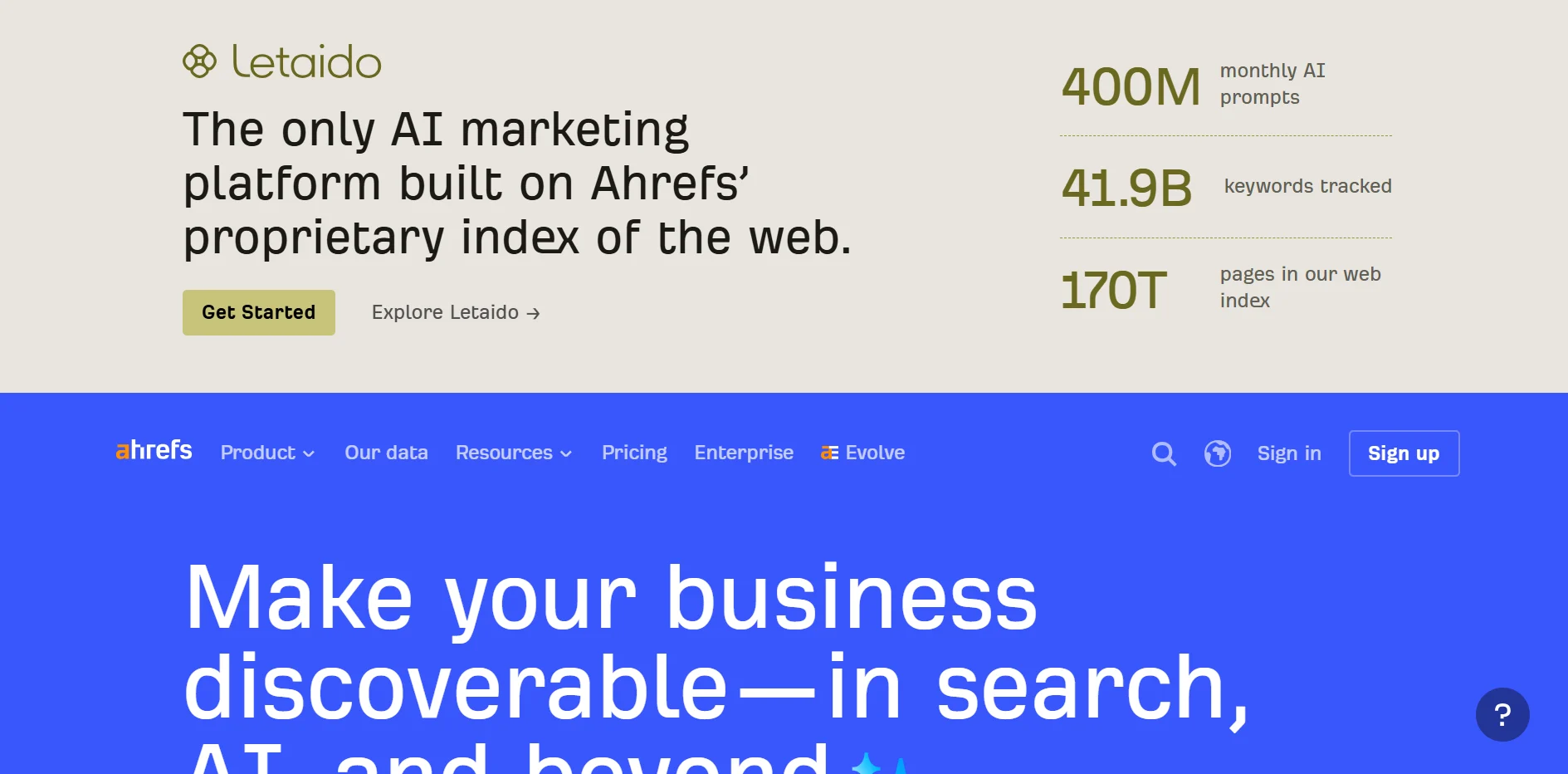
Aherfs is a comprehensive, data-driven search engine optimization and AI marketing platform used by digital marketers, SEO professionals, and website owners.
It provides you with some of the best and most powerful tools related to backlink analysis, keyword research, competitive intelligence, content discovery, and technical website audits.
Its key USP is link intelligence, which makes it a particularly strong fit for teams looking to understand authority, referring domains, and prospects for organic growth.
This capability is incredibly valuable for organizations that rely on link intelligence and competition SEO research.
Pros
- Great backlink analysis and competitive link study.
- Robust tools for researching keywords and uncovering content.
- Useful site audit functionality for technical SEO tests.
- Reliable for analyzing competitors' organic search methods.
Cons
- It might be too expensive for smaller teams.
- Some functionalities are restricted by usage or credit-based access.
- Local SEO and workflow collaboration features are not as strong as some enterprise systems.
- First-party analytics don't necessarily align with traffic predictions.
G2 rating: ⭐⭐⭐⭐⭐– 4.5/5
Conclusion
The right platform brings together technical SEO, content optimization, and competitive intelligence so decision-makers have the insights they need to protect visibility, improve rankings and ensure accurate attribution.
Whenever you’re Considering an enterprise SEO tool, take into account your site architecture, content needs, integration requirements, and your team’s skill set. You can find powerful AI-powered reporting and analytics on platforms such as Conductor, BrightEdge, seoClarity, and Semrush.
Ultimately, the best enterprise SEO tool for your business is the one that fits with scale, strategy, and operational workflow and provides measurable results and ROI.
Is Your Business Suffering a Conversion Problem?
Get more value from the traffic you already have by improving landing pages, forms, page flow, messaging, and user experience.



Your SEO, on autopilot
Saffron OS runs 15+ AI agents that audit your visibility across Google, ChatGPT, Gemini and Perplexity every day — then fix what's broken, automatically. Built over 18 months. Results in 2–15 minutes.
Explore Saffron OSFrequently Asked Questions
What are the biggest hidden problems with enterprise SEO tools?

The main issues are data overload, weak adoption, expensive renewals, and reports that do not translate into action. A tool can look powerful and still fail if teams do not use it to make decisions or push fixes
How do enterprise teams compare tools when every vendor says they do everything?
That is where evaluation gets messy, because feature lists look similar until you test the workflow on your own data. The real comparison is usually about data quality, automation depth, and whether the tool fits how the team actually works.
What features matter most in an enterprise SEO tool for B2B teams?
B2B teams usually care about technical audits, keyword visibility, content planning, backlink analysis, and reporting tied to pipeline. If the tool cannot support business attribution or scale across large site structures, it often creates more noise than value.
How do I know whether I need a full enterprise platform or a stack of smaller tools?
The answer depends on whether your real bottleneck is data access, workflow coordination, or reporting at scale. If the team mostly needs one or two specific capabilities, a full suite can become more overhead than help.
How do teams compare enterprise SEO tools without getting fooled by feature lists?
Feature lists rarely show how well a tool handles real workflows, permissions, data quality, and scale. The smarter comparison is whether the tool solves the exact problem you have today, not the broadest set of promises.
What is the biggest hidden risk in buying enterprise SEO software?
The biggest risk is choosing a platform that fits the vendor’s demo more than your company’s operating model. That mismatch can create expensive shelfware, reporting clutter, and more process friction than before.

Shreya Debnath

Shreya Debnath is a Marketing Manager at Saffron Edge with over 5 years of experience in SEO, AI-driven marketing, growth marketing, and technical SEO. She has hands-on expertise in optimizing existing content, improving performance, and driving scalable growth through data-backed strategies. She has worked with international markets, especially the US and UK, and diverse teams to build effective marketing campaigns, strengthen brand positioning, and enhance audience engagement across multiple channels. Her approach focuses on aligning sales and marketing to ensure consistent and measurable results. Outside of work, Shreya enjoys exploring new cities, pursuing creative hobbies, and discovering unique stories through travel and local experiences.
Related Blogs
We explore and publish the latest & most underrated content before it becomes a trend.


2 min read
Social Media Content Strategies To Improve Your Conversions
By Praveen Kumar

Subscribe to Saffron Edge Newsletter!


Your SEO, on autopilot
Saffron OS runs 15+ AI agents that audit your visibility across Google, ChatGPT, Gemini and Perplexity every day — then fix what's broken, automatically. Built over 18 months. Results in 2–15 minutes.
Explore Saffron OS