


What is Account-Based Marketing? ABM Strategy, Benefits, etc.


Apr 25, 2025

Contents
 11 min
- TL;DR: ABM Marketing
- What is Account-Based Marketing?
- What is The Importance of Account-Based Marketing?
- What Are The Benefits of ABM Marketing?
- What Are The Types Of Account-Based Marketing?
- What Are The Account-Based Marketing Tactics For B2B Marketing?
- 9 Step Workflow To Implement An ABM Strategy
- Step 1: Define Your Business Goals for ABM
- Step 2: Build Your Ideal Customer Profile (ICP) and Target Account List
- Step 3: Map Decision-Makers and Stakeholders
- Step 4: Conduct Account Research and Develop Insights
- Step 5: Align Sales and Marketing Teams
- Step 6: Develop Personalised Content and Campaign Assets
- Step 7: Execute Multi-Channel Campaigns
- Step 8: Measure, Analyse, and Optimise
- Scale and Expand
- Examples Of ABM Campaigns
- 1. Terminus: Personalised Ad Campaigns for Target Accounts
- 2. Snowflake: Executive Roundtables for Strategic Accounts
- 3. HubSpot: Multi-Channel Outreach with Account-Level Customisation
- How To Craft Winning ABM Campaigns?
- Map Decision-Makers and Stakeholders
- Develop Account-Specific Insights
- Personalise Content for Maximum Impact
- Align Sales & Marketing Efforts
- Leverage Technology for Personalisation and Tracking
- Measure Campaign Performance at the Account Level
- Optimise and Scale
- Few ABM Best Practices For B2B Success
Your team just closed a deal with a high-value client that was once out of reach. The secret behind that win?
A highly personalised, account-focused strategy that engaged every decision-maker at the right time.
In 2026, AI will change how we reach out on LinkedIn or write cold emails. Tools now predict who’s shopping, personalize at scale, and prove every dollar spent drives revenue.
That’s ABM in action, turning hard-to-reach accounts into loyal customers and long-term revenue.
That’s the power of ABM: it aligns sales and marketing, maximises ROI, and turns target accounts into long-term customers and brand advocates.
In this guide, we’ll dive deep into what account-based marketing is, why it matters, and how to implement winning ABM strategies and campaigns.
Whether you’re just starting or looking to scale your ABM efforts, this guide will give you actionable insights and proven tactics to transform how your business engages high-value accounts.
TL;DR: ABM Marketing
Short on time? Here’s everything you need to know about ABM at a glance.
- Targets high-value B2B accounts with personalised campaigns.
- Aligns sales and marketing for better results.
- Engages decision-makers effectively across multiple channels.
- Accelerates deals and drives higher ROI
- Key steps: define accounts → map stakeholders → personalise content → launch campaigns → measure → optimise & scale
ABM is a precision-focused, revenue-driven strategy that helps businesses win, grow, and retain their most important accounts, making every campaign count.
What is Account-Based Marketing?
Account-based marketing (ABM) is a strategic marketing approach in the B2B world where you treat individual target accounts (companies) as markets of one rather than casting a wide net.
In simpler terms: rather than broadly generating leads, you identify high-value accounts, engage them with personalised content and campaigns aligned with their specific needs, and coordinate sales + marketing to win that account.
This approach emphasises depth (relationship, customisation) over breadth (volume). For example, you will create account maps, decision‐maker personas inside the company, tailored campaigns and aligned CRM and marketing automation.
It also links tightly with ABM marketing technology (account-based marketing CRM integration, account-based advertising, etc.).
What is The Importance of Account-Based Marketing?
ABM marketing is important because B2B buying is more complex than ever: multiple stakeholders, longer sales cycles, increasing competition, more emphasis on ROI and senior-level buy-in. ABM addresses these realities.
Here are some of the key reasons:
- It aligns sales & marketing around the same high-value accounts, reducing waste, duplication and confusion.
- It enables marketing to focus scarce resources on the accounts that matter most, rather than “spray and pray.”
- It drives better outcomes: higher ROI, faster sales velocity, larger deal sizes, deeper account expansion (upsell/cross-sell) rather than just new leads.
- In a complex B2B context, buyers expect personalised experiences, not generic messages. ABM meets that expectation. In short, if you have high-value accounts, long sales cycles, or a need to optimise resource allocation, then ABM becomes not just a nice-to-have, but a must-have.
What Are The Benefits of ABM Marketing?
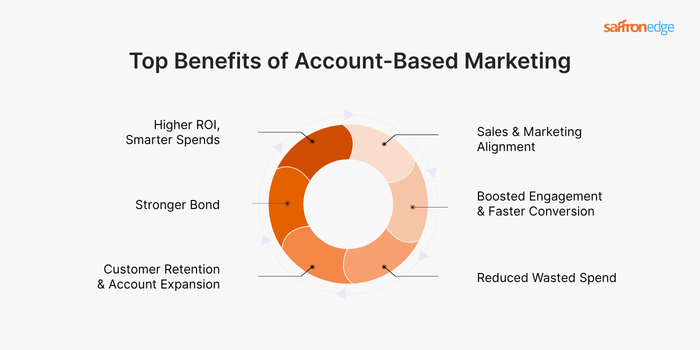
Let’s break down some of the key benefits of account-based marketing:
- Better ROI: Because you focus on fewer, high-value accounts, ABM programmes often deliver higher returns than broad demand-gen.
- Improved sales & marketing alignment: With ABM, both teams work off the same account list and campaign plan, which reduces friction.
- Higher conversion and engagement rates: Tailored messaging resonates better, and engaged accounts progress faster. For example, ad-influenced target accounts progress 234 % faster through the pipeline.
- Lower wasted spend: Because you’re not targeting everyone, your spend is more efficient (fewer irrelevant leads).
- Account expansion & retention: ABM isn’t just for new account acquisition but also for growing existing high-value customers.
- Deeper relationships and brand advocacy: By giving personalised experiences, you build trust, which in turn can lead to referrals and long-term loyalty.
What Are The Types Of Account-Based Marketing?
It’s helpful to understand the different flavours of ABM, because not all ABM programmes will look the same. According to multiple sources, there are three main types (and some extend to more). Here they are:.
- 1:1 (One-to-One) ABM / Strategic ABM: You pick a very small number of high-value accounts (often existing or target large-enterprise) and create customised campaigns for each account. Most resource-intensive.
- 1:Few (One-to-Few) ABM / ABM Lite: You pick a cluster of accounts (5-15) that share similar characteristics and create tailored programmes for that cluster. Balanced between resource and scale.
- 1:Many (One-to-Many) ABM / Programmatic ABM: You scale personalised efforts across perhaps hundreds or thousands of accounts using automation, data, and targeted messaging. Less deeply customised but scaled.
Many organisations use a portfolio model: e.g., a handful of 1:1 accounts, a larger block of 1:Few, and a broad 1:Many programme for the next tier.

What Are The Account-Based Marketing Tactics For B2B Marketing?
Now you’ve got your ABM strategy defined, what tactics do you use to execute? Here are proven account-based marketing tactics:
Key Tactics:
- High-quality account research & ideal customer profile (ICP) definition: Identify which accounts qualify, their firmographics, technographics, intent signals, etc.
- Personalised content and messaging: Create customised offers, landing pages, and content assets that speak to the account’s challenges and decision-maker personas.
- Multi-channel outreach: Use a mix of channels — email, display ads, LinkedIn/company targeting, events/webinars, direct mail (especially for 1:1), field marketing.
- Account-based advertising (ABA): Use display, programmatic ads targeted at employees within your target accounts, refining by job title, company, industry.
- CRM and marketing automation integration: Use your CRM to track account engagement, align with sales stages, trigger personalised workflows. Incorporate account-level data rather than just contact-level.
- Sales-marketing orchestration: Sales and marketing teams collaborate on account lists, campaign timing, asset deployment, and follow-ups. Without this alignment, ABM falls short.
- Measurement & analytics at account-level: Focus on metrics like ‘number of engaged accounts’, ‘pipeline value from target accounts’, rather than just MQLs.
- Expand within existing accounts: Use ABM not just to win an account, but to grow it (cross-sell/upsell) and turn it into a champion.
- Intent and behaviour signals: Using digital/intent data (e.g., web visits, content downloads, event attendance) to identify when target accounts are ‘in market’.
- Scale with technology for 1:Many: For broader ABM programmes, automation and account-based platforms help to deliver relevant messaging at scale.
9 Step Workflow To Implement An ABM Strategy
Implementing an effective account-based marketing (ABM) strategy requires a systematic approach that aligns your marketing, sales, and technology teams around high-value target accounts.

Here’s a step-by-step workflow to guide you:
Step 1: Define Your Business Goals for ABM
Before you start targeting accounts, it’s critical to define what you want ABM to achieve. Are you focused on:
- Winning high-value enterprise accounts?
- Expanding revenue within existing clients?
- Entering a new vertical or market segment?
Setting clear goals helps you prioritise accounts, allocate resources, and measure ROI.
For example, a SaaS company might aim to increase its top-tier enterprise account revenue by 20% over 12 months through ABM.
Step 2: Build Your Ideal Customer Profile (ICP) and Target Account List
An Ideal Customer Profile (ICP) defines the characteristics of the accounts most likely to deliver high ROI. Consider:
- Industry and vertical
- Company size and revenue
- Technology stack (technographics)
- Buying intent and readiness signals
Once defined, create a target account list segmented by potential value, strategic fit, and likelihood to engage. This step ensures that your ABM program focuses on accounts that matter most.
Step 3: Map Decision-Makers and Stakeholders
B2B buying is rarely a single-person decision. For each target account, identify:
- Decision-makers (C-level, directors)
- Influencers (team leads, technical advisors)
- Gatekeepers (assistants, procurement teams)
Creating a stakeholder map helps you personalise messages for each persona and ensures that your campaigns address the needs and challenges of all key players.
Step 4: Conduct Account Research and Develop Insights
The more you know about your target accounts, the more personalised and effective your ABM campaigns will be. Research should cover:
- Company business goals, challenges, and pain points
- Recent initiatives, acquisitions, or news
- Social media presence and content consumption patterns
- Existing relationships with your brand
Use this data to craft bespoke value propositions for each account or account cluster.
For example, if a target account recently expanded into a new market, highlight how your solution can accelerate their growth in that area.
Step 5: Align Sales and Marketing Teams
ABM requires tight alignment between sales and marketing:
- Agree on the target account list and segmentation.
- Define roles and responsibilities: who owns outreach, who manages nurturing, who tracks engagement.
- Set a shared measurement framework: pipeline creation, account engagement score, and opportunities created.
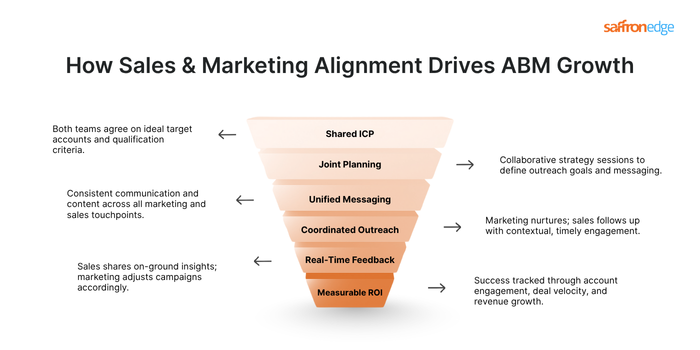
This alignment ensures that both teams are working toward the same goals and prevents duplication or miscommunication.
Step 6: Develop Personalised Content and Campaign Assets
Tailored content is at the heart of ABM. Examples include:
- Personalised emails addressing specific account challenges
- Custom landing pages or microsites
- Case studies and whitepapers relevant to the account’s industry or pain points
- Webinars and virtual events targeted to a specific account or persona
The goal is to deliver relevant, high-value experiences that demonstrate a deep understanding of the account’s needs.
Step 7: Execute Multi-Channel Campaigns
Leverage multiple channels to engage accounts where they are most active:
- Email & LinkedIn: Directly engage key stakeholders.
- Account-Based Advertising (ABA): Display ads, programmatic campaigns tailored to specific accounts.
- Events & Webinars: Invite account stakeholders to exclusive sessions.
- Direct Mail: Send personalised packages or letters to executives in 1:1 ABM campaigns
Synchronise your channels for consistent messaging and higher engagement rates.
Step 8: Measure, Analyse, and Optimise
ABM success is measured at the account level, not just by individual leads:
- Account engagement score (how active are stakeholders within the account?)
- Pipeline generated from target accounts
- Conversion rate from target accounts
- Revenue generated or expanded within accounts
Analyse these metrics regularly to identify what’s working and what needs adjustment. Optimise messaging, channels, and tactics based on data-driven insights.

Scale and Expand
Once your pilot ABM campaigns show success:
- Add new target accounts or clusters for 1:Few or 1:Many campaigns.
- Expand into additional regions, industries, or account tiers.
- Incorporate lessons learned from initial campaigns to refine targeting, content, and channel mix.
- Begin account expansion programs: upsell and cross-sell opportunities within existing accounts.
The goal is to grow ABM impact over time while maintaining the personalised approach that drives engagement and ROI.
Examples Of ABM Campaigns
Seeing ABM in action makes it easier to understand how strategy and creativity come together to win high-value accounts. Here are a few realistic examples of effective ABM campaigns used by leading B2B brands:
1. Terminus: Personalised Ad Campaigns for Target Accounts
Objective: Increase awareness among decision-makers at key accounts
Strategy: Terminus ran highly targeted ad campaigns that showed personalised display ads to stakeholders from selected accounts.
Result: 230% increase in account engagement and shorter deal cycles due to higher visibility and brand recall.
2. Snowflake: Executive Roundtables for Strategic Accounts
Objective: Build trust with C-level decision-makers.
trategy:S Snowflake invited executives from target accounts to private, data-driven roundtable discussions relevant to their industries.
Result: Over 40% of attendees moved to pipeline opportunities within a quarter.
3. HubSpot: Multi-Channel Outreach with Account-Level Customisation
Objective: Drive qualified meetings from enterprise accounts.
Strategy: HubSpot combined personalised email sequences, LinkedIn messages, and tailored landing pages specific to each account’s pain points.
Result: 65% increase in demo bookings and improved collaboration between sales and marketing teams.
The most successful ABM campaigns share a few core elements: personalisation, alignment, and data-driven orchestration.
Whether it’s hosting tailored events, building account-specific microsites, or delivering personalised ads, every action is focused on building relationships and driving measurable revenue.
How To Craft Winning ABM Campaigns?
Creating a successful ABM campaign is more than just sending personalised emails or running targeted ads.
It’s about strategically orchestrating multiple channels, messages, and touchpoints to engage key stakeholders at the right time.

Here’s an elaborated step-by-step guide to crafting winning ABM campaigns:
Define Your Target Accounts and Priorities
Before any campaign begins, clearly identify your high-value accounts. Segment them based on factors like:
- Potential deal size and strategic value
- Buying stage and readiness signals
- Industry, geography, and technology stack
Prioritising accounts enables your ABM efforts to focus on the highest-ROI opportunities. You may also assign tiers, such as Platinum, Gold, and Silver, to determine how many resources and levels of personalisation each account receives.
Map Decision-Makers and Stakeholders
Each target account has multiple stakeholders involved in the buying decision. Map out:
- Decision-makers (C-level executives, directors)
- Influencers (team leads, technical specialists)
- Gatekeepers (assistants, procurement)
Understanding the role of each stakeholder helps you tailor messaging that resonates with them individually, increasing the likelihood of engagement.
Develop Account-Specific Insights
Research each account thoroughly to uncover:
- Business objectives and challenges
- Recent initiatives or expansion plans
- Competitor involvement or market pressures
- Digital footprint and content consumption patterns
Use these insights to craft highly relevant messaging, showing each account that you understand their unique needs and can provide solutions.
9. Influ2
Personalise Content for Maximum Impact
Content is the backbone of ABM campaigns. Tailor your assets for:
- Individual accounts (1:1) or clusters of similar accounts (1:Few)
- Different stakeholders (technical vs business)
- Buyer journey stage (awareness, consideration, decision)
Examples of personalised content include:
- Custom landing pages or microsites
- Account-specific case studies or ROI calculators
- Targeted webinars or workshops
- Direct mail packages or personalised gifts
The key is relevance over volume; each piece of content should feel bespoke to the account.
Choose Multi-Channel Outreach
To maximise engagement, use a combination of channels:
- Email & LinkedIn: Reach stakeholders directly with personalised messages
- Account-Based Advertising: Programmatic or display ads targeted at employees of the account
- Events & Webinars: Invite stakeholders to exclusive sessions tailored to their industry or business challenge
- Direct Mail / Gifts: High-touch campaigns for strategic accounts in 1:1 ABM
Coordinate all channels for a consistent and cohesive experience across touchpoints.
Align Sales & Marketing Efforts
ABM campaigns only succeed when sales and marketing work in lockstep:
- Marketing nurtures accounts until they’re ready to engage
- Sales team follows up with timely outreach informed by campaign engagement data
- Both teams share account insights and update CRM data continuously
This alignment ensures that accounts don’t fall through the cracks and that messaging remains consistent.
Leverage Technology for Personalisation and Tracking
Use your CRM and marketing automation tools to:
- Track engagement at account and contact levels.
- Trigger personalised workflows based on actions (e.g., content download, webinar registration).
- Score accounts by engagement to prioritise sales outreach.
- Analyse patterns and optimise campaigns in real time.
Popular ABM platforms and CRM integrations include Salesforce, HubSpot, Demandbase, and Terminus.
Measure Campaign Performance at the Account Level
Traditional metrics like leads or MQLs aren’t enough. Focus on:
- Number of engaged accounts
- Account progression through the sales funnel
- Revenue influenced or generated by target accounts
- Engagement of key stakeholders (clicks, downloads, webinar participation)
Regular reporting allows you to identify gaps and refine campaigns for better results.
Optimise and Scale
After reviewing results:
- Identify campaigns, channels, and messaging that worked best
- Adjust targeting, personas, and creative for future campaigns
- Scale campaigns to additional accounts or clusters (moving from 1:1 to 1:Few or 1:Many)
- Incorporate account expansion opportunities to upsell or cross-sell
Continuous optimisation ensures your ABM campaigns remain relevant, effective, and revenue-driving.
Few ABM Best Practices For B2B Success
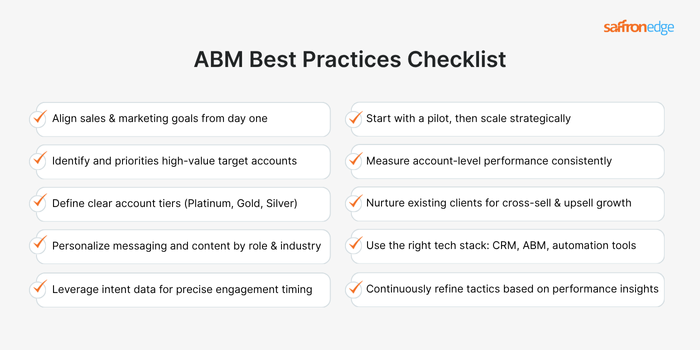
Here are some best practices to ensure your account-based marketing (B2B) programme is effective:
- Ensure sales and marketing alignment from the start: shared goals, shared account list, regular cadences.
- Prioritise quality over quantity: less accounts, more depth leads to better outcomes.
- Build the account logic: define tiers (e.g., Platinum, Gold, Silver) and assign resources accordingly.
- Use clear metrics and governance: establish what constitutes “engaged account”, how many target accounts per tier, who owns what.
- Start with a pilot, then scale: test, learn, refine before going broad.
- Don’t forget existing customers/expansion: treat them as target accounts too.
- Choose the right technology stack: CRM, marketing automation, ABM platform, and intent-data providers.
- Create personalised content experiences: tailored by role, by account industry, by account challenge.
- Timing matters: nurture over time, but engage at the right moment when the account shows buying intent.
- Continuous measurement & optimisation: keep tracking account-level performance, refine your approach, iterate.
Share


10 Mistakes in Your GTM Strategy
Frequently Asked Questions
What size of business needs Account-Based Marketing tools?

Account-based marketing platforms are ideal for B2B companies targeting high-value clients. Small and midsize businesses can also use ABM platforms to personalize campaigns and improve ROI.
Can I run ABM without Account-Based Marketing tools?
Yes, you can start ABM manually. However, Account-Based Marketing tools automate targeting, personalization, and measurement, making campaigns more scalable and efficient.
How much does Account-Based Marketing software cost?
Account-Based Marketing software pricing varies by features and scale. Entry-level ABM tools start at a few hundred dollars monthly, while enterprise ABM platforms can cost thousands.
What metrics should I track using ABM platforms?
Track engagement rates, pipeline value, and ROI using ABM platforms. The best Account-Based Marketing tools provide account-level analytics to measure impact precisely.
How can I ensure my team adopts Account-based Marketing tools effectively?
To maximize adoption, choose intuitive Account-Based Marketing software, integrate it with your CRM, and train both sales and marketing teams on how to use ABM tools efficiently.
Improve Lead Engagement with Marketing Automation!
Streamline your marketing & sales workflows with AI-driven automation. From lead nurturing to CRM integration, Saffron Edge helps you boost conversions, save time, and drive revenue.
Nishant Ahlawat

Nishant Ahlawat is a marketing professional specializing in SaaS, SEO, and content strategy. He has experience working with B2B companies to improve online visibility, develop content frameworks, and implement data-driven SEO practices. His work focuses on helping businesses grow their organic presence through search optimization, strategic planning, and performance tracking. Outside of work, Nishant enjoys traveling to offbeat destinations, trekking in the mountains, and exploring local cultures and landscapes.
Related Blogs
We explore and publish the latest & most underrated content before it becomes a trend.


Subscribe to Saffron Edge Newsletter!


10 Mistakes in Your GTM Strategy